Inhabited citadel
Berat Castle Audio Guide (Kalaja e Beratit)
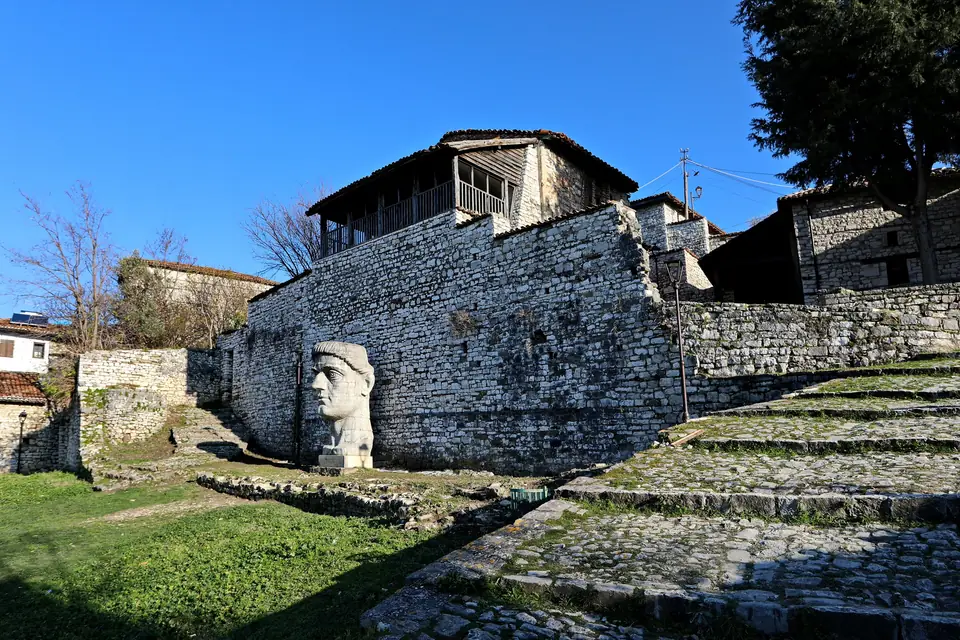
A triangular citadel on the Osum hill that nobody has managed to empty: inside its walls the Kala quarter is still lived in, among Orthodox chapels, ruined Ottoman mosques and the red-brick signature of a despot of Epirus.
- 90 min of audio
- Medieval and Ottoman fortress
The history of Berat Castle begins long before its visible stones: in 200 BC the Roman legate Lucius Apustius took Antipatrea, the city identified with Berat, tore down its walls and burned it. The building phases of the enclosure run from the 4th century BC to the rule of Ali Pashë Tepelena (1813-1821), and the result is a wall of about 1,400 metres on a triangular plan, with 24 towers now known by the Turkish word “tabje”.
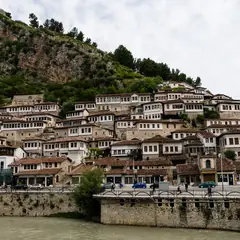
The contrast is that this fortress never became an empty ruin. As early as 1431 the Ottoman register counted 227 families inside the castle, and since Berat was proclaimed a “museum city” in 1961 the Kala quarter has kept houses in use among the monuments: cobbled alleys, whitewashed courtyards and neighbours who live where sieges, lords and creeds followed one another.
Highlights
- Michael Komnenos's monogram — a 13th-century cross of red bricks on the gate
- Triangular wall — about 1,400 m with 24 towers, or “tabje”
- Red Mosque minaret — a pentagonal tower in cloisonné technique
- Kala quarter — inhabited houses and 8 churches still standing inside the walls
- Southern lookout — the Osum, the city and Mount Shpirag
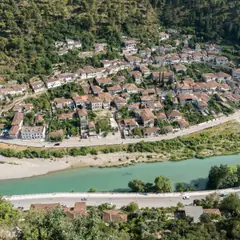
On a rocky hill beside the Osum river, Berat Castle (Kalaja e Beratit) encloses a whole quarter within its triangular wall. Its history starts with fire: in 200 BC the Roman legate Lucius Apustius took Antipatrea, the city identified with Berat, by force, killed the men of military age, handed the spoils to his soldiers, tore down the walls and burned the city. Then came Bulgarians, Byzantines, despots of Epirus, Angevins, Ottomans and pashas, and each left a layer of stone.
After the conquest by the First Bulgarian Empire in the 9th century, the city was renamed Bel(i)grad, “White City”, a name that lasted throughout the Middle Ages and evolved into Berat under Ottoman rule. In the 19th century the castle was again the stage of revolt: in October 1833 some 10,000 people surrounded it and forced out the Ottoman governor Emin Aga, and in September 1839 the rebels took it. In June 1961 Berat was officially proclaimed a “museum city”.
The history of Berat Castle is best understood walking from the north gate to the southern spur, and that is the route of the audio guide: five stops, researched and checked against historical sources, from a despot’s red signature to the mountain where one name turned into another.
Within the same enclosure, the former Dormition cathedral houses the Onufri Museum, and below the inner citadel stands Holy Trinity Church. On the climb up, the Llavda house of the Berat Ethnographic Museum shows how a well-off family of the city lived.
A red-brick cross on the north gate
Michael Komnenos's monogram
Summary of this stop
The visit begins in the fortified courtyard of the north entrance, a walled space before the second gate, designed to deflect direct attacks. Very close appears the first signature of the enclosure: in the early 13th century, Michael I Komnenos Doukas, despot of Epirus, rebuilt the castle and left on the gate wall a monogram in the form of a cross of red bricks bearing his initials. That entrance is still called “Porta e Mihal Komnenit”.
From here the architecture of Berat Castle can be read as a book of signatures: about 1,400 metres of wall on a triangular plan, with an east side of 620 metres and two others of 410, and 24 towers of differing shapes and sizes. Its phases run from the 4th century BC to Ali Pashë Tepelena, who ruled from 1813 to 1821.
According to documented tradition, that same Ali Pasha had besieged these walls years earlier: in 1808-1809 he laid siege here to Ibrahim Pasha, his co-father-in-law, with an army of 8,000 men and British Congreve rockets. It is said that, in the middle of the siege, a young Lord Byron arrived in Ioannina and found the vizier busy in Berat. How Ibrahim ended up is one of the episodes the narration keeps for this point.
A living quarter above lost churches
Alleys of the Kala quarter
Summary of this stop
Once through the gate, the fortress turns into a neighbourhood. The cobbled alleys of the Kala line up whitewashed inhabited houses and courtyards where life goes on among the monuments. It is no recent habit: the Ottoman register of 1431 already counted 227 families inside the castle, some 1,500 inhabitants.
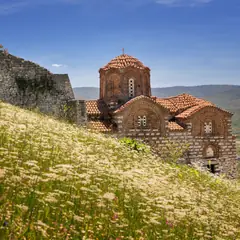
What is missing can also be seen. According to the municipal website and the National Tourism Agency, the enclosure came to hold 42 churches and chapels, of which 8 intact churches remain today, besides the ruins of 2 mosques; other sources lower the figure to about 20 churches. Among those still standing are Saint Theodore, beside the citadel gates, the Dormition, home of the Onufri Museum, Saint Mary of Blachernae and Saint Nicholas, although several are usually closed.
The paving holds more than it shows. According to what has been published about the find, in 2012, while laying a new network of hydrants, workers came upon the polychrome mosaic floor of an early Christian church from the late 5th or early 6th century, with remains of a Greek inscription and a burnt layer over the tesserae. What that burning says about the end of the church is revealed in the audio guide.
The five-sided minaret
Xhamia e Kuqe
Summary of this stop
Beside the walls of the acropolis rises a tower that outlived its own building: the minaret of the Red Mosque (Xhamia e Kuqe), pentagonal, of brick and stone in cloisonné technique, with an interior stair. Of the prayer hall, 9.9 by 9.1 metres, only ruins remain, and the minaret is the best-preserved part.
It is one of the first Islamic buildings in Berat, although its exact date is disputed: some place it in the late 14th century, others after the Ottoman conquest of 1417, and the traveller Evliya Çelebi attributes it to the reign of Bayezid II. Çelebi himself described it as an old, solitary and strange building.
This minaret marks the first Ottoman gesture in a city the Ottomans called Belgrad-i Arnavud, “Albanian Belgrade”, to tell it apart from Serbian Belgrade. Why such a tower could seem strange to an Ottoman traveller is part of what is told at the foot of the mosque.
Water underground and a sleeping guard
Inner fortress cistern
Summary of this stop
In the highest part of the enclosure, the inner fortress keeps a cistern reached down ruined steps. The castle secured its water with a freshwater tank in the south-east sector and, in the Late Middle Ages, with a stone tunnel on the south side that carried water up from the river to the fortress.
But a fortress can also be lost through carelessness. In 1449, when the lord of the castle Theodore Muzaka lay dying and had called on Skanderbeg to occupy it, Ottoman soldiers from the Gjirokastër garrison scaled the poorly guarded walls at night, killed some 500 Albanian defenders and hanged the dying Muzaka.
Very close, on the acropolis, stand the low white limestone walls of the White Mosque (Xhamia e Bardhë or Ak Mesxhid), built in 1417 and destroyed in the 19th century after a local revolt against the Tanzimat reforms. Today only foundation walls of about a metre and the base of the minaret survive; the reason for that revolt is told beside its remains.
Rafts on the Osum and NEVER on the mountain
Southern lookout
Summary of this stop
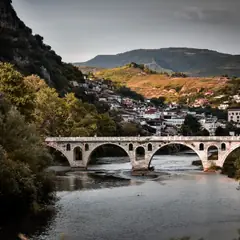
The route ends at the southern lookout, the tip opposite the main entrance, with the city far below and the Osum in view. That river sustained the besieged during the Angevin siege of 1280-1281: the Byzantine general Michael Tarchaneiotes supplied the citadel by floating rafts loaded with provisions downriver, and in the spring of 1281 Hugh of Sully fell into an ambush with only 25 escorts and his army fled.
The valley also saw Skanderbeg’s siege fall apart. In July 1455 he bombarded the castle with Aragonese-Neapolitan artillery and the Ottoman commander promised to hand over the keys if no reinforcements arrived within a set period; a relief army of 20,000 men under Ishak Bey Hranić defeated the besiegers, and some 6,000 of Skanderbeg’s men died.
Opposite the lookout rises Mount Shpirag. According to accounts, in the late 1960s volunteers wrote “ENVER” on its slope in giant letters, plotting the layout with telescopes stationed, among other places, on the west side of the castle. Today the mountain reads “NEVER”: how the letters changed, and who did it, is the closing story the audio guide keeps.