National icon museum
Onufri Museum Audio Guide (Muzeu Kombëtar Ikonografik Onufri)
Inside Berat Castle, the former Orthodox cathedral of 1797 holds a gold iconostasis that spans the nave from side to side and the panels of Onufri, the 16th-century painter whose red nobody has been able to make again.
- 45 min of audio
- Post-Byzantine icons
The church of the Dormition of Saint Mary was rebuilt in 1797 in the Kala quarter, on the foundations of an earlier church, and was Berat's cathedral: together with the buildings of the Metropolis it formed the city's main ecclesiastical centre, and of that complex only the church still stands. It served as a church until 1967, when the Albanian state's atheist campaign placed it under state administration, and on 27 February 1986 it became the Onufri National Museum, with an exhibition of 173 pieces of icons and liturgical objects from the 14th to the 20th century.
Behind so much gold there are humble signatures: the two carvers of the iconostasis were village masters, and Onufri himself, forgotten for centuries, resurfaced in 1951 thanks to an inscription in which he called himself “sinner and ignorant painter”. And beneath the apse of this same church the Codex Purpureus Beratinus came to light in 1968, a 6th-century gospel book written in silver on purple parchment.
Highlights
- Gilded iconostasis — hazelwood with gold leaf, carved around 1806-1807
- Three icons by Onufri — the 16th-century painter and his red of a lost recipe
- 173 pieces on display — 106 icons and 67 liturgical objects from the 14th to the 20th century
- Frescoes of 1860 — by the workshop of the Çetiri family, with a carved pulpit and episcopal throne
- The crypt of the Purple Codex — hiding place of a 6th-century gospel book found in 1968
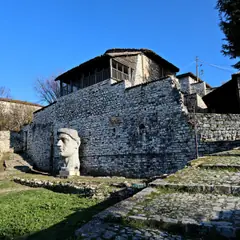
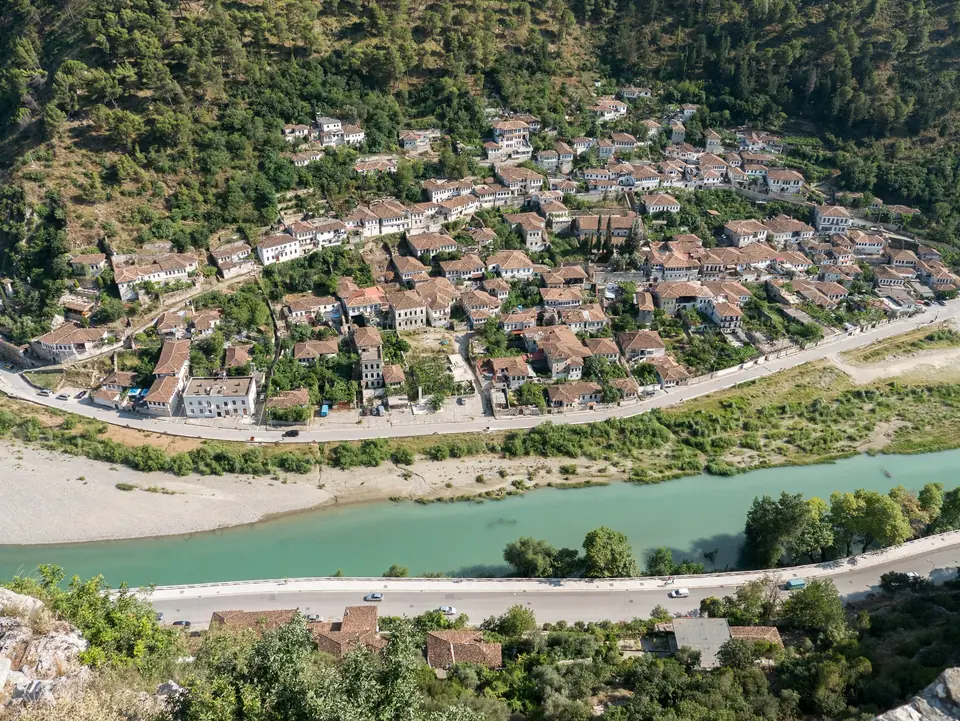
Among the stone houses of the Kala quarter, inside the walls of Berat Castle, a sober facade hides the most important icon museum in Albania. The history of the Onufri Museum begins in 1797, when the church of the Dormition of Saint Mary, the city’s cathedral, was rebuilt here, and takes a turn in 1967, when the state closed the country’s places of worship. On 27 February 1986 the church reopened as the Onufri National Museum, named after the great master of 16th-century Albanian painting.
What to see at the Onufri Museum fits in few words and much detail: a monumental gilded wooden iconostasis, frescoes of 1860, a carved pulpit and episcopal throne, and a selection of 173 pieces, 106 icons and 67 liturgical objects, chosen from a collection of about 1,500 objects from Albanian churches and monasteries. Onufri, his son Nikolla, Onufër Qiprioti, David Selenica, Kostandin Shpataraku and the Çetiri family are all represented. In 2026 the museum celebrated its fortieth anniversary; in 2025 it had received more than 100,000 visitors.
The audio guide, researched and checked against historical sources, walks through the building in four stops, from the main door to the icon rooms, to read on the spot what the gold does not tell at first glance.
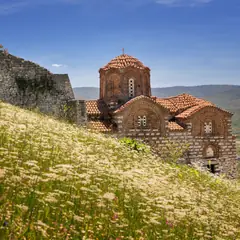
The museum stands inside the walls of Berat Castle, in the Kala quarter, and a few steps away the 14th-century frescoes of Holy Trinity Church show the Byzantine painting that influenced the masters of the 16th century.
A cathedral of 1797 behind a wall
Muzeu Kombëtar Ikonografik Onufri
Summary of this stop
In front of the main door, the building scarcely announces what it holds. A monumental inscription above the entrance gives the year of construction, 1797, and the architecture of the former cathedral follows the pattern of Berat’s churches: a basilica-type nave with two domes, a narthex as a vestibule and a hajat, a portico that partly surrounds it on the outside.
This was the largest church of the castle quarter and, together with the buildings of the Metropolis of Berat, the city’s main ecclesiastical centre. Of that whole complex only the church survived, built on the foundations of an earlier one. The date carved in the stone is the first clue to a story the narration finishes revealing at this very door.
A gold iconostasis with a village signature
Gilded iconostasis
Summary of this stop
In the centre of the nave, beneath the domes, the great gilded screen crosses the church from side to side. The iconostasis, carved around 1806-1807, is considered one of the peaks of Baroque wood carving in the Balkans: floral motifs, sculpted ornaments and figures between rows of icons. The surprise is in the small print, because its makers inscribed their names: master Naum, from Lavdar, and master Stefan Barka, from Misras, two villages of the Opar region. The date is not entirely settled, and another reading of that inscription places the work in the mid-19th century.
Behind it, beneath the apse, another chapter lies hidden. In 1968 a small metal box with the Codex Purpureus Beratinus was found in the church crypt, a 6th-century gospel book written in silver on purple parchment, now inscribed in UNESCO’s Memory of the World register. The original is not in the museum: it is kept in the National Archives in Tirana.
Around the manuscript circulates a disputed tale: during the Second World War Hitler is said to have wanted to seize it, and several monks and priests to have risked their lives to hide it. Whether or not that hunt was real, the hiding place ended up here, a few metres from the gold of the iconostasis, and the audio guide tells at this point how it came to be found.
The red of Onufri that nobody repeats
Onufri icons on the iconostasis
Summary of this stop
At the foot of the iconostasis, set into the hazelwood gilded with gold leaf, wait three icons by Onufri. In them one looks for the trait that defines the painter: the so-called “Onufri red”, which he applied in icons and frescoes and whose recipe was lost with him. Some sources speak rather of a pink that he would have introduced into icon painting; in any case, nobody has managed to reproduce his pigment.
The master’s name was forgotten for centuries. It resurfaced in 1951, when an expedition of the Institute of Sciences found in the church of Saint Nicholas at Shelcan an inscription in which the painter asks the priest to remember him as “sinner and ignorant painter Onufri”. At Valsh, in 1554, he had signed as priest, painter and protopope of Neokastro, present-day Elbasan. His origin remains debated: one inscription makes him come from Berat, other sources point to the Kastoria or Grevena region, and both the Greek and the Albanian tradition claim him. The narration unpicks that humble signature in front of the panels themselves.
Onufri’s son and the rescued icons
Icon rooms of the Onufri school
Summary of this stop
In the icon rooms, the school of Onufri carries on in other hands. In 1956 the inscription “and the painter is Nikolla, son of Onufri, year 1578” appeared in the church of Saint Mary of Blachernae in Berat, the first to identify Nikolla as the master’s son. The workshop passed to him and then to Onufër Qiprioti and Kostandin Shpataraku, and all three are present in the museum alongside David Selenica and the Çetiri family, who also painted the church’s wall frescoes in 1860.
Many of these panels have their own odyssey behind them. According to the country’s recent history, after the fall of communism hundreds of icons vanished from churches in Korçë, Voskopojë, Delvinë, Krujë, Sarandë and Gjirokastër; most of the icons in safekeeping escaped the anarchy of 1997, and in February 2000 a good number of the most outstanding were taken to a secret place to protect them. The Onufri Museum ended up as the country’s icon centre, with pieces such as Nikolla’s Saint Anthony and Saint John the Baptist.
Between a church closed in 1967 and today’s national icon refuge lies a story of losses and rescues that the audio guide keeps for the end of the route, in front of the works that survived.