Ottoman mosque
King's Mosque Audio Guide (Xhamia e Mbretit)
A sultan on campaign founded it, a vizier bombarded and rebuilt it, a dictatorship cut off its minaret and, beneath its walls, lay the floor of a church dedicated to the Mother of God.
- 30 min of audio
- Ottoman architecture
The King's Mosque, also called the Sultan's Mosque or Xhamia e Hynqarit, was finished in 1492 by order of the Ottoman sultan Bayezid II, at the foot of the slope that climbs to the citadel of Berat. It forms part of the Medieval Centre of the lower town, beside the Teqeja e Helvetive and other dervish houses, and has been a Cultural Monument of Albania since 1948.
Its serenity deceives. The artillery of Reshid Mehmed Pasha left it almost destroyed in 1830-1831, and the same commander had it raised again from the foundations in 1832-1833. In 2018, drainage works brought to light beside its south side a late-antique mosaic with the Greek word “Theotokos”: the floor of a Christian building of the late 5th or early 6th century, almost a millennium older than the mosque.
Highlights
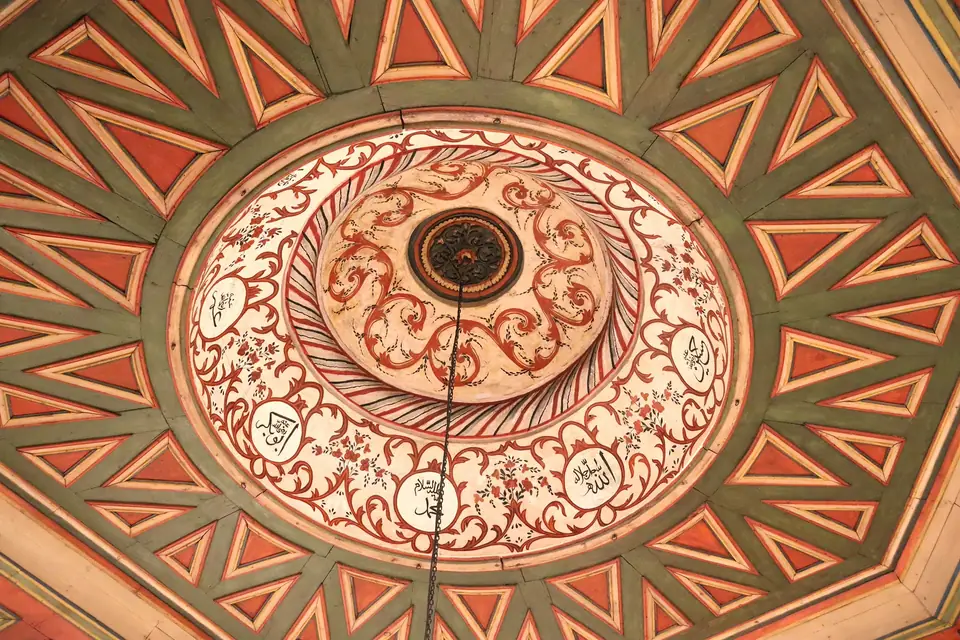
- Painted wooden ceiling — ten flat domes with octagonal marquetry
- Calligraphic frieze with the 99 names of God and a rosette with Quranic verses
- Minaret of two eras — a 15th-century base and a shaft rebuilt after its demolition in 1967
- Portico by Usta Dush Barka, larger than the hall, with a second mihrab
- Early Christian mosaic with the word Theotokos, found in 2018
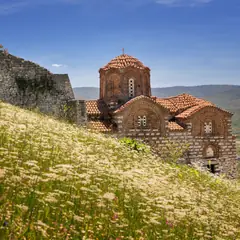
In the lower town of Berat, where the slope towards the citadel begins, the Xhamia e Mbretit looks like a simple building: plastered walls, an arched portico, a slender minaret and a small Ottoman cemetery before the entrance. Its history is something else. It was finished in 1492 by order of Bayezid II, left almost in ruins by the cannons of 1830-1831, rebuilt from the foundations in 1832-1833, lost its minaret in 1967 under the dictatorship of Enver Hoxha and, in 2018, revealed that a Christian church had once stood beneath it.
That is why the question of what is truly old in it has no closed answer: the founding date coexists with an almost total reconstruction, some records place its present appearance in the 18th century and of the building of 1492 only the base of the minaret is clearly attributed. Nor is there agreement on whether it is the oldest mosque in Berat, as some guides claim, or one of the first alongside the Red Mosque and the White Mosque of the castle. The audio guide, researched and checked against historical sources, walks through that story of clashing hands in four stops, from the courtyard to the south side.
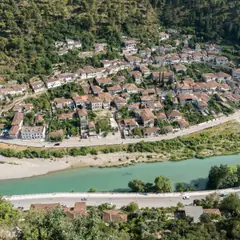
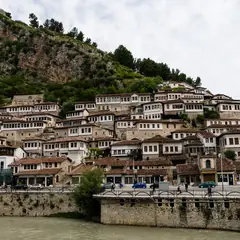
The mosque lies in the lower town, beside Mangalem Quarter, which climbs in terraces towards the fortress, and a few minutes away, on that same climb, the Berat Ethnographic Museum shows a Berat house from inside.
A minaret stitched between two centuries
Xhamia e Mbretit
Summary of this stop
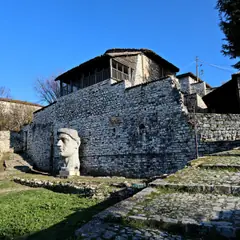
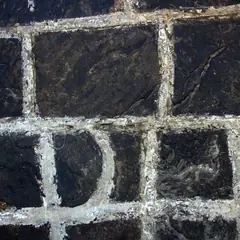
In the courtyard, facing the minaret, the building shows its layers in plain sight. The base, in cloisonné masonry, with stone framed by brick, belongs to the first construction of the 15th century; the upper part of the shaft is a reconstruction of the early 21st century. Between the two lies 1967, the year in which Enver Hoxha’s regime demolished the minaret and altered the portico, both restored afterwards according to the original plans. The facade holds another deception: ashlar blocks were drawn onto the plaster to imitate stonework.
The name on the sign, “King’s”, points to the founding sultan. According to documented tradition, Bayezid II passed through Berat in 1492 during a campaign in Albania and ordered by imperial firman several works to give the city an Islamic appearance, among them this mosque. That same expedition had Himara, on the coast, as its objective, and a chronicle dated October of that year describes a fierce repression in the region. What that chronicle says, and how it fits with the sultan’s gift to Berat, is left for the narration in the courtyard itself.
A mihrab for those who did not fit
Portico of Usta Dush Barka
Summary of this stop
Beneath the portico arcade an anomaly appears: this open space is larger than the prayer hall itself. It was built in the late 18th century by master Usta Dush Barka, with arches on stone columns, its own ceiling and a second mihrab on its north wall, so that worshippers who did not fit inside could pray outside. It is the mark of a mosque that had grown too small.
The building’s name has its tangle too, and it is disputed history. In Turkish it is known as Kral Camii or İmparator Camii, but the imperial epithet was not always exclusive to it: in the 17th century the traveller Evliya Çelebi cited in Berat a quarter called Hünkâr and listed separately several mosques with a sultan’s name. Which of them corresponds to the one that bears the sign today is an open question that the audio guide raises beneath these same arches.
Ten domes paid for by their executioner
Ceiling of ten wooden domes
Summary of this stop
In the centre of the prayer hall, the gaze rises to a painted wooden ceiling, divided into ten flat domes with octagonal marquetry and geometric and calligraphic motifs. At the centre, a rosette carries phrases from the Quran; beneath the ceiling runs a frieze with the 99 names of God. On the north side, the wide two-storey gallery reserved for women rests on two wooden pillars. A micro-XRF analysis published in 2019 by Eglantina Merkaj and Nikolla Civici indicates that the original decoration used red lead, orpiment and indigo, later covered by repainting with ochres, Prussian blue and other modern pigments.
That ceiling was commissioned by Reshid Mehmed Pasha, the commander whose artillery had left the mosque almost destroyed in the campaign against the Albanian revolts of 1830-1831, and who had it rebuilt in 1832-1833. According to documented tradition, he was grand vizier of the Empire, had come into Ottoman service as a child slave from Circassia and stands behind one of the darkest episodes of Albanian history, that of Manastir in 1830, which Ismail Kadare turned into a novel. What happened there and what relation it bears to the nobility previously gathered in Berat is told in the audio guide, beneath the ten domes.
The Mother of God beneath the Sultan
South side of the mosque
Summary of this stop
The south side of the mosque shows nothing special, and that is precisely where its secret lies. In 2018 the Turkish agency TIKA and the Albanian Ministry of Culture began the joint restoration of this mosque, the Teqeja e Helvetive and the Bachelors’ Mosque. On opening trenches to isolate the walls from damp, a human skeleton appeared first and, beneath it, some 77 centimetres below the level of the courtyard, a three-colour mosaic, grey, white and brick red, with traces of fire. The archaeologist Dritan Çoku documented it, and it was covered over again.
The mosaic keeps in Greek the word “Theotokos”, Mother of God, a title spread after the Council of Ephesus in 431. Recent studies attribute it to a Christian basilica of the late 5th or early 6th century, outside the walls of ancient Antipatrea; at the time of the find there were also voices urging caution as to whether it was a place of worship. Beside the courtyard, the Teqeja e Helvetive, of 1782 according to most records, holds up its portico on five stone columns brought from ancient Apollonia. The narration closes the route here, with a complex built out of reuse.