UNESCO heritage
Mangalem Quarter Audio Guide
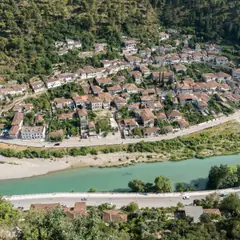
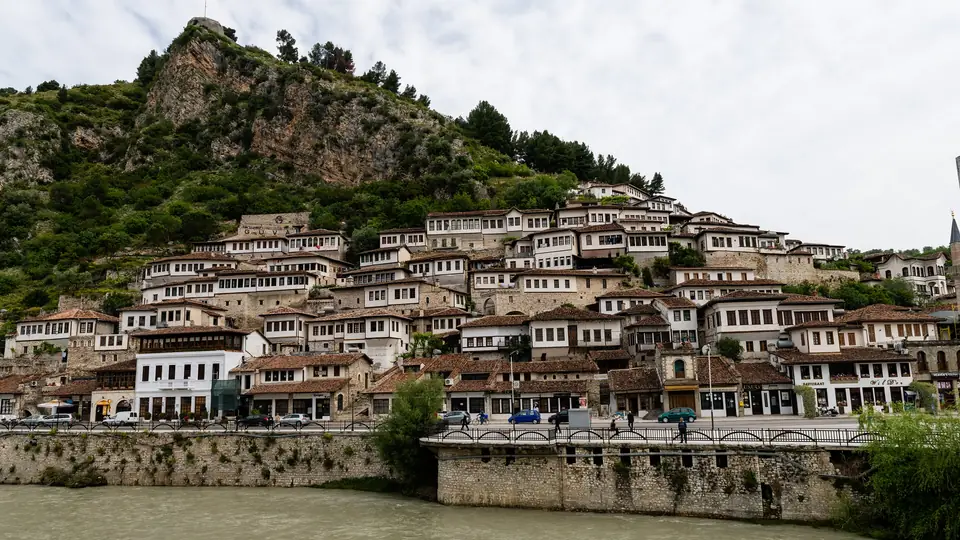
A pyramid of white houses climbing from the Osum river to the fortress, with so many stacked windows that it gave Berat its nickname: the city of one window above another.
- 60 min of audio
- Ottoman architecture
Mangalem was the great bazaar quarter of Berat, the city that after the Ottoman conquest of 1417 stepped out of its walls and descended in terraces towards the Osum river. Its houses, mostly from the late 18th and the 19th century, are an open variant of the Balkan house designed for craftsmen and merchants: stepped up the slope, horizontal in plan and lit on every side. In its lower part stand most of the city's Islamic buildings.
The postcard hides an earthquake: that of 17 October 1851 brought down the upper floors of many houses, then built entirely of stone, and the quarter was rebuilt with a heavy stone ground floor and, above it, a white timber storey with large windows. And it hides a mixture too: the mostly Muslim quarter facing the Orthodox Gorica had at least three churches, of which only a small chapel by the road remains.
Highlights
- Slope of stacked windows — the origin of Berat's Albanian nickname
- Lead Mosque — lead domes and a tall minaret, finished around 1553-1554
- Bachelors' Mosque — arcaded portico and wall paintings, around 1827
- Houses rebuilt after the 1851 earthquake — stone base and timber upper floor
- Chapel of Shën Mëria e Ujërave — what is left of a much larger church
The history of Mangalem begins inside the fortress. Under the rule of the Muzakaj, in the 13th and 14th centuries, Berat was already spilling beyond its walls; after the Ottoman conquest of 1417 the city grew outside the fortifications and its quarters took the shape they keep today, with Mangalem laid out in terraces at the foot of the castle hill. It was born as a great bazaar stretched along the Osum river, and that market vocation explains its architecture: houses of craftsmen and merchants, open to the light and stepped one above another.
In June 1961 Enver Hoxha’s regime declared Berat a “museum city”, and many private houses were placed on the list of first-category monuments. On 8 July 2008 the old town, with Mangalem, entered UNESCO’s World Heritage List as a rare example of Ottoman-period architecture. From the upper houses the view opens onto the Osum valley and the bulk of Mount Tomorr to the east. The audio guide walks the quarter in four stops, from the river street to the slope, with a documented narration that separates checked history from legend.
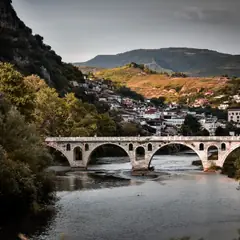
The slope is best seen head-on from the Gorica bank, across Gorica Bridge. In the lower part stands the King’s Mosque, and on the climb to the castle the Berat Ethnographic Museum opens up one of these houses from inside.
Lead domes where the bazaar began
Xhamia e Plumbit
Summary of this stop
The route starts in the city centre, at the foot of the quarter, in front of the Lead Mosque (Xhamia e Plumbit). Its grey domes take their name from the lead that covers them; they are accompanied by a tall, slender minaret and a portico on the north side. It was finished around 1553-1554 by Ahmet Bej Uzgurliu, a local noble of the Skuraj family, although sources do not fully agree on the date and some push it to 1555. In 2014 the Turkish agency TIKA restored it.
What is today an isolated building was, according to the description by the Ottoman traveller Evliya Çelebi, the crowning piece of a whole complex: bazaar, madrasa, imaret, school, hammam and ablution fountain. It is the first great trace of the city that came down from the walls.
In Berat it is said, figuratively, that Mangalem is “derdhja e Kalasë”, what spilled out of the castle: urban life flowing from the fortress to the rest of the city. That image changes the way the slope is seen, and the narration develops it right there, with the domes in front.
Bachelors on guard above the shops
Xhamia e Beqarëve
Summary of this stop
The flat street beside the river was the heart of the old bazaar, and on it stands the Bachelors’ Mosque (Xhamia e Beqarëve). It was built around 1827, although other sources date it to 1828, for the guilds of unmarried craftsmen who also served as guards of the bazaar. The identity of those bachelors is also disputed: some describe them as young assistants in the service of merchants and others, simply, as merchants often unmarried.
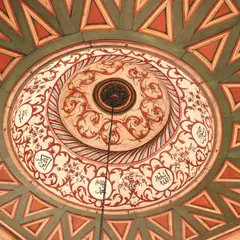
The facade is one of the most recognisable in Berat: an arcaded portico on the upper floor, a low minaret and wall paintings of flowers, plants and houses, inside as well. On the ground floor open commercial premises.
The contrast comes with present-day use. It is said that, since the dictatorship of Enver Hoxha, the portico has served as a shop, of all things for women’s underwear, and in 2007 there were souvenir shops beneath the mosque. The scene of those young men watching over the bazaar takes on another meaning with today’s shop windows in view.
One window above another, not a thousand
Mangalem window slope
Summary of this stop
From the river street one sees the image that has travelled the world: rows of large, regular windows, white houses piled in terraces and the fortress at the apex of a pyramid. From it comes Berat’s Albanian nickname, “Qyteti i një mbi një dritareve”, the city of one window above another. The tourist formula “city of a thousand windows” is usually presented as a mistranslation, because the epithet speaks of stacked windows and not of a number, although ICOMOS’s own evaluation of 2008 records that version.
Each facade also tells its own story of architecture. The houses date mostly from the late 18th and the 19th century, and many show two periods: the solid stone base that withstood the earthquake of 1851 and, above it, the living floor plastered white, with a light timber frame and large windows, raised after the disaster.
Legend has it that every house was supposed to have five windows and that a neighbour, Gezim the Vain, gave his six; for that rebellion they tied him up and threw him into the Osum. That is why, they say, Berat has not a thousand windows but a thousand and one, and from the Gorica bank people look for that odd window. The narration proposes the game in front of the slope.
The church the road kept trimming
Chapel of Shën Mëria e Ujërave
Summary of this stop
The last stop is a small chapel beside the road into Mangalem, before Gorica Bridge, with a bas-relief of the Virgin and, next to it, the mouth of a tunnel cut into the rock. It is what remains of Shën Mëria e Ujërave, the quarter’s Orthodox church, from the 15th-16th centuries.
Its story is one of loss by stages: it was damaged in the earthquake of 1851, trimmed in 1940 to widen the road along which the Italian army had to pass with heavy vehicles towards Përmet during the Greco-Italian war, and in the communist era it disappeared altogether when the tunnel was opened. Its existence belies the postcard of the Muslim quarter facing Christian Gorica: Mangalem had at least three churches, and today the two quarters are not told apart by religion.
The paradox closes the route: in the same century in which this church was being erased, the regime declared Berat a museum city and protected the houses of Mangalem, which in 2008 would reach the World Heritage List. The audio guide joins both threads in front of the chapel.