Historic bridge
Gorica Bridge Audio Guide (Ura e Goricës)
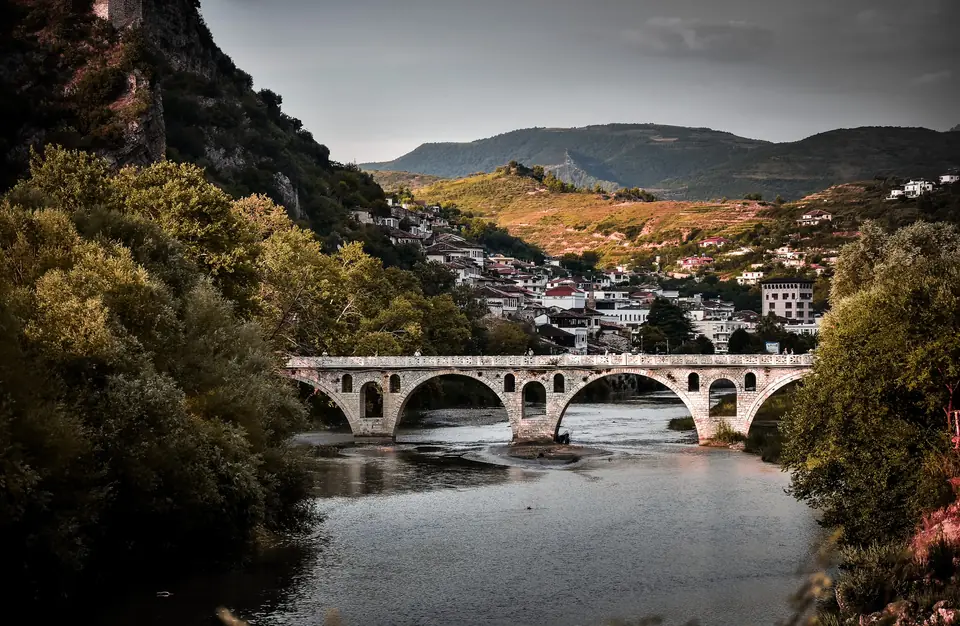
Seven arches of white stone stitch the Mangalem quarter to Gorica across the Osum. Behind its calm lies a wooden bridge that amazed Evliya Çelebi, a centre blown up with dynamite in 1918 and Albanian stonemasons who closed it in 1927.
- 25 min of audio
- Seven-arch bridge
Gorica Bridge is the historic crossing that joins Mangalem with Gorica over the Osum. In 1672 the Ottoman traveller Evliya Çelebi described here a great bridge of nine wooden arches on stone piers, with an oak deck. Depending on the source, it was the pasha Ahmet Kurt Pasha who turned it to stone around 1777 or 1780. The floods of 1880, the Austrian dynamite of 1918 and the works of 1923 to 1938 left the bridge crossed today: seven arches, about 129 metres long and a little over five wide.
In Albanian it has three names: Ura e Goricës, after the quarter it leads to; Ura e Kurt Pashës, after the pasha to whom it is attributed; and Ura turke e Goricës, the “Turkish bridge”. That very Ottoman nickname belongs to a structure that, in good part, Albanian stonemasons from Opar finished in the 20th century, with 10,000 lira put up by the people of Berat themselves.
Highlights
- Seven stone arches — uneven spans of 9 to 16.7 metres over the Osum
- The rebuilt centre — the scar of the arch the Austrians blew up in 1918
- The cantilevered parapet — iron rails projecting outwards that betray the 20th-century widening
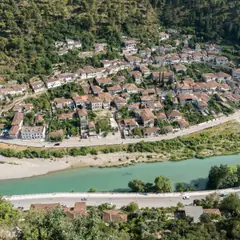
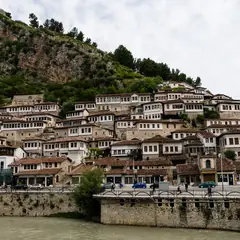
- The facade of Mangalem — the quarter of windows, seen head-on from the Gorica bank
- Cross to the river — every 6 January Berat's Orthodox faithful throw it into the Osum
Gorica Bridge (Ura e Goricës) looks like a quiet crossing of white stone over the Osum river, but its history is that of a seam mended again and again so that the two banks of Berat would never stop touching. Nobody has found the date of the first bridge: before it, people crossed by raft, and the historian Ferit Duka reasons that it must have been built, at the latest, in the second half of the 16th century, when the left bank began to be settled. An Ottoman tax register of 1583 already counts the mahalla “on the other side of the Osum”, and in Evliya Çelebi’s account of 1672 that bank appears as the “dry suburb”.
The history of Ura e Goricës runs through pashas, neighbours who paid for works in exchange for exemptions, floods, dynamite and a restoration that in 2015 lifted it, in Edi Rama’s words, “out of the mud and darkness” in which it had spent twenty years. In March 2014 UNESCO chose it for “Balkan Bridges Speak”, a stage of its project on the bridges of South-East Europe as symbols of unity, attended by its Director-General, Irina Bokova. The audio guide, researched and checked against historical sources, walks it from bank to bank: from the original start to the centre rebuilt after the war, ending beside the river with the window facade of Mangalem opposite.
The bridge comes out in Mangalem Quarter, whose slope of windows is seen head-on from this bank, and from the lower city one climbs to the castle hill, where Holy Trinity Church keeps 14th-century frescoes.
Nine wooden arches and a forest protected by law
Ura e Goricës
Summary of this stop
The route starts on the Mangalem bank, where the approach spans keep the bridge’s original fabric. Beneath today’s stone lives the memory of another bridge: in 1672 Evliya Çelebi described, below the coppersmiths’ market, a great crossing to the Gorica bank with nine wooden arches resting on stone piers and an oak deck. It impressed him so much that he compared it with the Koxha bridge in Herzegovina, which has a single arch.
Keeping it standing was a matter for the whole city. The timber and beams to repair it came from the wooded hill of Gorica, and anyone who cut even a thin tree there ended up before the court. In 1688 three Christian neighbours of the castle quarter, Papa Jani, Staso Jani and Bane Dhimo, declared they were still exempt from extraordinary duties in exchange for preparing materials and covering costs for the bridge.
From this first span, the wooden crossing the Ottoman traveller saw can be guessed at in the stone piers planted in the riverbed. What linked a guarded forest, some castle neighbours and an oak bridge is truly understood by listening to it there, with the Osum running underneath.
The scar of the arch dynamited in 1918
Rebuilt central vaults
Summary of this stop
In the centre of the bridge lies its most visible wound. In 1880 the floods of the Osum brought down part of the structure, and later interventions partly changed its original form. In 1918, at the end of the First World War, the Austrians blew up the centre with dynamite before leaving Berat; the Italians hung a steel-cable footbridge for pedestrians beside the broken arch. In September 1944 the German army tried to destroy it on its retreat, without success.
The vaults seen here tell the story: two were rebuilt in 1923 and a pier with two half-vaults around 1938, against the original springings on each bank. Local legend says that the first bridge, the wooden one, hid a dungeon in which a girl was shut up and left to starve, as a sacrifice to appease the spirits on which the bridge’s standing depended.
It is a story nobody has been able to document, yet it is still told whenever someone leans over the water from the middle of the bridge. The clash between that sacrifice to placate the river and a bridge that floods and dynamite did bring down is the heart of this stop.
A “Turkish bridge” finished by Opar stonemasons
Cantilevered parapet
Summary of this stop
On reaching the Gorica bank, the bridge reveals its paradox. It is attributed to Kurt Pasha, pasha of Berat: a book of the church of Shën Gjergj, published in the journal Diturija in 1927, says that in 1777 he financed the work and turned it to stone, although other sources speak of 1780 or of a wooden bridge that was not made of stone until the 20th century. Hence its names: Ura e Kurt Pashës and Ura turke e Goricës.
The 20th-century reconstruction does not have a single version either. One attributes it to the firm Tamburlini, with an investment of 45,000 lira, of which 10,000 came from the people of Berat. Another says that in 1927 a builder who had come from Italy abandoned the work after raising a single pier, and that master Hamza Molla, from Gjonbabas, and master Mahmut Belul Lekasi, with his crew from Opar, finished it that same year.
The clearest trace of those works is in plain view: to allow two-way traffic, the deck was widened with a new parapet resting on iron rails set in cantilever and concreted in, which juts out from the stone body and leaves two narrow pavements. It is the parapet seen today, and it explains why the bridge’s most Ottoman nickname belongs to a structure closed in good part by Albanian hands.
The view Edward Lear drew
Seven arches over the Osum
Summary of this stop
From the Gorica bank the seven semicircular arches can be taken in at a glance, with uneven spans of between about 9 and 16.7 metres, rising some 10 metres above the mean water level. The published length varies by source, from 127 to 130 metres. Opposite, Mangalem, the quarter of windows, steps up at the foot of the castle hill.
On 14 October 1848 the English painter Edward Lear entered Berat and, as evening fell, crossed this bridge to the left bank. The next day he had to abandon a drawing because the chief of police was handing out blows among the curious crowd gathering to watch him; he then spent two or three hours drawing on the bridge. He told it in 1851 in his “Journals of a Landscape Painter in Albania”, with a surprising verdict: the best general views, he noted, were to be had from the castle side.
The bridge is still alive. Damaged for years by heavy vehicles from the foundations to the arches, it stayed closed to traffic and in January 2015 its restoration was completed, with 130,000 dollars from the Albanian Development Fund. And every 6 January, Epiphany or Blessing of the Waters day, Berat’s Orthodox faithful walk in procession from the church of Shën Dhimitri to throw the cross into the Osum; what happened the year seven young men from Gorica jumped into the water is left for the narration, beside the river.