Byzantine church
Holy Trinity Church Audio Guide (Kisha e Shën Triadhës)
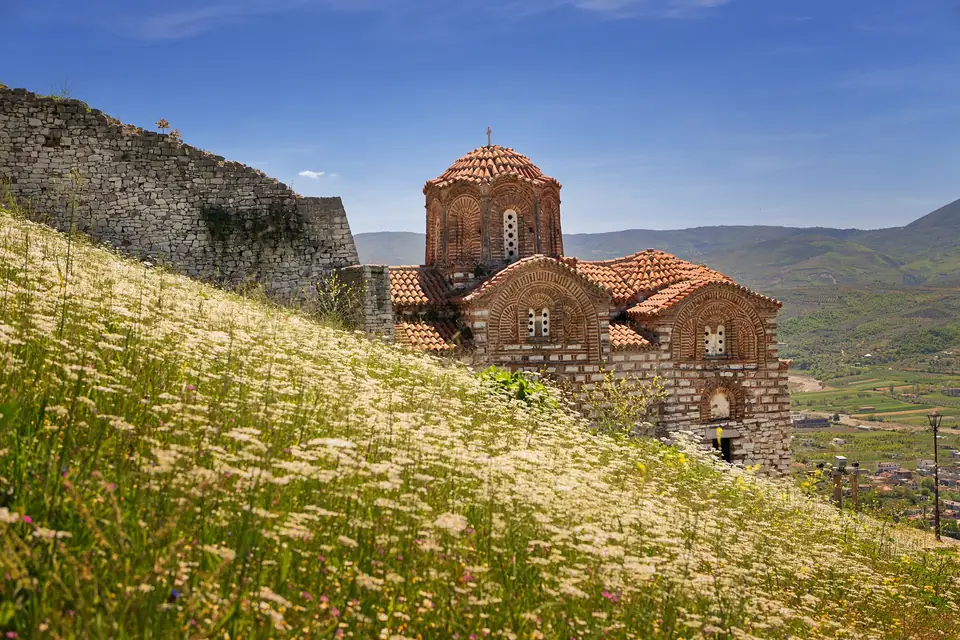
A tiny Byzantine church with a red dome and walls of stone and brick, perched below the inner citadel of Berat Castle: a governor who ended in exile paid for it, and it still keeps 14th-century frescoes.
- 25 min of audio
- Byzantine frescoes
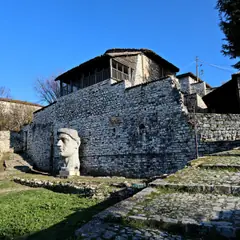
The Kisha e Shën Triadhës is a small cross-plan church crowned by a dome, with nave, narthex and apse, built between the 13th and 14th centuries on the site of a 7th-century church. Attached to the second ring of walls of Berat Castle, it combines the Byzantine pyramidal silhouette with Western elements of its time and has been a Cultural Monument of Albania since 1948.
Its Palaiologan-period wall paintings figure, together with the Codex Purpureus Beratinus and the Epitaphios of Glavenica, among the testimonies of Berat's Byzantine artistic weight, and those anonymous 14th-century painters influenced the post-Byzantine masters of the 16th. Damaged in 1997 and by decades of damp, the frescoes were restored between 2018 and 2020.
Highlights
- Cross plan with dome — a Byzantine pyramidal silhouette of the 13th-14th centuries
- Cloisonné walls — stone framed by courses of brick, beside the inner wall
- Donor's inscription — the name of the governor Andronikos Angelos Palaiologos
- Two columns with reused capitals — probably from Berat's classical ruins
- 14th-century frescoes — remains of the Last Supper and the Passover, restored in 2020
On the slope of Berat Castle, just below the inner fortification, the Kisha e Shën Triadhës seems too small for so much history. It was built between the 13th and 14th centuries on the site of a 7th-century church, with money from a Byzantine governor whose name is still written inside. It was declared a Cultural Monument of Albania in 1948 (register X0074), passed the communist era with hardly any work, suffered illegal interventions in 1997 and, between 2016 and 2020, recovered its facade, dome, door and frescoes. What to see at Holy Trinity Church, its history and its architecture are better understood on site: the audio guide, researched and checked against historical sources, walks round the church from outside in, in three stops.
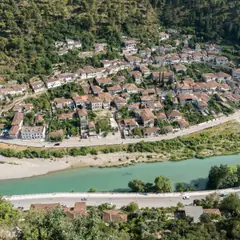
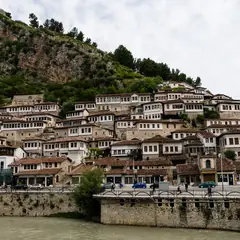
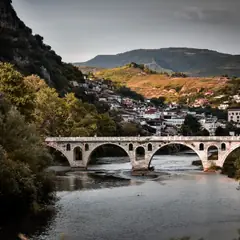
The church is part of the visit to Berat Castle, and in the same enclosure the icons of the Onufri Museum show how that painting tradition continued in later centuries. Going down towards the river, Gorica Bridge links the city with the opposite bank.
A red dome below the citadel
Kisha e Shën Triadhës
Summary of this stop
From the esplanade the architecture of the Kisha e Shën Triadhës reads at a glance: a cross plan crowned by a dome, with the narthex at the entrance, the side arms and the altar apse stepping into a pyramidal silhouette of Byzantine root, combined with Western elements of the same period. The walls, in cloisonné technique, frame the stone with courses of brick, and above rises the second ring of walls of the citadel, to which the church is literally attached.
That freshly restored look has a date: in June 2016 the Minister of Culture Mirela Kumbaro visited the final phase of a restoration that recovered the facade and the dome. According to the press at the time, the building had not been touched since the early 1970s, in the midst of the communist regime’s religious ban, although another archive record notes a restoration in the sixties.
In Berat it is repeated that inside the castle there were once forty churches, or even 42 chapels and churches. It is a disputed story: other counts speak of about twenty, and in 2019 the architects Genc Samimi and Dritan Çoku argued that there were almost half of that inflated figure. What that revision means for this small Trinity, a survivor among the few still standing, is revealed on listening to the narration right there.
The governor who paid and fled
Restored narthex door
Summary of this stop
Before the narthex door, restored in 2020, begins the story of the man who financed the church. An inscription inside contains the name of Andronikos Angelos Palaiologos, Byzantine governor of the province of Berat, grandson on his father’s side of Michael II of Epirus and on his mother’s side of the emperor Michael VIII Palaiologos. Sources place him as military governor of Velegrada, the medieval name of Berat, in 1327-1328.
The chronology, however, is not closed: some sources date the church to the 13th century, others to the 14th, and while the church’s own page credits the donor with a government from 1302 to 1326, the prosopography of the Palaiologan era limits it to 1327-1328, which would take the inscription to the end of that decade. What is documented is his fall: in the Byzantine civil war he first backed Andronikos III and then switched to the side of Andronikos II; when Andronikos III triumphed in 1328, his family was arrested, his lands confiscated and he died that same year, in exile in Prilep.
A documented tradition adds a revealing detail: Manuel Philes, the verse-maker of the Constantinople court, famed for his petition poems and his blunt flattery, dedicated verses to him. That such a poet sought his favour says much about the power of the lord of Berat before he ended as a fugitive.
Classical capitals and rescued frescoes
Dome frescoes
Summary of this stop
Beneath the dome, the interior is intimate, almost within arm’s reach. Two columns hold up the space with reused capitals, different from the rest of the medieval fabric and probably taken from the classical ruins of the city itself. Around them, the anonymous 14th-century frescoes keep, faded and fragmentary, remains of the Last Supper, of Christ with his disciples and of the rites of Passover.
Those paintings came close to being lost. Many were damaged by illegal interventions in 1997, as well as by erosion and poor maintenance. In 2017 the roof was repaired and the restoration of the interior began; in December 2018 the restorers of the Regional Directorate of Culture of Berat were working on the second half of the dome, removing salts and deposits with ammonium carbonate in Arbocel poultices, and in March 2020 the door and the frescoes were declared finished.
The result is an interior where the old has been reused again and again to keep standing, from the classical capitals to the rescued layers of paint. How those scenes read today, and what they reveal about the painters who influenced post-Byzantine art, is left for the narration beneath the dome itself.