Historic market
Bergen Fish Market Audio Guide (Fisketorget)
A square that was once harbour: Bergen's fish market stands on land won from the Vågen with the rubble of its fires. Almost five centuries later, the city is still arguing about how to buy fish beside the water.
- 40 min of audio
- Maritime history and market life
Bergen's first documented market, mentioned in 1278, stood at the end of Nikolaikirkeallmenning. In 1558 Christoffer Valkendorf, the Danish nobleman who dismantled a good part of the privileges of the Hanseatic merchants, moved it to the head of the Vågen harbour, where it remains today. Since then the square has never stopped growing towards the water: quays, 17th-century landfill and, after the fire of 1702, the gravel and rubble of the burnt plots.
For centuries fish was sold from boats, then from live-fish tanks, later under red tents and, since 2012, also behind the glass of the Mathallen. A building of timber portals is due to arrive in 2027 to replace those tents, the latest turn in a square that Bergen has defended with signatures, letters and controversy for generations.
Highlights
- The 2012 Mathallen, with paving that traces the plots of the old warehouses
- Red tents of the outdoor market, about to be replaced by a timber building in 2027
- Statue of Shetlands-Larsen and the Nordstjernen monument with 514 sailors' names
- Three masts in a triangle marking the outline of the vanished Triangelen quay
- A square won from the harbour with the rubble of the 1702 fire
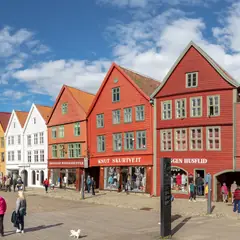
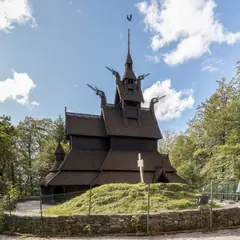
The history of the Bergen Fish Market (Fisketorget) begins far from where it stands today. The city’s first documented market, mentioned in 1278, stood at the end of Nikolaikirkeallmenning, although its exact spot is still debated among historians. In 1558 Christoffer Valkendorf, lensherre of Bergenhus between 1556 and 1560 and the man who cut back the power of the Hanseatic merchants, moved it “just below Skostrædet, inside Vågen”, to the head of the harbour. Tourist promotion speaks of a market active “since the 13th century”, but the municipal archive separates the two stages: the present site dates from 1558 and its ground was later extended with landfill. Anyone wondering what to see at Fisketorget finds a glass market hall, stalls under red tents, maritime memorials and a row of façades over the water, with Bryggen in the background. The audio guide walks the square stop by stop and gives each corner back the history it hides. About 300 metres away, on the same harbour, the Hanseatic warehouses of Bryggen line up, and from the centre a funicular climbs to Fløyen, the mountain that overlooks the city. Further south in Bergen, the Fantoft Stave Church tells another story of timber and fire.
The floor that remembers the warehouses
Mathallen
Summary of this stop
The ground floor of the Mathallen, the covered market opened in 2012 (the local encyclopedia Lokalhistoriewiki dates it to 2011), opens onto the harbour with a glass façade. The building came out of a 2009 competition that drew 66 entries and was won by Eder Biesel Arkitekter, the studio of Christine Biesel and Wilhelm Eder, with a motto that sums up the idea of the project: “Historien fortsetter”, “History continues”. The bands of paving, inside and outside the building, trace the limits of the old warehouse plots of the quay, so that the architecture of Fisketorget carries the memory of the harbour literally underfoot.
Behind the counters a family saga survives. In 1976 the brothers Øystein and Ragnar Fjellskål opened a small stall in the market, and for almost fifty years their surname has been tied to Torget. In 2012 the whole family moved into the Mathallen, where the business runs as a fishmonger’s and restaurant with a glazed gallery over the Vågen.
The glass brought no calm. In October 2013, three of the four fresh-fish sellers had exhausted their capital and all four were operating at a loss. Tom Rørnes, who had sold fish there since 1985, warned that the market might end up reduced to a takeaway food spot. What that warning says about the future of the square is told on the audio route.
From the rowing boat to the party tents
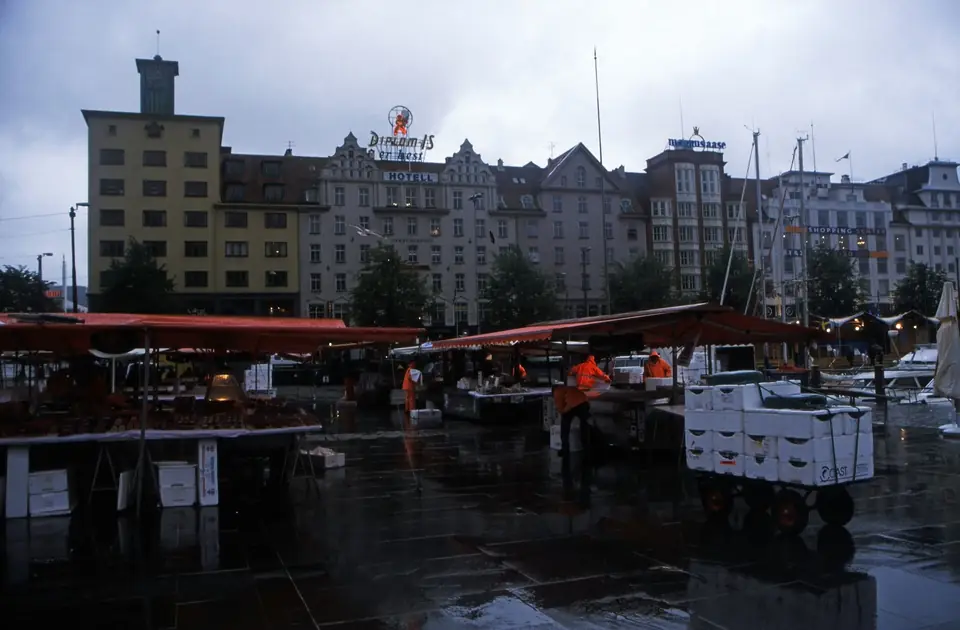
Red tents of the outdoor market
Summary of this stop
Facing the water, the red tents gather fish, seafood, fruit and flower stalls from May until the end of summer. But selling fish here has always been a fight. For centuries it was sold directly from boats, rowed in by fishermen from outside the city who returned home the same day. In 1889, because of the sewage discharged into the Vågen, it was decided to fit the Zachariasbryggen quay with 60 tanks for selling live fish.
In 1953 it was agreed to pull down Zachariasbryggen and move the wholesale sale of live fish to the new Bontelabo quay, beside Festningskaien. The response came in March 1954, when the housewives’ associations “Hjemmenes vel” and “Unge husmødres klubb” wrote to the council asking that live fish continue to be bought at Torget.
The present tents carry a mocking nickname, “partytelt”, party tents. In 2022 the Bergen historian Morten Hammerborg called them “horrible” and added that Bergen has “285,000 town planners”, all with the same authority to give an opinion; the head of the city government, Roger Valhammer, replied that the market is part of the soul of the city and that is why it is so much debated. To that dispute are added accusations of prices aimed at tourists and of fresh-fish sales being displaced by takeaway food. In June 2025 the bystyre approved replacing the tents with a grindabygg, a traditional construction of timber portals, and in June 2026 the concession went to Bergen Fisketorg AS: three fishmongers along a 5-metre passage, with opening planned for summer 2027.
Shetlands-Larsen at the helm before 514 names
Shetlands-Larsen statue
Summary of this stop
At the tip of the quay, Shetlands-Larsen stands at the helm of his fishing boat. The statue, by Knut Steen, was unveiled on 8 May 1995 and recalls Leif Andreas Larsen, who during the occupation crossed the North Sea to Shetland 52 times in fishing boats. In front, the Nordstjernen monument, a stone hemisphere, bears the names of 514 Bergen sailors who did not return from the Second World War.
The calm water of the Vågen also brought war to the square. In 1943, under the German occupation, the shortage of fresh fish caused queues so long that the authorities banned queueing at Torget; the queues did not disappear, they only became less visible.
On 20 April 1944 the Dutch ship Voorbode, loaded with explosives for the occupiers, blew up at Festningskaien, inside the harbour. At least 154 people died, a wave flooded the quays, and Torget and the surrounding buildings suffered great damage. How that day was lived from the market is reserved for the narration on the quay itself.
Three masts over a vanished quay
Triangle masts
Summary of this stop
Between the three flagpoles comes the key to the whole square: the ground was harbour. In 1663 a quay was raised between Torget and the old Vågsallmenningen, the 17th-century landfill pushed the square towards the water and, after the fire of 1702, the inner part of the Vågen was filled with the gravel and rubble of the burnt plots. On that fill the pile quay Triangelen was built in 1730, projecting from Torget until 1911.
The masts, first raised on 17 May 1932, were a gift from Det nyttige Selskab, designed by Johan Lindstrøm and Nic Schiøll. They were planted in a triangle to mark the corners of the vanished Triangelbryggen and were repositioned in the 1997 renovation.
Around 1865, Triangelen was the classic meeting point between the “stril”, the people of the islands and nearby coast, and the Bergeners. Amalie Skram portrayed it in the Hellemyr saga: on Saturday afternoons the islanders arrived in droves in their sea boots with their wooden vessels while the maidservants looking for bread for Sunday hurled jibes at them. Those peasants rowed to the city several times a week, haggled and were paid in cash, and so got ahead of many in the money economy. The full irony of that social frontier is revealed at the end of the route.