Open-air museum
Old Bergen Museum Audio Guide (Gamle Bergen Museum)
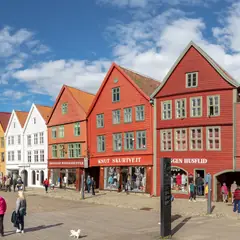
A whole quarter that was not born here: dozens of timber houses taken down in central Bergen, for street widening or by the 1944 explosion, once again form streets, a square and alleys on a former pleasure estate in Sandviken.
- 90 min of audio
- 18th- and 19th-century timber houses
The Old Bergen Museum occupies Elsesro, the estate and shipyard that the shipbuilder Rasmus Rolfsen bought in Sandviken in 1784 and named in honour of his wife, Elsebe. Since 1949 the open-air museum has worked as a port of refuge for the Bergen of the 18th and 19th centuries: the houses arrived between 1945 and 1981, threatened with demolition in the centre, and today they rebuild what was the largest timber city of 19th-century Europe. The museum counts 55 timber houses; other sources speak of about 50, depending on whether outbuildings are counted.
Behind the postcard lie unexpected layers. In the Chinese pavilion on the hill, Edvard Grieg composed part of the music for Peer Gynt in the summers of 1873 and 1874. The elegant main house, today a restaurant, was between 1919 and 1939 a municipal home for children with syphilis. And one corner of the street is held up by a marble column brought from Carthage in 1892 as ballast.
Highlights
- Masteboden, the shed of over 40 m built to repair the Russian ship St. Peter
- Chinese pavilion where Grieg composed music for Peer Gynt in 1873 and 1874
- 1728 bakery that survived the Voorbode explosion, with its great wood-fired oven
- Sjømannshuset, the smallest house: 3 × 6 m, moved whole by lorry in 1950
- Roman column from Carthage and period actors in the square from May to September
The history of the Old Bergen Museum (Gamle Bergen Museum) is that of a city that saved itself by moving. Bergen burned in 1702, widened its streets throughout the 20th century and saw the ship Voorbode blow up in its harbour on 20 April 1944, with 131 houses destroyed and another 117 uninhabitable. Many of the timber houses that were in the way or had been damaged ended up dismantled piece by piece and raised again in Sandviken, on the former pleasure estate of Elsesro. The museum opened in 1949 with its first three houses and went on receiving buildings until 1981. Anyone wondering what to see at the Old Bergen Museum finds two worlds: the Rolfsen estate, with its romantic park and the pavilion where Grieg composed, and a small relocated town, with a bakery, furnished houses, a square and alleys. The architecture of the Old Bergen Museum is best understood by walking it with the audio guide, which tells where each house came from and why it had to leave. Many of these houses came from the centre, where the timber warehouses of Bryggen still stand beside Bergenhus Fortress; the villa Grieg built in 1885 south of the city is Troldhaugen.
A shipyard without a permit and the tsar’s ship
Masteboden
Summary of this stop
Before the relocated houses there was a shipyard. In 1784 the shipbuilder Rasmus Rolfsen (1760–1808), who had come from Kristiansand, bought the land in Sandviken, installed his slipways there and built the pleasure estate of Elsesro, which his family kept until 1903. According to a documented tradition, he had arrived in Bergen on Christmas Eve 1781 to help a master shipwright who died the next day, and the newcomer inherited his post.
On the way to the entrance from Sandviken, the Masteboden stretches beside the water, a building a little over 40 metres long and 10 wide. Rolfsen built it in 1800–1801 to repair the “St. Peter”, a ship of the tsar’s fleet that in November 1799 lost its bowsprit and its three masts off Austevoll and reached Bergen with 506 crew. The repair lasted a year and eight months, until July 1801.
Tradition adds a paradox: Rolfsen’s shipyard had no privilege and, by law, could only build new ships, not repair them. Even so, it was to him that the Russian vessel was entrusted, and with it and its escort ships some 700 Russians arrived in the city. The narration on the spot tells how that impossible commission was resolved.
The pleasure house that hid an isolation home
Elsesro main house
Summary of this stop
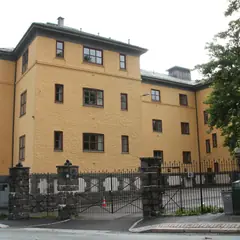
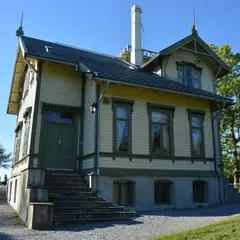
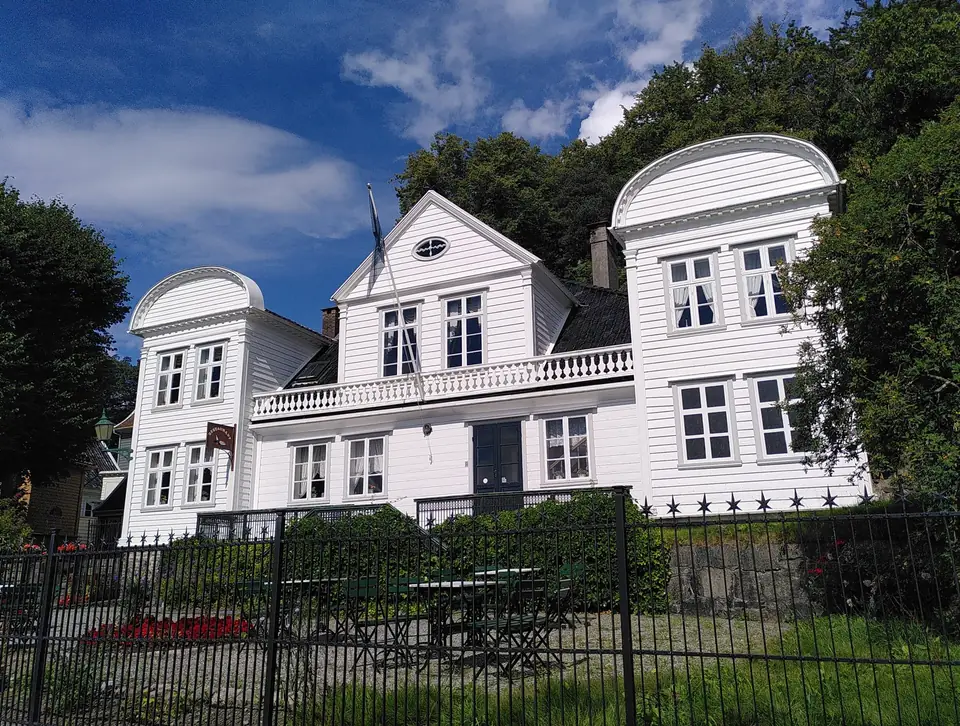
The main house of Elsesro has a central body from around 1785 and two wings added by Tønnes Rolfsen, the founder’s son. Today it houses the museum’s offices and the restaurant Gamle Bergen Tracteursted, and its pleasant façade gives no hint of the 20th century it lived through.
Rasmus Rolfsen the Younger died in 1903 without descendants and the municipality of Bergen took the estate in 1906. Between 1911 and 1918 it was the children’s home “Maiblomsten”, for children from families with tuberculosis, and from 1919 the main house hosted the Welanderhjemmet, a municipal home for children with syphilis, closed by decision in 1939.
According to documented tradition, the idea was launched in 1917 by the physician Dagny Tyvold, who later cared for the little ones. It could take up to 20 children, from infants to school age; some babies came straight from the maternity ward of Haukeland hospital and many stayed for years. When it closed, 110 children had passed through the house, and their records, with a photograph of each, are kept in the municipal archive. The audio guide gives that façade back the memory of those years.
The Chinese pavilion where Grieg wrote Peer Gynt
Grieg's Chinese pavilion
Summary of this stop
Around 1810, back from a long journey through Europe, Tønnes Rolfsen laid out at Elsesro a romantic English-style park, with paths, hawthorn hedges, ponds and small waterfalls. One entered through a pavilion with the interior of a Greek temple, and on the hill stood a summerhouse of Chinese inspiration. The park, with its duck pond, is open to all year round.
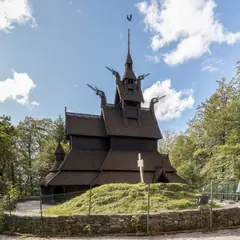
That small octagonal pavilion was Edvard Grieg’s composing workshop for two summers running, 1873 and 1874. There he wrote the music for the opera fragment “Olav Trygvason”, by Bjørnstjerne Bjørnson, and part of the music for “Peer Gynt”, by Henrik Ibsen.
From the summerhouse one overlooks Sandviken and the fjord, the same view the composer had over his manuscript paper. The history of the Old Bergen Museum crosses here with that of Norwegian music, and the narration places that scene at the exact point on the hill.
The bakery that survived the 1944 explosion
Old Bergen Museum
Summary of this stop
Crossing into the museum proper, the main street stops being an estate and becomes a town. The association Foreningen Gamle Bergen was founded in 1934, according to most sources, by a group of cultural historians led by the architect Kristian Bjerknes, who planned the museum and directed it from 1941 to 1971. The complete “old town” he imagined was never finished.
The yellow bakery house comes from Kroken 1, beside Mariakirken. It dates from 1728, when Detleff Martens, from Ditmarsken and a citizen of Bergen since 1723, founded a dynasty of bakers in it. The Voorbode explosion left it damaged and it was re-erected here for the opening of 1949. In its courtyard bread is still made for visitors; on the same street stand the captain’s and the merchant’s houses, also hurt in 1944.
The great wood-fired oven of the bakehouse, restored to its state of around 1840, fell out of use for very concrete reasons: lighting it required three days’ worth of firewood, the chimney smoked day and night and the fire brigade turned up again and again without need. In 2018 Trygve Fett, “mayor” of the museum since 2006, launched a collection to repair it, estimated at half a million kroner. How its soot was cleaned remains a matter of dispute, and the audio guide tells both versions.
A house of three by six and a column from Carthage
Roman column on the corner
Summary of this stop
In the alleys the scale shrinks. The Sjømannshuset, formerly the Sypikehuset of Nordnesgaten 27, mentioned in 1766, is the smallest house in the museum: it measures 3 × 6 metres and in 1950, when Nordnesgaten was widened, it travelled whole in a single lorry trip. It is furnished for a sailor or sailmaker with his wife, four children and a seamstress sublet in the loft.
Nearby is preserved the house of the poet Dorothe Engelbretsdatter. She lost hers in the great fire of 1702, in 1704 presented King Frederik IV with a poem of homage with a plea to obtain another, without result, and only in 1712 obtained this dwelling on the corner of Kong Oscars gate and Heggebakken. The sources disagree on the dates of its move to the museum.
On one corner stands a Roman column of veined marble with the inscription “Carthage Punic 800 A.C. Bergen 1892 A.D.”. Captain Niels Løvold brought it from Carthage in 1892 as ballast and set it up as a gatepost at Tollbodallmenningen 23; during the war, house and column were moved to the museum. The marble comes from the quarries of Karystos, in Euboea, a journey the narration follows in full.
The square where the neighbours of 1826 still receive
Torvsalen square
Summary of this stop
At the top of the street opens the square, presided over by the hall Torvsalen: the former prayer house of Solheimsviken, raised in 1881 by the Bergen Inner Mission, demolished in 1977 during the redevelopment of the district and re-erected here in 1981, the last year in which houses arrived. Beside it, the Repslagerhuset, the ropemaker’s house of Sandviksveien 85 mentioned in 1747, had behind it a ropewalk 175 metres long, the longest in Sandviken. Grieg’s parents lived in it for a time; it was moved in 1952–1953 and today is the square’s café.
From May to September, actors bring the museum to life: the family of the civil servant “anno 1826” and that of the merchant “anno 1886” receive in their houses, and short pieces are performed in the square throughout the day. The museum even has a “mayor”, a role once played by the actor Rolf Berntzen and now held by the former director Trygve Fett.
When Advent arrives, Gamle Bergen holds its pre-Christmas day: the neighbours of 1826 and 1886 prepare for Christmas, gingerbread is baked and, at four in the afternoon, a torchlight procession sets out that ends with dancing around the tree and carols in the square. The audio guide closes the route in that neighbourhood heart, where the relocated town sounds again like a living town.