Medieval stave church
Fantoft Stave Church Audio Guide (Fantoft stavkirke)
A post-built timber church born around 1170 beside the Sognefjord, moved piece by piece to a Bergen forest, reduced to ashes in 1992 and raised again in 1997. Rarely has a building told so much about what is won and lost in preserving the past.
- 40 min of audio
- Timber architecture and black metal history
The original church was raised around 1170 at Fortun, in the interior of the Sognefjord, as a long stave church with a raised central nave, and its first written mention dates from 1323. Condemned to demolition after the consecration of a new church in 1879, it was bought in 1883 by the consul Fredrik Georg Gade, who took it piece by piece to his estate at Fantoft and raised it in the park as a family chapel. His son-in-law, the conservator Anders Lorange, directed the reconstruction and invented the lost parts in the image of the Borgund stave church.
On 6 June 1992 the church burned almost to its foundations in half an hour: it was the first to burn down completely in the wave of Norwegian church fires of 1992 to 1996 and the only stave church lost in it. Varg Vikernes, of Burzum, was tried for the fire and the jury acquitted him of this charge. The replica, consecrated in 1997 with four-century-old pine, reproduces not the medieval church of Fortun but its version as imagined in 1883.
Highlights
- Stave church from around 1170 brought piece by piece from Fortun, in the Sognefjord, in 1883
- Tiered roofs, covered gallery and apse with a small tower in the image of Borgund
- The 1992 fire, the first of the wave of church burnings in Norway
- 1997 replica in Kaupanger pine 350 to 400 years old
- Medieval stone cross from Tjora on a mound beside the church
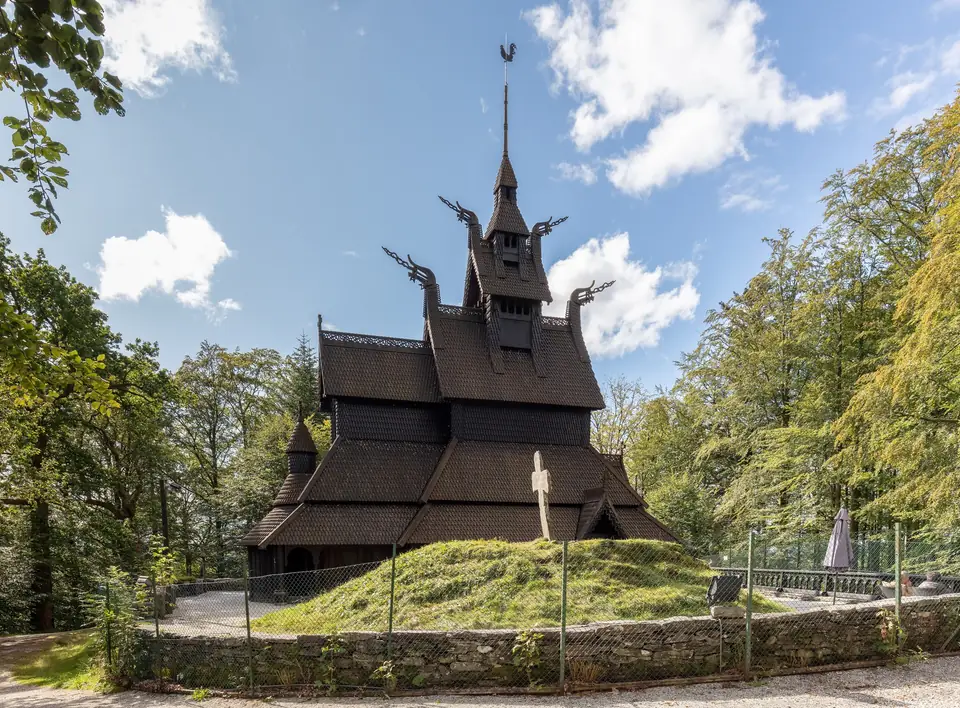
Among the pines of a Bergen hill stands a church that does not belong to this place. The Fantoft Stave Church (Fantoft stavkirke) was born around 1170 at Fortun, in the interior of the Sognefjord; the sources differ on the exact date, between 1150 and 1180, and its first certain written mention is from 1323. In 1883 it arrived dismantled in Bergen, in 1992 it vanished in an arson fire and in 1997 it was raised again as a faithful copy of a reconstruction that was already, in part, imagined. The history of the Fantoft Stave Church is that of a nomadic church, rebuilt twice, and anyone wondering what to see there finds tiered roofs, a covered gallery, a nave of posts in half-light and a medieval cross on a mound. The audio guide covers those layers on the ground, in four stops around and inside the building. Some two and a half kilometres away lies Troldhaugen, Edvard Grieg’s villa, and the medieval Bergen of timber and runes is explored on the quay of Bryggen.
A cross from Tjora and a foreign church
Fantoft stavkirke
Summary of this stop
The route begins on the north side, beside a mound crowned by a medieval stone cross. It is not from here: it comes from the churchyard of Tjora, in Sola (Jæren), where it was one of four crosses, and it reached Bergen in 1885 at the request of the conservator Anders Lorange. The cross anticipates the key to the place: at Fantoft almost everything is transplanted.
The church is too. At Fortun it was raised as a long stave church with a raised central nave, and it served there for centuries until the parish consecrated a new church on 6 June 1879. The old stave church was then offered to the Society for the Preservation of Norwegian Ancient Monuments, which could not pay for it, and it was condemned to demolition.
Its fame as a nomad comes from earlier. It is said to have been moved once before reaching Fortun and perhaps first raised at Bolstadmoen, in Skjolden, at the head of the Lustrafjord, a move that has never been verified. If true, the hill of Fantoft would be at least its third site. The narration on the spot follows the trail of that journey.
Borgund roofs on Fortun posts
Round apse with conical turret
Summary of this stop
In front of the eastern apse appears the profile everyone photographs: overlapping shingle roofs, a small turret above the nave, the covered gallery that runs round the building at ground level and a semicircular chancel topped by a cylindrical tower with a conical roof. The architecture of the Fantoft Stave Church looks medieval from top to bottom, but a good part of that appearance was decided in 1883.
That year, the consul Fredrik Georg Gade, a Bergen merchant and owner since 1877 of the Øvre Fantoft estate, bought the materials of the demolished church, brought them piece by piece and raised it in his park as a family chapel. The work was directed by his son-in-law, Anders Lorange, who removed the later additions and invented the lost parts taking the Borgund stave church as a model. The gallery, for example, was recovered because the Fortun church had lost it.
The nave was shortened: from seven pairs of posts in the central space it went to five, and the surplus served to rebuild a chancel of posts. Neither the 17th-century west tower nor the log chancel of 1666 was raised. In 1940 the architect Kristian Bjerknes documented that several of those adaptations were mistaken. How much of Fortun and how much of Borgund remains in this silhouette is what the audio guide takes apart piece by piece.
The tar that protected it made it burn
Safety fence
Summary of this stop
The fence that has surrounded the church since 1997 is the most visible scar of its recent history. On 6 June 1992, according to most sources (the Bergen byleksikon places the fire on the night of 6 to 7 June), the church burned almost to its foundations in half an hour. The firefighters arrived 2 minutes after the alert and found it engulfed in flames; 20 firefighters could not save it, and only the remains of a skeleton without load-bearing capacity were left. It was privately owned and had no automatic extinguishing system.
At first a lightning strike or an electrical fault was suspected. Later it came out that someone had sprayed petrol on the tarred pine walls: the same tar that had protected the wood for centuries turned it into a torch. Fantoft was the first church to burn down completely in the wave of Norwegian church fires of 1992 to 1996, and the only stave church lost in it.
Varg Vikernes, of the black metal project Burzum, was tried for this fire. In the appeal court the jury acquitted him of this charge, while the professional judges considered him clearly guilty; already sentenced to 21 years for murder and other church burnings, there was no new trial over Fantoft, so technically he remains acquitted. Vikernes even presented the burning as retaliation for raising a church on sacred pagan ground, an argument that collides with a detail the narration develops right there.
Kaupanger pine and two survivors
Post-built nave
Summary of this stop
Inside, the nave in half-light rests on five pairs of posts, the structure that gives the stave church type its name. Almost everything is new. The replica was raised between 1992 and 1997 under the architects Johan L. Andersen and Kjell H. Irgens, with the master builders Ole Johan Minde and Halldor Skaatun, using pines 350 to 400 years old from Kaupanger grown at about 400 metres above sea level. It was paid for by the Horn family, owners of the building, and consecrated on 24 August 1997 before some 300 people, although it holds only 66.
Not even the remains saved from the fire survived: they were kept in a garage that also burned later. From Fortun the church retains a wishing stone, perhaps a reliquary, set into a wall, and the altar cross, although a 1997 report quotes the builder saying that only the original door frame was saved. The crucifix in the chancel is new, carved by Sven Valevatn and painted by Solrun Nes, and some chairs bear reliefs of the saga of Sigurd similar to those of the Hylestad portal. The walls, by contrast, are bare: the murals from before the fire could not be reconstructed.
Minde, caretaker of the church for 25 years, recalled that before the fire he found people camped on the steps, enjoying the history, when he arrived before opening time. In 1997, facing the new gate with its alarm, he admitted that this was no longer possible. What was lost in 1992, besides the wood, is the closing note the audio guide reserves for the interior of the nave.