Viewpoint and funicular
Fløyen Audio Guide
At 320 metres above Bergen and six minutes by funicular, Fløyen looks like pure nature. It is in fact a work of the city: a bare mountain that Bergeners planted by hand and defended again and again.
- 90 min of audio
- Viewpoint, funicular and planted forest
The name Fløyen comes from a weathervane (fløy) that for centuries showed ships about to leave the Vågen harbour the wind direction from the mountain. In the 19th century the slope was pasture bare of trees, until in 1868 a forestry society set out to cover it with forest. The Fløibanen funicular, proposed in 1895 by the deputy John Lund, did not open until 15 January 1918, delayed by the First World War and the shortage of materials.
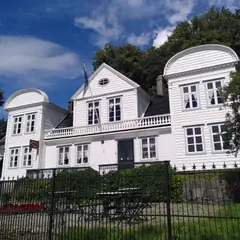
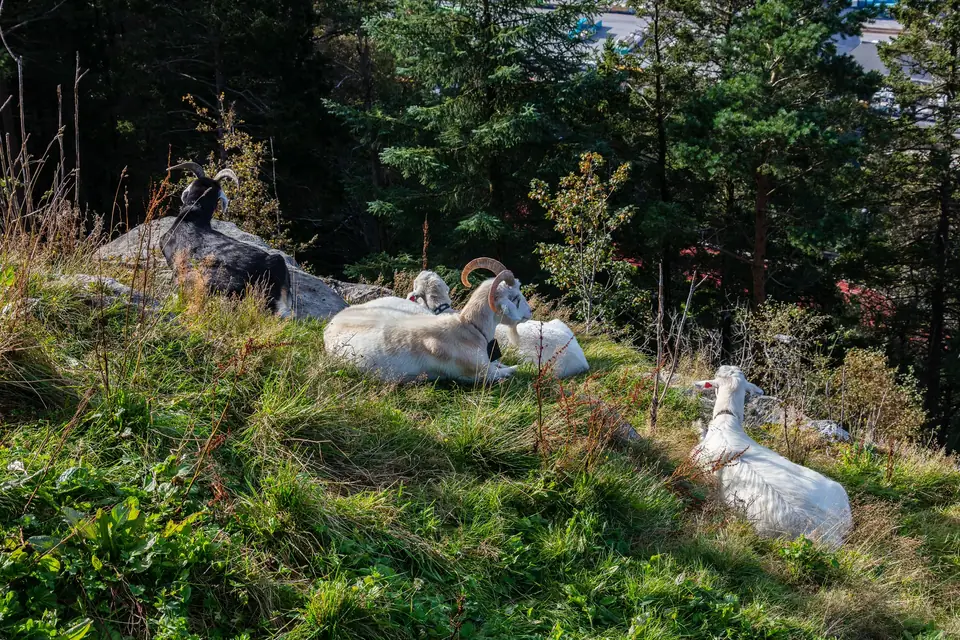
Beside the upper station stands the Fløien Folkerestaurant, a white timber building of 1925 that provoked protests from the temperance movement and that in 1984 came close to being demolished, until architects and heritage defenders saved it. Today a herd of cashmere goats grazes the slope with a curious mission: to hold back a forest that grew too well.
Highlights
- The 1918 Fløibanen funicular, with its cars Rødhette (red) and Blåmann (blue)
- Fløytrappene terrace over the Vågen harbour, Bryggen and the seven mountains
- Fløien Folkerestaurant, white timber and 1925, saved from demolition in the 1980s
- Forest planted since the 1870s, with more than 12 species of conifer
- Cashmere goats that clear the slope and Advent candles at the viewpoint
Fløyen is the balcony from which Bergen is understood: a city wedged between mountains, the fjord and the rain. Its viewpoint, at 320 metres, has been reached since 1918 by the Fløibanen funicular, and from its terrace one takes in the Vågen harbour, the timber façades of Bryggen and the crown of peaks that gives the city its nickname. But the history of Fløyen holds a twist few visitors suspect: the forest around the paths is not wild. In the 19th century the mountain was bare pasture, and from 1868 Bergeners covered it with trees brought from half the world. Anyone wondering what to see at Fløyen finds in addition a timber restaurant of 1925 saved by the city, a stone recalling the resistance of Norwegian sport during the occupation and a herd of goats with an assigned job. The audio guide covers the summit in four stops, from the upper station to the shed, with an account documented and checked against historical sources. Below, on the shores of the Vågen, lie the Bergen Fish Market and, at the mouth of the harbour, Bergenhus Fortress.
Six minutes that took twenty-three years
Fløibanen upper station
Summary of this stop
The exit from the upper station is the first point of the route. The Fløibanen track runs straight down the slope towards the centre: some 850 metres of line that overcome 302 metres of height between Vetrlidsallmenningen and the summit, with gradients of between 15 and 26 degrees. Its two cars hang from the same cable and balance by counterweight, so they pass each other halfway up at a passing loop. The fifth generation of cars, each with room for 120 passengers, entered service on 1 April 2022.
Those six minutes of climbing cost more than two decades. The Bergen deputy John Lund proposed transport to Fløyen in 1895; the company A/S Fløibanen was founded in 1912 and works began in the autumn of 1914 with a deadline of a year and a half. The First World War and the lack of materials stretched the wait to 15 January 1918.
The next war also left its mark. During the German occupation, between 1940 and 1945, bunkers and defences were built on the mountain, and the funicular carried supplies and personnel. Afterwards one car was painted red and the other blue, and together with the white building of the lower station they formed the Norwegian flag. Today they are called Rødhette (Little Red Riding Hood) and Blåmann, names chosen by competition. The narration on the spot also tells of the day in 1986 when the funicular stopped with a future Eurovision winner on board.
The weathervane that gave leave to sail
Fløyen
Summary of this stop
On the central balcony of the Fløytrappene, the stepped terrace rebuilt in 2002, Bergen unfolds in full. Below is drawn the tongue-shaped inlet of the Vågen harbour, with Bryggen on one side and the fish market at the head. From that harbour sailed the ships that watched this mountain: the name Fløyen comes from a weathervane (fløy) that for centuries showed the wind direction from here. The old Fløien, with the weathervane Fløipilen, lies some 500 metres to the north; the sources disagree on whether the one seen there today is the original or a replacement.
The panorama also explains the city’s reputation for rain. In Bergen an average of about 2,250 millimetres of precipitation falls a year, with some 232 days of rain, and on the slopes climbing towards Fløyfjellet the figure is 10 to 15% higher than in the centre. When the funicular opened, its first director, Waldemar Stoud Platou, invited people to climb the mountain on a Sunday, facing snowy peaks, fjord and sea, to get to know the forces that forge the Bergener.
From the terrace one also sees the crown of mountains that gives Bergen its nickname “the city between the seven mountains”, with Ulriken, the highest, to the southeast, and Rundemanen and Blåmanen behind. Which peaks exactly make up that group of seven is disputed, and the lists vary according to who draws them up. Fløyfjellet appears in all of them; the audio guide unpicks on the ground which ones are in and which fall off the count.
The restaurant Bergen would not let be demolished
Fløien Folkerestaurant
Summary of this stop
Facing the terrace rises the Fløien Folkerestaurant, a white timber building designed by Einar Oscar Schou, who also designed its interior and the funicular stations. It opened on 13 July 1925, seven years after the Fløibanen, and not without controversy: the temperance movement protested on learning that there would be a restaurant on the mountain serving alcohol.
Half a century later it came close to disappearing. In 1984 the company AS Bergen tomteselskap acquired it in a sorry state and decided to pull it down. The Bergen architects’ association and Fortidsminneforeningen responded with an open day; the building was restored, housed the Bergen school of architecture between 1986 and 1991 and in 1992 became a restaurant again. The city would defend its mountain once more: a large leisure centre with a heliport proposed in 2008 was abandoned in 2013 in the face of opposition from residents, the council and the county governor.
In front of the restaurant, a vertical stone slab with two men shaking hands recalls the sporting youth who fell for Norway between 1940 and 1945. It was raised by Bergen’s sports federation in 1946, and behind it lies the sports strike, one of the most notable episodes of the occupation. What happened in the stadiums during those years is revealed in the narration beside the stone itself.
A planted forest and goats to tame it
Goat shed
Summary of this stop
Below the restaurant, beside the goat shed, the route reaches its last surprise. The forest that smells of resin is a manufactured landscape. In the 19th century Fløyfjellet was the city’s grazing land and bare of trees; in 1868 the Bergenske Skov- og Træplantningsselskab was founded to cover with forest the bare slopes surrounding Bergen. Planting began on a small scale in the 1870s in Fløydalen, under the forester Nicolai Endresen Krog, with spruces from 1879. A fire in 1889 destroyed a good part of the young conifers, and since then beeches, maples, elms, red oaks and birches have also been planted.
The result is a garden of outsiders: more than 12 species of conifer along the paths, among them the Sitka spruce of the North American west coast and the mountain pine of the Alps and the Pyrenees, when on the Norwegian west coast the only native conifer is the Scots pine. It took so well that it now has to be held back: a herd of cashmere goats born in 2020 in Radøy grazes the slope within a virtual fence, eating scrub and forest.
The mountain remains the city’s in winter too. Every Sunday of Advent, at 13:00, one more large candle is lit at the viewpoint, visible from Bergen, with carols and choirs from the city’s churches, a tradition that in 2026 reaches its twenty-seventh consecutive year. Behind the restaurant there also grows an “Advent forest” decorated by nursery-school children, and the audio guide closes the route with what hangs from its branches.