Hanseatic quarter
Bryggen Audio Guide
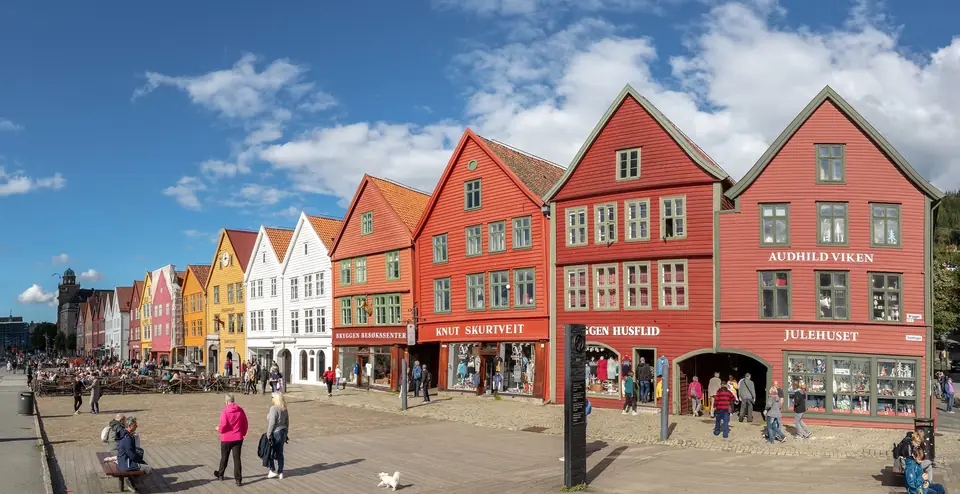
The row of timber warehouses with their gables to Bergen's harbour is the only one of the Hanseatic League's four overseas kontors still standing. It is no intact medieval postcard: Bergeners came close to pulling it down, and today it sinks slowly into ten centuries of remains.
- 60 min of audio
- Hanseatic League and timber architecture
Bergen never belonged to the Hansa, but from the mid-14th century Bryggen housed one of its four overseas kontors, alongside those of Novgorod, Bruges and London, and the German Kontor operated here until 1754. It was paid for by the dried cod of northern Norway, which in the 14th century made up more than 80% of the country's exports and which Hanseatic merchants stored on these quays in exchange for grain, flour and cloth. Each gable is the front of a long, narrow gård that pushed out over the water following the limits of its medieval plot.
The houses seen today are not medieval: they come from the reconstruction after the great fire of 1702, raised on the same layout and with the same techniques. In 1944 the Reich Commissioner Josef Terboven wanted to flatten the quarter, and after the fire of 1955 many Bergeners took to the streets to demand that it be pulled down entirely. Archaeology saved it: on the burnt site, hundreds of runic inscriptions with messages from everyday life came to light.
Highlights
- The only one of the Hanseatic League's four overseas kontors to survive
- A row of timber gables rebuilt after the great fire of 1702 on the medieval plots
- Schøtstuene, the winter assembly rooms of the Hanseatic merchants
- Some 670 medieval runic inscriptions found since 1955, in Bryggens Museum
- Finnegården, jacked up by a metre to give it new foundations
The history of Bryggen is that of a stubborn survivor. According to tradition, King Olav Kyrre founded Bergen in 1070, when the shore of the Vågen ran between 100 and 150 metres inland from today’s quay; the warehouses gained ground from the water plot by plot until, around 1500, the front reached the present line. From the mid-14th century (most sources say around 1350; others, 1360) the German Kontor of the Hanseatic League operated here, officially closed in 1754, although the last gårder did not pass into Norwegian hands until a few years later. Between 1857 and 1945 the quay was officially called Tyskebryggen, “the German quay”; after the Nazi occupation it regained the name Bryggen, and in 2011 Bergen’s council rejected a proposal to return to the German name. Anyone wondering what to see at Bryggen finds much more than a row of coloured façades: fires, hazing rituals, runes and a sinking ground, pieces the audio guide fits together from south to north along the quay. At the far end of the same harbour stands the Bergen Fish Market, and at the mouth of the Vågen rises Bergenhus Fortress. Other timber houses from the centre, dismantled and moved, are preserved in the Old Bergen Museum.
Finnegården against the 1913 brick
Finnegården
Summary of this stop
The route begins at the southern end, where the postcard bears a scar. Around 1900 the southern stretch of the timber row was pulled down and replaced by “neo-Hanseatic” brick buildings, such as Murbryggen, raised in 1913 by the architects Fredrik Arnesen and Arthur Darre Kaarbø. Part of Finnegården escaped the pickaxe for a very simple reason: its owner refused to sell the plot.
That surviving house, home of the Hanseatic Museum since 1872, closed on 1 October 2018 because of a problem invisible from the quay. The log framework it rests on had rotted once the groundwater was lowered, and the whole building was jacked up by about a metre to give it new foundations, with reopening planned for 2027. 1913 brick and timber raised on jacks, side by side: the narration on the spot explains why that contrast sums up everything that follows.
Gables paid for with dried cod
Bryggen
Summary of this stop
Facing the Vågen stand the pointed gables of painted timber, each the door of a long, narrow gård that runs back towards Øvregaten. Bergen was never a member of the Hansa, but Bryggen housed one of the League’s four overseas kontors, alongside Novgorod, Bruges and London, and it is the only one of the four that survives.
The wealth that sustained this architecture smelled of the sea. In the 14th century the dried cod (tørrfisk) of northern Norway made up more than 80% of the country’s exports; the Hanseatic merchants stored it here in exchange for grain, flour and cloth, although they were forbidden to sail north of Bergen, towards the Lofoten. Bergeners also had their own nickname for these Germans of the quay, “garper”, the tough guys.
Behind the coloured façades lay a power that stopped at nothing. The sources record that in 1440 more than a hundred armed Hanseatics burst into the rådstue, the medieval town hall that stood in the middle of Bryggen, and chased the councillors with axes and swords. Fifteen years later, in 1455, the clash ended at Munkeliv monastery with the death of Olav Nilsson, commander of Bergenhus, and of more than sixty people, among them Bishop Torleiv. How the Crown reacted, and how long compensation took to arrive, is part of the story heard in front of the gables.
An alley rebuilt after every fire
Alley between Bellgården and Jacobsfjorden
Summary of this stop
The passage between Bellgården and Jacobsfjorden, partly covered by galleries, reveals the depth of a medieval plot: timber on both sides, little light and a width measured by the shoulders. At the back of the gårder appear the small stone warehouses, fireproof, where valuable goods were kept safe from fire.
This timber, however, is not medieval. The great fire of 1702 destroyed almost 90% of Bergen, and the present houses came out of the reconstruction that followed, on the same layout of plots and with the same techniques. In 1944, after the explosion of the ship Voorbode in the Vågen on 20 April, Josef Terboven wanted to raze Bryggen with the backing of the municipal technicians; the German professor Hermann Phleps, of the Technical University of Danzig, ruled that the “German quarter” could be saved with simple means, and temporary “Domus” sheets covered 8,000 m² of roof. The mix of tile and sheet metal seen on the roofs is the trace of those emergency repairs.
Fire remains the great threat. Bryggen has sprinklers and thermal cameras, and every would-be firefighter in Bergen has to train here. Most of the buildings belong to the Stiftelsen Bryggen foundation, created in 1962 to preserve them, and in this alley the audio guide tells how many times everything has come close to disappearing.
The chimney where apprentices were smoked
Schøtstuene
Summary of this stop
Beside Øvregaten and the Mariakirken stand the Schøtstuene, the winter assembly rooms of the Hanseatics, rebuilt in 1937–1938 with original parts and now the temporary home of the Hanseatic Museum, with a medieval ruin visible beneath a glass floor. The Kontor was governed by two oldermenn and a council of 18; in summer each group lived separately within its own gård, but in winter all moved to the skytningsstue, the great common hall.
It was an exclusively male colony: apprentices from northern Germany who could neither marry nor have children in Bergen. The ban was broken, and the archives of Lübeck hold the wills of Hanseatics who had returned home naming the mistress they had in Bergen and their children.
To be truly admitted, the apprentice had to pass the “games” staged by merchants and journeymen, a documented tradition. In the best known, the smoke game, the newcomer was hoisted in a sack up the hall’s great chimney while shavings, hair and scraps of leather burned below, and he had to answer questions and sing aloud. One apprentice died of suffocation. King Christian V banned these games by law in 1671, and what happened in the other two rites is reserved for the narration in front of the halls.
The burnt site that gave back the runes
Bryggens Museum
Summary of this stop
At the northern end, in front of the Radisson Blu Royal hotel, six timber fronts reproduce the houses that burned on 4 July 1955; the copies were raised around 1980, although the sources disagree on the exact date of the hotel. That fire destroyed a good part of the old houses that remained (half, according to some sources; a third of the buildings, according to others), and many Bergeners, who called the quarter a “rats’ nest”, demonstrated to demand that it be pulled down entirely.
Public opinion was turned around by the archaeological excavation of the burnt site, directed by Asbjørn Herteig. Since 1955 some 670 medieval runic inscriptions have appeared in Bryggen and its surroundings according to one count (other sources give 597), most on small pine sticks: ownership tags such as “Eysteinn owns me”, a “my love, kiss me” and the stick on which someone carved “Gyða says come home”. They are kept in Bryggens Museum, opened in 1976 on the same ground.
The finale has a touch of irony. In 25 years the water table beneath part of Bryggen dropped by more than a metre and a half, mainly through the drainage of the sheet-pile wall of the hotel’s car park, and the ground is locally sinking by up to 6–8 mm a year. Bredsgården and Bugården, at the northern end of the row, are the most affected, and the audio guide closes the route here with the medieval city that still lies beneath one’s feet.