Composer's home
Troldhaugen Audio Guide
The timber villa that Edvard Grieg called his “best opus”, with the hut where he composed on the shore of the Nordåsvannet and the rock where he rests beside Nina. A composer's home that still sounds: his 1892 Steinway is still played.
- 90 min of audio
- Music, architecture and Grieg's life
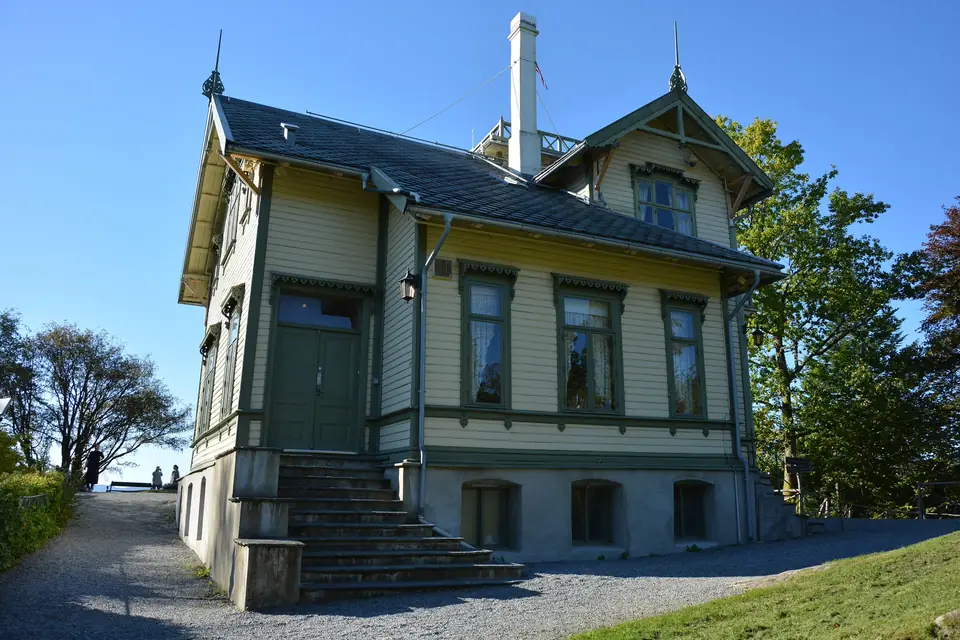
Troldhaugen was built in 1885 to a design by Schak Bull, architect and cousin of Edvard Grieg. It was meant to be a simple Norwegian country house and ended up a richly decorated historicist villa, with a panoramic tower, a large veranda and windows enormous for their time, designed to let in light and air. The name, “the troll's hill”, was proposed by Nina Grieg after the neighbouring Trolddalen, the “valley of the trolls”. On the slope that runs down to the lake lie the villa, the Troldsalen concert hall, the composing hut and the couple's tomb.
The house came close to disappearing. In 1919 Nina, without enough income, sold it and its furniture went to auction; in 1921 an architect drew in its place a stone residence that required demolishing the villa. It did not happen: the estate passed to the municipality of Fana, the belongings were recovered one by one and in 1928 it opened as a museum.
Highlights
- 1885 timber villa with a panoramic tower, which Grieg called his “best opus”
- 1892 Steinway piano, a silver-wedding gift, still heard in concerts
- Composing hut on the shore of the Nordåsvannet, with its Brødrene Hals piano
- Tomb cut into the rock where Edvard and Nina Grieg rest
- Troldsalen, a half-buried concert hall with a glass wall towards the lake
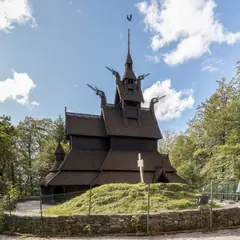
The history of Troldhaugen is that of a man 152 centimetres tall who built himself, to his own measure, a home, a refuge and a tomb on the same hillside, south of Bergen. Edvard Grieg settled here in 1885, in a timber villa that he himself called “mitt beste opus hittil”, “my best opus so far”. In 1891 he added a hut by the water to compose away from visitors, and in 1907 his ashes were placed in a grotto in the rock wall above Lake Nordåsvannet, where since 1936 Nina’s also rest. Between the house and the water stands, since 1985, Troldsalen, the chamber-music hall that makes the place sound without covering it. Anyone wondering what to see at Troldhaugen finds a route that descends from celebration to farewell, and the audio guide follows it stop by stop, from the façade of the villa to the rock. In the same south of Bergen, some two and a half kilometres away, stands the Fantoft Stave Church, and the Chinese pavilion where Grieg composed in the summers of 1873 and 1874 is preserved in the Old Bergen Museum.
The “country house” that ended up with a tower
Edvard Grieg Museum Troldhaugen
Summary of this stop
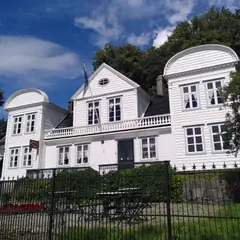
In front of the villa appears the first paradox of the architecture of Troldhaugen. The design, signed in 1885 by Schak Bull, the composer’s cousin, was conceived as a “simple Norwegian country house”. What was built was a richly decorated historicist villa, with a lookout tower, a large veranda and windows enormous for their time. Grieg wanted them so to fill the house with light and air; the price was an interior that was cold in winter.
The name also has a history. It was proposed by Nina Grieg, because the house sits on a knoll beside Trolddalen, the “valley of the trolls”; another version, recorded in some sources, says it was the children who called the little neighbouring valley that. Behind the drawing-room windows waits the Steinway grand piano built in Hamburg in 1892 on commission from the Bergen merchant Carl Rabe: it was the Griegs’ silver-wedding gift, on 11 June 1892, it has stood in the same place ever since and is played regularly in concerts.
That anniversary also left a piece that carries the name of the house around half the world, “Wedding Day at Troldhaugen”. It was not written on the day of the celebration but years later, and its original title was different. How and when “Troldhaugen” entered the score is one of the details the narration keeps for this point.
The hall buried to save the house
Troldsalen
Summary of this stop
At the entrance to Troldsalen one understands how close everything came to being lost. In 1919 Nina Grieg, without enough income because of the First World War, sold Troldhaugen to the consul Joachim Grieg, after trying in vain to have the authorities take it on. Furniture and belongings were auctioned. In 1921 the architect Ole Landmark designed for Einar Grieg a new stone residence, inspired by the Barony of Rosendal, which required demolishing the composer’s villa. The sources do not entirely agree on the dates of those transfers.
The demolition never came. Joachim Grieg ceded the estate to the municipality of Fana and, under the direction of Aslaug Mohr, the scattered objects were recovered until the museum opened in May 1928. That patience explains why the house keeps its interior today.
The concert hall seen here is the architectural answer to that history. It opened in 1985, on the villa’s centenary, designed by Peter Helland-Hansen and Sverre Lied: about 200 seats, a grass roof and the volume half-buried in the slope so as not to hide the house. The rear wall of the stage is glass and frames, behind the musicians, Grieg’s hut and the lake. In front of the hall, a replica of the statue by Ingebrigt Vik shows the composer at life size.
Seated on Beethoven, safe from the noise
Grieg's composing hut
Summary of this stop
On the shore of the Nordåsvannet, among birches, hides the small timber hut where the music was made. Grieg had it built, according to most sources in 1891, although one reference work gives 1887, to escape the constant visitors and the noise of the villa’s kitchen. The first work he finished there was the Lyric Pieces, Op. 54. Inside are preserved the desk, the wood stove, the divan, the rocking chair and a Brødrene Hals piano.
At that piano, the composer sat on a thick book to reach the keyboard: the 32 Beethoven sonatas in the edition of Ignaz Moscheles, his teacher in Leipzig. Nor was the hut born on this spot. It stood on a knoll exposed to storms, and Grieg moved it to the woods on the shore with the help of some fifty peasants, paid in beer and aquavit, who rolled it over logs. That summer tourists began to anchor their boats beneath the window to hear him play for free.
After 1907 the hut made a longer journey: it spent some time in the open-air museum on Bygdøy, in Oslo, and returned to the water’s edge when Troldhaugen opened as a museum in 1928. What Grieg left written for possible intruders on leaving is part of what is told right there.
The rock chosen by the last sun
Tomb of Edvard and Nina Grieg
Summary of this stop
The path ends at the rock wall above the lake, where a plaque with the names of Edvard and Nina Grieg closes a sealed grotto. Before reaching it, the story passes through the composer’s last summer. On the night of 25 July 1907 the Australian pianist Percy Grainger, twenty-five years old, whom Grieg had met in London, arrived at Troldhaugen. He found him sunk by asthma and insomnia, but for about ten days they prepared together the Piano Concerto in A minor for the Leeds Festival, and Grieg even proposed a great tour for the following year. He was the last guest of the house.
Grieg had chosen his burial place years before, on an outing with his friend Frants Beyer, on seeing the rock lit by the last sun. He died on 4 September 1907, was the seventh person cremated in Norway and, after the funeral of 9 September, his urn was placed in this tomb cut into the rock.
Nina died in Copenhagen in 1935. Her urn was placed beside Edvard’s on 15 June 1936, his birthday, and the cave has not been opened since. It is one of the very few burials on private land in Norway. On both their birthdays and at the opening of the Bergen Festival, flowers appear beneath the plaque, and the audio guide closes the portrait of the hillside here, facing the water.