UNESCO heritage
55 Window Palace Audio Guide
A palace of carved wood born of an earthquake, with a cornice of 147 musical ragas and a mural in which King Bhupatindra Malla painted himself as the god of the cosmos.
- 40 min of audio
- Newar wooden architecture
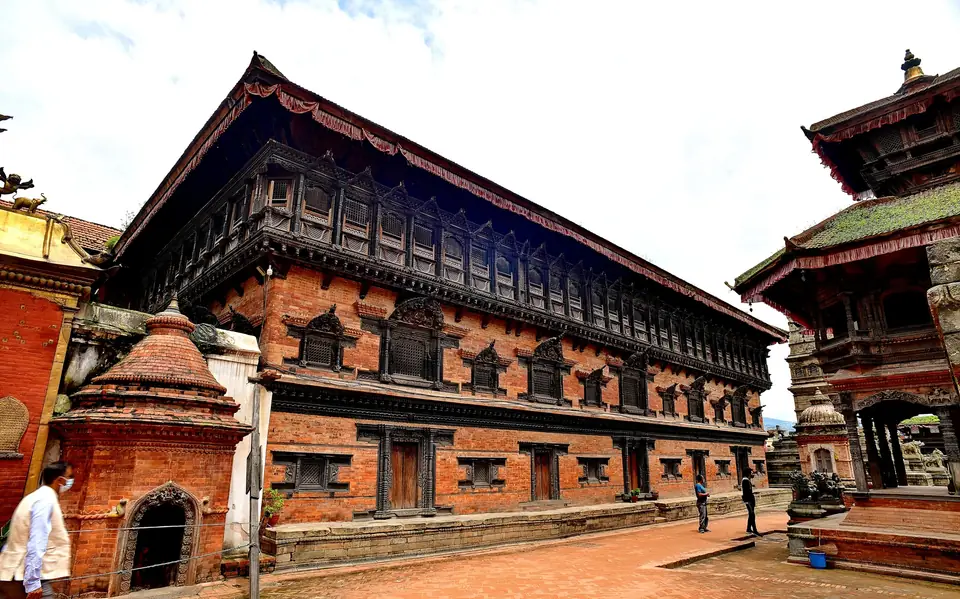
Bhupatindra Malla commissioned the palace after the 1681 earthquake destroyed an earlier building, and the work was finished, according to most sources, in 1708. Its brick-and-wood facade, with the row of projecting windows that gives it its name, presides over Bhaktapur Durbar Square beside the Golden Gate and the adjoining palace that today houses the National Art Gallery.
The most repeated explanation, one window for each of his 55 wives, does not hold up: the king probably had a single queen, Vishva Lakshmi. What is documented is stranger: a palace conceived for music, a monarch portrayed as Vishwaroop on its walls and a hall of murals that the police ended up using as a kitchen.
Highlights
- Cornice of ragas — 147 carved miniatures of musical modes
- Vishwaroop mural — the king with the face of a god holding the chariots of Rama and Ravana
- Golden Gate — gilded, repoussé copper, planned in 1646 and finished between 1751 and 1754
- Window gallery — the balcony the 1934 earthquake pushed against the wall and the restoration gave back
- Narasimha and Hanuman — statues of 1698 that a guthi washes with ghee six times a year
What to see at the 55 Window Palace begins with a paradox: the most famous building on Bhaktapur Durbar Square is, in good part, what earthquakes, governors and the heirs of the Malla dynasty themselves have left standing. Bhupatindra Malla, who reigned from 1696 to 1722, had it built over the ruins of an earlier palace that the 1681 earthquake had destroyed. The sources do not agree on the completion date: most give 1708 (Nepal Sambat 828) under Bhupatindra, while others stretch the work to 1754, already under his son Ranajit Malla.
The story of the 55 Window Palace does not stop at the facade. The 1934 earthquake took the upper floor; the 19th and 20th centuries turned it into offices, a police station and a post office; and a restoration begun in 2004, with a budget of 16 million rupees, had to wait for the eighth tender to find wooden struts of 18 and 21 feet for the roof. The audio guide route follows this complex from one end to the other, from the lions in the west to the carved cornice, with documented narration checked against historical sources.
The visit is completed by the rest of Bhaktapur Durbar Square and, to continue with Newar wood carving, by the Peacock Window of the Pujari Math.
Fifty-five windows and a single queen
Window facade
Summary of this stop
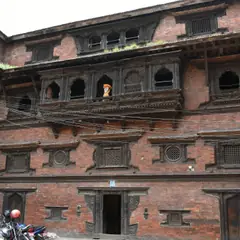
Facing the facade, in the middle of the square, the gallery of carved wooden windows on the upper floor dominates. The legend of a harem of 55 wives, one per window, has circulated for decades in tourist texts, but it clashes with what is documented: Bhupatindra Malla probably had a single queen, Vishva Lakshmi, and the number reads better as an architectural decision.
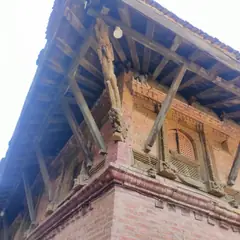
The architecture of the 55 Window Palace tells its own biography. The 1934 earthquake completely destroyed the upper floor and, in the hasty rebuilding, the windows that had projected like a balcony ended up pressed against the facade, under a roof of European-style tiles. The restoration by the Department of Archaeology and the Bhaktapur municipality put the balcony back in its place, recovered the traditional jhingati tiles and reused more than 42% of the original wood. What that gallery reveals when you look at it calmly is left for the narration, in front of the facade itself.
Ghee-anointed lions and a lost glass pane
National Art Gallery
Summary of this stop
At the western end, two great stone lions guard the portal of the adjoining palace, finished in 1698 and known as Nhēkanjhya Lyākū, Simhādhwākhā Lyākū for those lions, or Mālati chok for the courtyard behind it, one of the few that remain of the 99 of the royal palace. Today it houses the National Art Gallery, although some sources place it inside the 55 window palace itself. Beside it, the statues of Narasimha and Hanuman carry an inscription of 9 February 1698 in the name of Bhupatindra Malla and his uncle Ugra Malla, who created a guthi to wash them with ghee six times a year.
Above the portal, on the second floor, there is a void: there stood the lattice with a pane of glass given by a Mughal emperor, which the king placed to show it to the people and which was lost in the 1934 earthquake. Between the lions and the Golden Gate there is also a white neoclassical building, the Lāl Baithak, which according to the documented tradition Governor Dhir Shumsher Rana raised in 1856 after demolishing the eastern half of the Malla palace of the lions. Its reconstruction after the 2015 earthquake set the city against itself over which style to recover, a debate the audio guide tells on the spot.
The Golden Gate that waited a century
Golden Gate
Summary of this stop
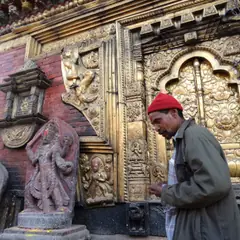
The Golden Gate, or Luṁ dhvākā, opens onto the inner courtyards with its gilded, repoussé copper, the figure of Taleju on the tympanum and two inscriptions by Ranajit Malla at the sides. Jagajjyoti Malla planned it in 1646 with two goldsmiths from Lalitpur who died before starting; it was their descendants, Subhākara, Karuṇākara and Ratikara, who made it between 1751 and 1754 with funds from Ranajit Malla.
The king who paid for it was also the last of Bhaktapur. According to the documented tradition, Ranajit had given shelter and schooling in the city to the young Prithvi Narayan Shah, the same man who years later, by then king of Gorkha, besieged it. The gates did not fall by force: they were opened from within, and how and by whom is the twist the narration keeps at this point.
A cornice of ragas and a god-king
Cornice of ragas
Summary of this stop
Between the ground floor and the first floor runs a carved band with 147 miniatures of musical ragas, a sign that the palace was conceived for music. Inside, when access allows, waits an 18th-century mural spread over five bands: the Vishwaroop, the cosmic form of the god, has the face of Bhupatindra Malla and holds in his hands the chariots of Rama and Ravana before their final battle, while the goddess he embraces has “Shree Bhupatindra” written in her hairstyle. The murals are signed, something rare in Nepali painting, although all that can be read is that the author was a Chitrakar from the Yāché quarter.
In the 19th and 20th centuries the police turned the hall of the great mural into a kitchen, and part of the painting remains under the soot of the stoves. Among those scenes a young Ranajit Malla rides beside his father, who is mounted on an elephant; tradition preserves how that boy ended up and a song of his that Bhaktapur still sings every spring, an ending best heard beneath the cornice itself.