Woodcarving Museum
Pujari Math Audio Guide
A 15th-century priests' house that hides in an alley the most copied window in Nepal and that, thanks to a wedding present, set in motion the rescue of the whole of Bhaktapur.
- 40 min of audio
- Newar wood carvings
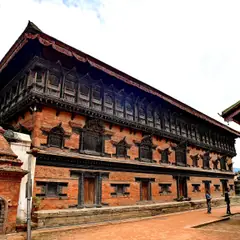
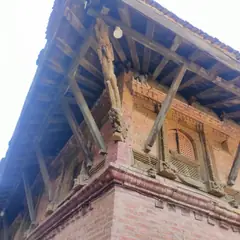
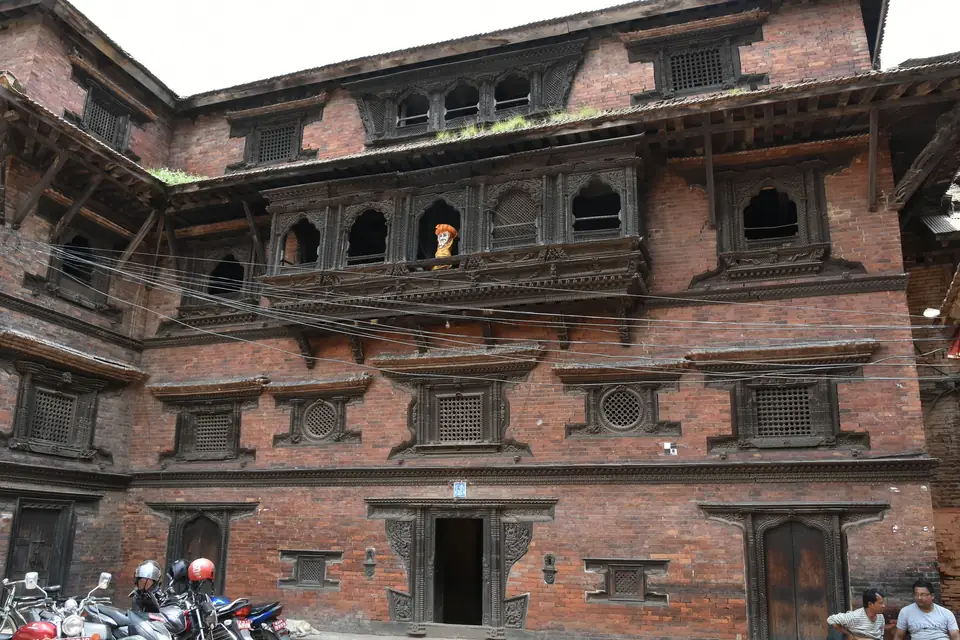
Next to the Dattatreya temple stands the Pujari Math, also called Dattatreya Math: a three-storey residence first built in the 15th century, during the reign of Yaksha Malla, and rebuilt in 1763. To look after it, mahantas, wealthy ascetics from Mayurgadh in India, were brought in, and they also took charge of the rituals of the neighbouring temple. Today it is the Woodcarving Museum, with three outstanding carvings: the Peacock Window, the Sun Window and the Singhkhawa beam.
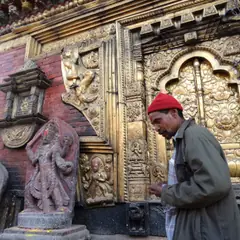
Its most famous piece does not face the square. The Peacock Window, considered the finest carving in the Kathmandu valley, looks onto a narrow alley on the east side, on a wall that the 2015 earthquake damaged and that had to be rebuilt. And the whole museum exists because, around 1970, a German diplomat proposed restoring this building as a wedding present instead of giving a porcelain dinner service.
Highlights
- Peacock Window — the finest carving in the Kathmandu valley, in a side alley
- Effigy of Guru Bakshya Giri — the first priest, at the second-floor window
- Singhkhawa beam — a row of faces of different creatures, not only lions
- Three inner courtyards — a Shiva lingam and a well
- Woodcarving Museum — more than 20 types of carved windows
The story of Pujari Math begins in the 15th century, during the reign of Yaksha Malla, when this priests’ residence was first built at the edge of the Dattatreya square; the present building is the reconstruction of 1763. Its first custodians were mahantas who came from Mayurgadh in India, to whom the rituals of the adjoining temple were also entrusted, hence its second name, Dattatreya Math. The dating is not entirely settled: the Peacock Window is dated to the 15th century, the building seen today is 18th-century, and one source credits its first priest with introducing that window to the valley. Since 1974 it has been part of the National Art Museum and works as the Woodcarving Museum, although behind the facade the descendants of that first priest still live. The audio guide walks the facade, the alley of the window, the courtyards and the rooms, and at each point tells the part of the story that is in front of you.
Its neighbour, the Dattatreya Temple, shares the Tachupal square with it, and whoever wants to continue with Newar wood carving will find it in the windows of the 55 Window Palace.
The first priest looking out onto the square
Pujari Math
Summary of this stop
The main facade is that of a house of ascetics brought from India to look after the math and serve the Dattatreya temple. In the front window of the second floor appears a wooden figure: it represents Guru Bakshya Giri, the first priest of the Pujari Math, who still looks out onto the square centuries later.
Tradition, which not all sources date the same way, attributes to him a novelistic biography: a rich and austere merchant from Mahuragarh who made his fortune trading with Tibet and spent a good part of it raising this building. According to that same tradition, his throne and other belongings are still kept inside. One version places him in the 16th century, a century after the reign to which the foundation is attributed, and the narration, in front of the facade, explains why those dates do not quite fit.
A window all of Nepal copies
Peacock Window
Summary of this stop
The central discovery of the tour is where you least expect it. The Peacock Window, the Mayur Jhyal, from the 15th century, is held to be the finest carved window in the Kathmandu valley, but it does not face the square: it is seen from a narrow alley on the east side, beside the museum, with the peacock spread in the centre of the lattice.
It is popularly known as “the Mona Lisa of Nepal”, and it is perhaps the most imitated window design in the country: the souvenir shops around sell miniature replicas. It shares the limelight with two other outstanding carvings of the building, the Surya Jhyal or sun window and the Singhkhawa beam of the first floor, whose faces are not only lions but different creatures of the earth.
The wall that holds it has its own recent history: the earthquake of 25 April 2015 badly damaged the math and the east wall, the one with the window, had to be rebuilt.
The courtyard of the richest house
Inner courtyards of the math
Summary of this stop
Inside, the three-storey building is organised around three brick courtyards: in one stands a Shiva lingam and in another there is a well. It is a silent space that hides one of the most improbable stories in Bhaktapur.
It is said that, because of its founder’s ties with Tibet, the Tibetan rulers sent this house every year one tola of gold, one tola of silver, a horse, a woollen carpet, 365 nuts and 216 rupees, double the sacred number 108. According to that belief, the tribute arrived for four centuries until it stopped in 1904, and with the lands donated by wealthy neighbours the math would probably have been the richest priests’ residence in the country.
The Guthi Sansthan took over the building around 1964 and, around 1974, it passed to the National Art Museum. Even so, only the front facade works as a museum: in other parts live the descendants of Guru Bakshya Giri, who keep up in a minimal way the rituals begun by their ancestors.
A building instead of porcelain
Rooms of the Woodcarving Museum
Summary of this stop
The rooms of the first floor gather more than 20 different types of carved wooden windows, together with pieces such as the Mara Vijaya, the Pooja Devi, the Vishwarupa and the Arya Tara. On the ground floor waits the mask of the wrestler Jayamal, from the Malla period, and one of the rooms is covered with paintings of the Ramayana and the Krishna Leela on wooden panels, even on the ceiling.
That all this is still standing has an unlikely origin. On the occasion of the wedding of Crown Prince Birendra, around 1970, the German diplomat Heinrich Seemann proposed as a state gift to restore a historic building instead of a porcelain tea set or an X-ray machine, and chose the Pujari Math. The architect Niels Gutschow had 100,000 German marks and six months of work, and the math was the first building restored, in 1971; some sources, however, place that renovation years later.
From that work was born the Bhaktapur Development Project, 17 years of German cooperation to rehabilitate the city, with the math itself as its headquarters. The narration, in these rooms, follows the thread that links a wedding present with the rescue of the whole of Bhaktapur.