Royal square of the Mallas
Bhaktapur Durbar Square Audio Guide
The Malla royal square is more open than its twins in Kathmandu and Patan for an uncomfortable reason: the earthquakes of 1833 and 1934 took away palaces and temples. What stands today has been raised again by the city itself, piece by piece.
- 60 min of audio
- Newar architecture
The story of Bhaktapur Durbar Square is read in its temples and in its gaps alike. Here stood the Basantapūra palace, nine storeys high and the tallest in the Nepal of its day; here Queen Karpura Devi consecrated the Yakshasvara temple to her late husband in 1484, and here Ranajit Malla, the last king of Bhaktapur, offered the great Taleju bell in 1737, which the priests still ring once a day.
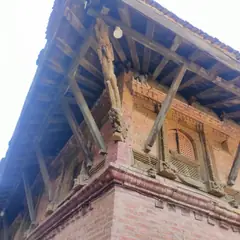
The most photogenic pavilion on the square, the Chyasilin Mandap, hides an earthquake-proof steel frame and came through the 2015 earthquake unscathed. Its 32 original carved struts, however, have been on a Kathmandu gateway since 1934. And after that 2015 earthquake, in 2018 the city turned down more than 10 million dollars from a German bank in order to rebuild with neighbourhood committees, donations and volunteer work.
Highlights
- Statue of Bhupatindra Malla: a king in gilded bronze with a bullet hole from the battle of 1769
- Chyasilin Mandap: octagonal pavilion rebuilt in 1990 on a steel frame
- Taleju bell: offered in 1737, the oldest of the great bells of the three royal squares
- Yakshasvara temple: the Pashupati of Bhaktapur, from 1484, with erotic wood carvings
- Lions of Lāpān Dega: all that remains of the tallest pagoda on the square
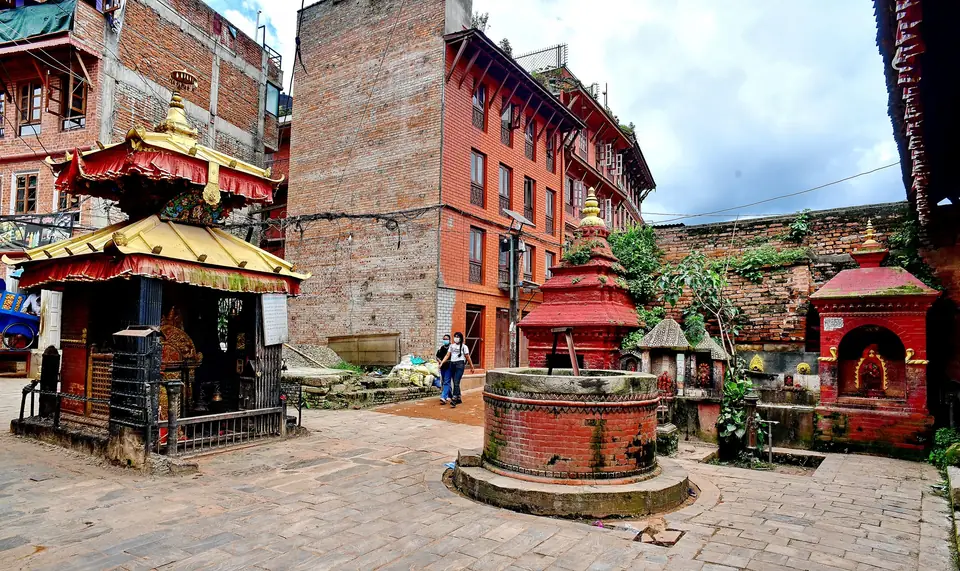
Anyone arriving from Kathmandu or Patan usually notices right away that Bhaktapur Durbar Square seems to be missing something. It is wider, more open, and that openness has dates: the earthquake of 1833 partly destroyed the Basantapūra palace, the one of 1934 brought down the tallest pagoda on the square and the ambassadors’ pavilion, and the one of 2015 seriously damaged 116 monuments in the city. The story of Bhaktapur Durbar Square is that of a Malla royal square that has been lost and put back together, and its gaps tell as much as its temples.
The architecture of the square brings together almost every register of Newar art: stone steles of fierce gods, pagodas with tiered roofs, shikhara temples of stone and brick, a gilded bronze king on top of a column and bells that still mark daily worship. The audio guide walks the square from west to east with documented narration checked against historical sources, which separates what is verified from what only tradition tells, and which is best enjoyed by listening on the spot, in front of each piece.
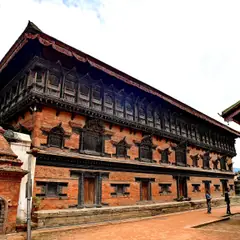
The 55 Window Palace faces this same square, and a few minutes’ walk away wait the Taumadhi Nyatapola Temple and Pottery Square.
The gateway of a palace that is gone
Ugrachandi and Ugrabhairava steles
Summary of this stop
At the western end, beside two guardian lions, rise the great stone steles of Ugrachandi and Ugrabhairava, two fierce deities commissioned by Bhupatindra Malla. They guard an entrance with no building: behind it stood the Basantapūra palace, nine storeys high and the tallest in the Nepal of its day. The earthquake of 1833 partly destroyed it, Dhir Shumsher Rana demolished it and planted an orchard on its site, and since 1947 a public school has stood on its foundations. The absence is plain to see.
A much-repeated story circulates about the steles: that the sculptor had his hands cut off so he could not repeat the work in Kathmandu or Lalitpur. No historical record confirms it. Even the date of the steles has two versions: the inscription on the pedestal speaks of their installation in 1706, and another passage of the same source places their inauguration in 1702, together with a repair of the palace.
This very square was, in 1992, the palace of the Shakyas in the filming of Little Buddha, by Bernardo Bertolucci. What happened between the authentic monuments and their fibreglass doubles is one of those episodes the narration saves for telling in front of the lions.
Chyasilin Mandap, the pavilion with a steel skeleton
Chyasilin Mandap
Summary of this stop
Facing the palace stands the Chyasilin Mandap, an octagonal two-storey pavilion. According to the most-cited historiography, it was a gift from Srinivasa Malla of Lalitpur to Jagat Prakasha Malla of Bhaktapur as a sign of friendship; local tradition, by contrast, attributes it to Bhupatindra Malla, who is said to have built it to protect his palace from the harmful energy of the Shiva temple opposite. In it the kings received ambassadors, from its windows the court watched the processions and, under the Ranas, it housed the tax office.
The pavilion collapsed nine hours after the earthquake of 15 January 1934. Its 32 carved struts with scenes of Krishna were taken to Kathmandu to decorate the modern gateway on New Road, and there they remain: in 1987 their return was refused, so the present pavilion has plain struts. Its reconstruction was Germany’s gift to Nepal on the occasion of Chancellor Helmut Kohl’s official visit in 1987, and it was only authorised when the architects Götz Hagmüller and Niels Gutschow showed the photographs that Gustave Le Bon had taken in 1885. In a shelter in Sallaghari, eight of the twelve original pillars turned up.
Beneath the woodwork there is an earthquake-proof steel frame designed by Walther Mann, visible on the upper floor. The decision was criticised at the time by the local government and by conservationists; the project’s technicians maintain that without those beams the pavilion would not have withstood 2015, from which it emerged unscathed. The year of the works, 1990, is hidden beside the staircase, in a spot few visitors find without knowing where to look.
A king with a bullet hole and a temple that fell
Vatsala temple
Summary of this stop
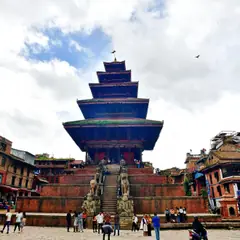
On top of a stone column, Bhupatindra Malla, king from 1696 to 1722, sits in gilded bronze with his hands joined towards the goddess Taleju. His leg keeps a bullet hole from the battle of 1769, when the Gorkhalis of Prithvi Narayan Shah took Bhaktapur. Beside him, the Vatsala temple, all of stone except the pinnacle and resting on twelve columns on a three-level plinth, collapsed in the 2015 earthquake and only the plinth remained; the municipality finished its reconstruction in 2020. On that plinth hangs a bell that Bhupatindra himself offered in 1699, known in the city as “the barking dog bell”.
That morning in 2015, a soldier posted at the entrance to the square watched the sandstone temple fall in a matter of seconds, by his own account, while three teenage girls chatting beside him fled unharmed, leaving their bags behind. Facing the ruins, the great bronze bell and the statue of the king stood intact.
That great bell is the Taleju bell, the tava gāṅ, which Ranajit Malla, last king of Bhaktapur, offered on 6 January 1737 after four and a half years of manufacture. The priests of Taleju ring it once a day, and it is the oldest of the great bells of the three royal squares of the valley. The story of the king who donated it, and of what happened to his kingdom in 1769, is what the narration reserves for this point.
The Pashupati of Bhaktapur, a temple still alive
Yakshasvara temple
Summary of this stop
On the south side of the square, the Yakshasvara temple is called the “Pashupati of Bhaktapur” for its resemblance to the Pashupatinath of Kathmandu. Queen Karpura Devi consecrated it in 1484 to her late husband, King Yaksha Malla, and it is one of the few temples on the square with active worship. Its wooden struts bear erotic carvings that tend to surprise those who discover them.
On the west side, Jitamitra Malla consecrated two Vatsala temples in 1695. The Siddhi Lakshmi, made of stone and the one still standing, flanks its stairway with pairs of guardians: a man and a woman with a child and a chained dog, camels, horses, rhinoceroses and mythical beasts.
One night a year, that of Vijaya Dashami during Dashain, the square becomes the stage of the Khadga Jatra, the procession of the sword, according to a documented tradition: the Navadurga, living gods of Bhaktapur, receive the power of the mantra from Taleju before the Golden Gate, and the sacred sword is carried around the city on a priest’s shoulder. The role of the goddess’s white horse before this temple is one of the details the audio guide tells in front of its doors.
Pumpkin temple and lions without a temple
Silu Mahadeva
Summary of this stop
The Silu Mahadeva is the tallest shikhara temple on the square. It fell in 1934 and was remade as a low dome that the neighbours called Fasi Dega, the “pumpkin temple”; after 2015 it returned to its pre-1934 form. Its exact age is debated: one source dates it under Jagat Prakasha Malla and another merely places it in the 17th century or earlier on architectural grounds. Two of its “flying lions”, the bo simha, remain today far from the temple, in the Golmadhi neighbourhood, for a reason that has more to do with local pride than with archaeology.
Very close by, standing stone lions guard an empty plot. They are all that remains of Lāpān Dega, “the temple that blocks the way”, the tallest pagoda on the square, which Srinivasa Malla of Lalitpur raised in 1657 right on the route of the processions. The earthquake of 1934 brought it down and it was never rebuilt.
The end of the tour explains the square as seen today. After the 2015 earthquake, Germany contributed 1,190 million rupees in 2016 for ten structures, among them the Fasidega; but in 2018 the city refused more than 10 million dollars from the German development bank and went on rebuilding with neighbourhood committees, donations and volunteer work. That stubbornness of Bhaktapur in rising again with its own hands is the thread the narration leaves for the end.