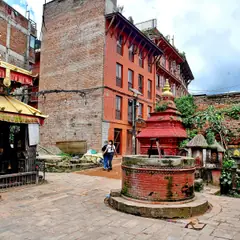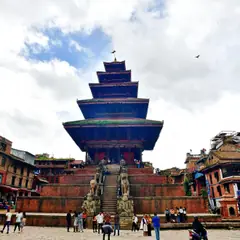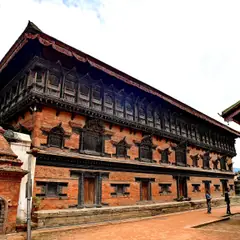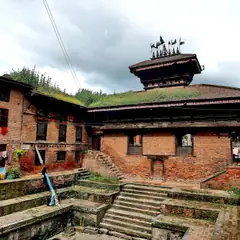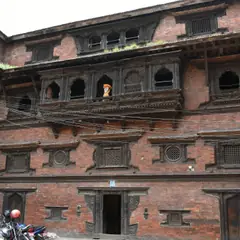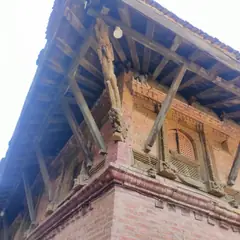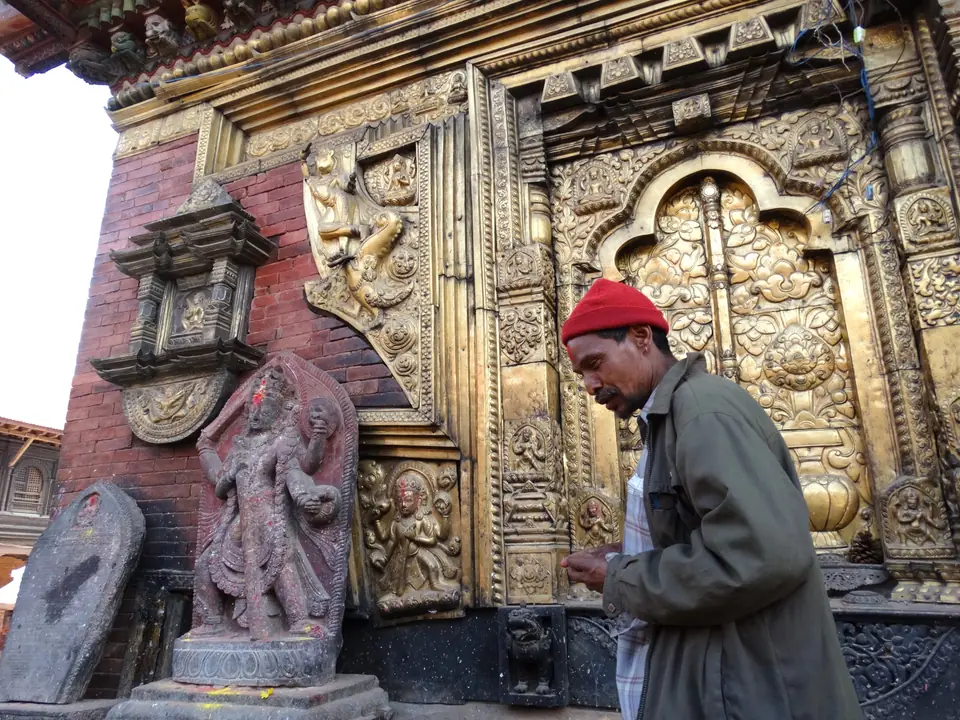
Vishnu shrine
Changu Narayan Temple Audio Guide
On top of Changu hill, beside the door of a pagoda rebuilt in 1702, stands the oldest dated inscription in Nepal: a stone pillar of the year 464 that watches over a god without a head.
- 75 min of audio
- Licchavi sculpture
The Changu Narayan temple is one of the most revered Vishnu shrines in the valley. The present building, a two-roofed pagoda on a single-level plinth, was raised in 1702 after a fire razed the precinct, but the place was sacred long before: the pillar that the Licchavi king Mānadeva set up beside the west door bears an inscription of 464 CE that describes it as a pilgrimage centre. Around the courtyard are spread Licchavi stone sculptures, stone guardians at each door and forty carved wooden struts.
Of the sanctum only the threshold can be seen. Only the priests enter, and according to tradition they descend from the Brahmin who, centuries ago, cut off the god's head when he sprang from a champak tree. That story of blood, guilt and forgiveness explains why the Narayan of Changu is venerated without a head, and why the temple remains in the hands of the same lineage.
Highlights
- Pillar of Mānadeva — the oldest dated inscription in Nepal, from the year 464
- Kneeling Garuda — 5th-century stone figure with a human face before the west door
- Vishnu on Garuda — the stone relief that appears on the Nepali 10-rupee note
- Pagoda of 1702 — two roofs and forty struts carved with avatars of Vishnu
- Statue of Bhupalendra Malla — stolen in 2001 and found the next day buried on a hillock
In Licchavi times, the shrine was not called what it is today. It was Dolashikhar Swami, “lord of the summit of Dolagiri”, after the name of the hill. The present name came with the Mallas, in Nepal Bhasa: “cha” for the champak and “gu” for the forest, the Narayan of the champak forest. When it was founded is a matter of dispute: some sources speak of 325 CE and King Haridatta Varma, others of the 4th or 5th century, and some even of earlier Kirata kings. The only firm datum is the pillar of 464, which already presupposes an important shrine.
What is seen today is a pagoda of 1702, fully restored at least three times before that date and reinforced after the 2015 earthquake. The story of Changu Narayan is best read by walking the courtyard piece by piece, from the west door to the corner of the minor temples, with the audio guide, which tells it right there.
Back in Bhaktapur, the Nyatapola Temple was raised in that same year of 1702, and the Dattatreya Temple, in Tachupal, tells how an ascetics’ hostel ended up turned into a temple.
A pillar of 464 and a Garuda with a human face
Mānadeva pillar and Garuda
Summary of this stop
Facing the west door rises a stone column crowned with the attributes of Vishnu: the disc, the conch, the lotus and the sword. On its shaft is carved in Sanskrit the oldest dated inscription not only of the Licchavi period but of all ancient Nepal, from the year 464 CE (Saṃvat 386). It does not recount a battle or a conquest: it tells how King Mānadeva persuaded his mother, Queen Rajyavati, not to immolate herself on the pyre of her husband, King Dharmadeva.
Beside it kneels a stone Garuda of the 5th century, the mount of Vishnu, with a human face and its gaze set on the shrine. Popular belief says that every Nag Panchami, the August festival of the snakes, this figure sweats as it recalls its fight with the serpent Takshaka, and that the priests collect the drops as a remedy. What was done afterwards with that sweat, and how far it went, is one of the details the narration keeps for this point.
The golden door of the headless god
Golden west door and royal statues
Summary of this stop
The main entrance, on the west side, bears a repoussé relief of Vishnu in gilded metal, and on both sides of each door stand guard pairs of life-size stone animals: lions, griffins, elephants and sarabhas, half lion and half bird. Beyond the threshold only the priests pass. The family of Anish Bhatta has lived for ten generations, some 325 years, in the temple, leading the worship, and after the 2015 quake he reached the back of the sanctum: he found statues of his own size, swords and gilded sculptures with large gems.
According to a documented tradition, the Brahmin Sudarshan followed his cows, which had stopped giving milk, and discovered that they were suckling a black child who had come out of a champak. He beheaded him, and from the headless body Narayan arose. Before the door there are also two royal statues that King Bhupalendra Malla of Kathmandu had erected around 1704: his own, of gilded cast iron, about 48 cm and almost 50 kg, and that of a woman in bronze whom the press identifies as his wife, Bhuvan Laxmi, although another source takes her for his mother. The king’s was stolen in September 2001; how it turned up the next day is a small story of its own.
A pagoda of 1702 among far older stones
Relief of Vishnu on Garuda
Summary of this stop
The building has two storeys: the lower roof is tiled and the upper one is of brass sheet. On both there are forty struts carved on three levels, with vegetation at the top, the deity in the middle, mostly forms of Vishnu and Shiva, and people and animals below. The architecture of Changu Narayan remains debated: the usual assumption is that the reconstructions repeated the pagoda, but some propose that in Licchavi times it was a shikhara, or a type of Nepali temple of its own.
What did not burn in 1702 is a good part of the stone sculptures. In the northwest corner of the courtyard, the relief of Vishnu riding Garuda, known as Garuda Narayan, is the image that the Nepal Rastra Bank printed on the 10-rupee note; its dating varies by source, between the 7th and 10th centuries. Nearby appear Vishnu Vikranta, the dwarf who covers heaven and earth in three steps, Narasimha tearing apart the demon Hiranyakashipu and the many-headed, many-armed Vishvarupa.
According to tradition, the dead are asked at the gate of the beyond whether they ever saw the perpetual lamp of Changu Narayan, which burns every November while devotees make 108 circuits of the temple. How much money keeps that ritual going today is a fact that surprises you when you hear it beside the relief.
Chhinnamasta, Kileshwar and the cracks of 2015
Chhinnamasta and Kileshwar temples
Summary of this stop
Beside the main pagoda stands the shrine of Chhinnamasta, the beheaded goddess, which withstood the 2015 quake. The hill was also a stronghold: Jagat Prakash Malla, king of Bhaktapur between 1644 and 1673, fortified it, Pratap Malla of Kathmandu took it for a time and, on recovering it, Jagat Prakash sacrificed soldiers of his rival in this temple.
The earthquake of 25 April 2015 left the four corners of the main temple crumbling, and an aftershock the next day twisted the whole structure. The temples of Laxmi Narayan and Seto Mahadev were left in rubble, and the collapse of the south sattal killed Laxmi Devi Karmacharya, aged 80. The small Kileshwar temple, to the left of the main one, rebuilt with German help, was in April 2016 the first heritage monument in Nepal fully restored after the quake.
The pagoda was reinforced without dismantling it, except for the high roof, and the Nepali press gives the Department of Archaeology’s work as finished in October 2017, although another source attributes it to a Chinese team and the cost figures do not match. In the galleries that close the courtyard, one of them turned into the Living Traditions Museum, and at the stone spout where neighbours still fill their water, the precinct shows that worship was never interrupted.