15th-century pagoda
Dattatreya Temple Audio Guide
A three-roofed pagoda that began as a free inn for ascetics and ended up as the temple of a triple god. It presides over Tachupal, the oldest square in Bhaktapur, which still bears its name.
- 30 min of audio
- Newar pagoda architecture
The Dattatreya Temple was originally a sattal, a large rest house for Shaivite ascetics donated by Yaksha Malla, king of the Kathmandu valley between 1428 and 1482. Its old name, Tao Capala, “the great rest house”, gave its name to the neighbourhood and to the Tachupal square. Its square plan of about 11.8 metres a side links it with the Kasthamandap of Kathmandu, its model, of which it is a third smaller.
Dedicated to Dattatreya, a fusion of Brahma, Vishnu and Shiva, the temple bears the emblems of Vishnu on its facade, while many worshippers come to it as to a great Shiva shrine. At Shivaratri, naked yogis covered in ash gather around bonfires in the adjoining square, as if the old ascetics' inn had never closed its doors.
Highlights
- Former 15th-century sattal — rest house for ascetics donated by Yaksha Malla
- Garuda pillar — a divine bird with a monk's face, according to neighbourhood tradition
- Golden door of 1849 — metal figures with foreheads worn through by devotion
- Erotic struts — 12 on the east side and 14 on the north
- Shivaratri — yogis covered in ash beside the bonfires of the square
On the west side of Tachupal, the oldest and quietest square in Bhaktapur, stands a three-roofed pagoda that was not born as a temple. A bilingual inscription in Sanskrit and Newari confirms Yaksha Malla, king of the Kathmandu valley between 1428 and 1482, as its founder, and its text invokes not Dattatreya but Shiva Nataraja: the building was a sattal, a free rest house for ascetics. King Vishva Malla repaired and renovated it in 1548, and its conversion into a temple of Dattatreya is attributed to Jitamitra Malla, king of Bhaktapur from 1673 to 1696. The dates and names do not quite fit between chronicles, inscriptions and local tradition, and that debate is part of the history of the Dattatreya Temple.
What to see at the Dattatreya Temple goes beyond its silhouette: a pillar with a Garuda of unexpected face, a golden door with metal figures worn by devotees, carved struts that appear only on two of its sides and a ladder that climbs up the roof. The audio guide walks the facade, the porch and the flanks of the temple with documented narration checked against historical sources, to understand why an ascetics’ hostel ended up turned into a temple.
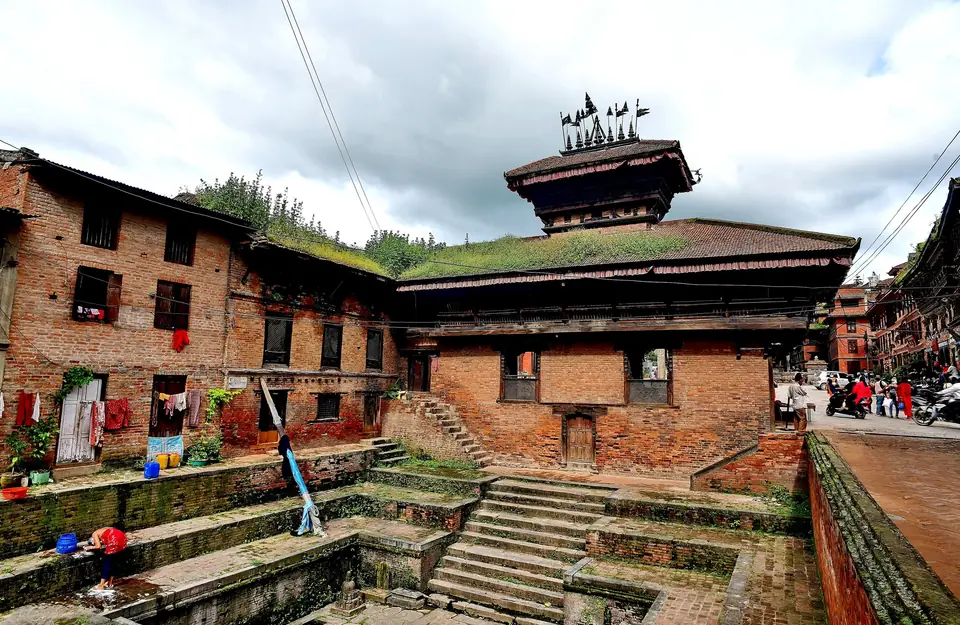
On the same Tachupal square, the Pujari Math was the house of the temple’s priests. To compare pagodas, the Nyatapola Temple is a walk away, and the Changu Narayan Temple sits on its hill on the outskirts of the city.
Tachupal, a square named after an inn
Dattatreya square
Summary of this stop
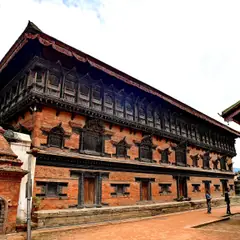
The tour starts on the west side of the square, facing the three-storey body of the old sattal: square plan, three stepped roofs and columned balconies on the upper floors. On the ground floor, the lattices fitted between the columns of the ambulatory betray the moment when the rest house was closed in to become a shrine.
The old name of the building was Tao Capala, “the great rest house”, and from it comes the name of the neighbourhood and of the square around it: Tachupal. The architecture of the Dattatreya Temple answers to that origin. Its plan measures 38 feet 8 inches a side, about 11.8 metres including the plinth, which juts out like a rim around the building. It is a third smaller than the Kasthamandap of Kathmandu, the model for this type of hostel.
Popular belief holds that the whole temple was built from the wood of a single tree, although architectural historiography considers it suspect and copied from the legend of the Kasthamandap. What this stop reveals is how an inn for ascetics still gives its name, centuries later, to an entire neighbourhood.
A Garuda with a monk’s face
Garuda pillar
Summary of this stop
In front of the facade rises a tall column with a kneeling metal Garuda, hands joined in greeting, looking toward the door. Beside it, two pillars resting on stone tortoises hold the conch and the chakra disc. They are the symbols of Vishnu, and they dominate the entrance of a temple dedicated to Dattatreya, the fusion of Brahma, Vishnu and Shiva.
The face of that Garuda is unusual for a divine bird. According to a neighbourhood belief, the column was originally meant to carry the statue of the monk Dev Narayana Giri, but the rule that a mortal cannot stand above a god prevailed and the figure ended up turned into a Garuda. That is why many neighbours call it the statue of the Mahant, the monk, rather than that of Garuda.
The pillar itself holds a clue about the passage from hostel to temple: its inscription says that the guru of the guru of Krpalagiri, a priest named on a bell of the Pujari Math dated 1763, was the first pujari of the temple. How that chain of teachers fits with the date of the conversion is one of the threads the narration untangles before the column.
Metal foreheads worn down by devotion
Golden door of the sanctum
Summary of this stop
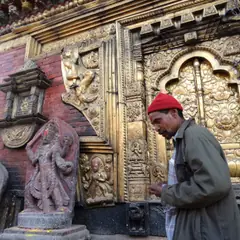
The two-storey porch attached to the west facade, topped by a half-dome with no function, was added in 1849 together with the golden door of the sanctum. Both were donated by the mahanta in memory of his guru’s guru, and the joint between the old plinth and the new one can still be seen. At the north end of the porch rests a large, heavily eroded stone slab: the founding inscription in Sanskrit and Newari signed by Yaksha Malla.
Above the door, a metal tympanum with Vishnu Vishvarupa gathers figures with worn foreheads. In 2019 most of them had pierced foreheads: devotees strike them and scrape off red powder and tika until the metal thins. The stone image inside, by contrast, cannot be touched, and the faithful look at it only from afar.
At dusk, around seven, this porch tends to fill with neighbourhood musicians. The temple has its own dapha group, the Dattatreya Navadapha, one of some sixty in Bhaktapur, which sings in two sides following a handwritten songbook. In that songbook is a song that the singers take to be a hymn to Ganesha and that is attributed to Ranajit Malla, the last king of Bhaktapur. What its lyrics actually say is one of the surprises the porch keeps for whoever listens right there.
The ascetics’ ladder and the Shivaratri bonfires
Carved struts and ladder
Summary of this stop
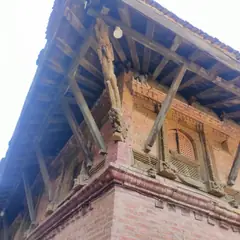
Walking round the temple along its east side, the carved struts appear under the first roof. Only some of them bear erotic scenes: 12 on the east side and 14 on the north. Also in view is a ladder that leaves the ambulatory, crosses the lower roof and reaches a hatch on the balcony of the second floor. It is the trace of the conversion: when the ground floor was walled in to make the sanctum, the inner access to the upper floors disappeared.
The old function as an inn has not been entirely lost. At Shivaratri, after venerating Pashupatinath, many yogis walk seven more miles to the temple and, naked and covered in ash, gather around bonfires in the adjoining square, as the ascetics who lodged in the sattal used to do.
The temple’s tradition adds an older story: this site is said to have been a pond with an island and a great tree, under which a famous guru died, and his disciples raised a shrine to him. That same legend credits them with the neighbouring monastery, the Pujari Math, and with a glance toward it the tour of the Dattatreya Temple closes.