Newar potters' quarter
Pottery Square Audio Guide
An open-air workshop where thousands of little lamps dry in the sun beside a Ganesh temple of 1646 that no king paid for, and where a centuries-old craft holds on with less and less clay, less firewood and fewer hands.
- 30 min of audio
- Living Newar pottery
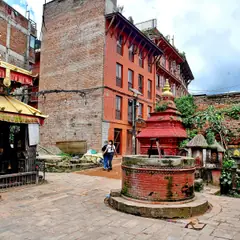
South of Durbar Square, the quarter the locals call Kumha Tole or Talakwoh, the potters' quarter, is the territory of the Prajapati guild. The ground is covered with lamps, flowerpots, piggy banks and vessels set out to dry; around them the wheels turn, the straw kilns smoke and rises the Jetha Ganesh, a two-roofed pagoda of 1646, the oldest firm date on the site.
What dries in this square is no longer the great jars for rice, liquor or water of old, but ritual pieces. The families once sold up to 400,000 little lamps in a single Tihar; in 2022 it was hard to place 20,000 against imported electric lights. And yet the elderly potters are still the ones who know where to dig the clay for the masks of the gods who dance through the city.
Highlights
- Drying ground — thousands of lamps and vessels in the sun in the middle of the square
- Jetha Ganesh temple — two-roofed pagoda of 1646 paid for by a private donor, not a king
- Carved struts — the eight mother goddesses and the eight Bhairavas together, a very rare combination in the valley
- Wheels and straw kilns — black Dyo Cha clay and firings of three to four days
- Armless Biska Jatra pole — the first to go up and the last to come down
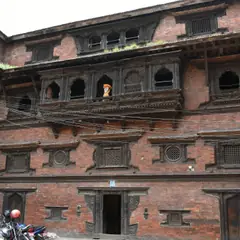
“Pottery Square” is a name given for visitors. For Bhaktapur, this corner south of Durbar Square is Kumha Tole or Talakwoh, the potters’ quarter, and its story is better told in clay than in stone. One travel guide gives it an origin in the 16th century, though without a primary source to back it up; what is dated is the Jetha Ganesh temple, from 1646, which presides over one corner of the square. Around it, the Prajapati guild works in plain sight: wheels mostly electric, traditional kilns smoking among piles of straw and firewood, and a central open ground where the pieces dry in the sun and nobody steps.
The story of Pottery Square is also that of a craft that holds on. In 2011, the guild’s association counted 226 potter families around Talakwa Tole, and only one in five still lived from ceramics. The 2015 earthquake, the pandemic and imported lights left their mark; an unexpected fashion, tea served in a clay cup, brought back part of the demand. The audio guide walks the square in four stops, in front of what it tells, with documented narration checked against historical sources.
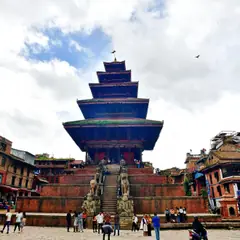
A walk away, the Nyatapola Temple dominates Taumadhi square, and Bhaktapur Durbar Square lies just to the north.
A floor carpeted with Tihar lamps
Pottery Square
Summary of this stop
From the edge of the drying ground, the square presents itself as what it is: an open-air workshop. Rows of palas, the clay lamps that light up Tihar, line up beside flowerpots, piggy banks and freshly thrown vessels, waiting for the sun to do its part before the kiln.
What is seen on the ground also tells what is missing. The big household vessels of old, the ghyampa for rice, the thyakafum for liquor or the gagri for water, have vanished from the repertoire; ritual pieces survive, such as the pala or the gapacha of funeral rites. And even those compete with what comes from outside: the families of the square once sold up to 400,000 lamps in a single Tihar, and in 2022 they struggled to sell 20,000 against the electric lights imported from India and China. What each of those palas means to the family that makes it is something the narration reveals right there, in front of the rows.
God’s clay and firewood from the rubble
Wheels and straw kilns
Summary of this stop
In front of the wheels, black clay spins and takes shape. The preferred kind is called Dyo Cha, “god’s clay”, and extracting it is anything but simple: it is dug once a year and requires digging more than three metres deep, a dangerous job. It used to arrive free from Sipadol, in Bhaktapur itself; today the extraction grounds lie under houses and other buildings, and the clay is bought by the minitruck, at 7,000 rupees each in 2022. It is often said that this black clay exists only in Bhaktapur, although the Nepali press documents deposits elsewhere in the valley.
Behind the wheels the straw kilns smoke. Traditional firing, with the pieces stacked between thick layers of straw, lasts three to four days, whereas a modern chimney kiln does it in about 12 hours. Years after the 2015 Gorkha earthquake, the potters were still firing and drying with wood salvaged from the rubble of collapsed houses.
The quarter also keeps a ritual role that few visitors know. According to a documented tradition, the masks of the Navadurga dances are made new every year, and before looking for the right clay the elders of the Prajapati caste are consulted on where to dig it. What happens next with that clay, and how it ends up turned into the faces of the gods, is discovered by listening to the narration beside the kilns.
A Ganesh of 1646 with no king behind it
Jetha Ganesh temple
Summary of this stop
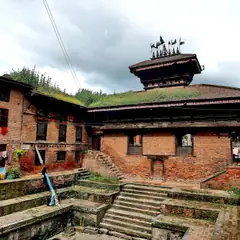
On the west corner of the square stands the Jetha Ganesh temple, a two-roofed pagoda of 1646. Unlike the royal temples around it, no king or prince erected it, but a rich donor; exactly who he was is disputed, because a local source speaks only of “a rich person” and a travel guide turns him into a potter. What is firm is that there was no crown behind it.
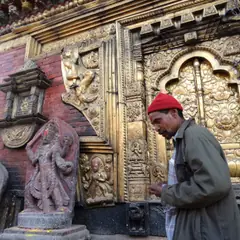
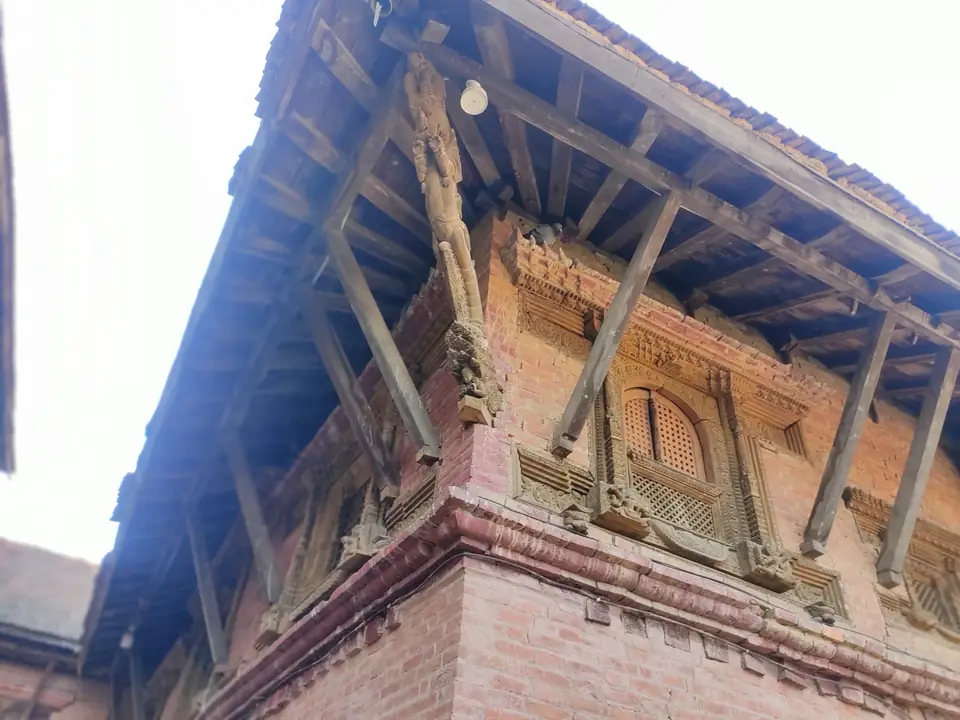
Under the eave, the wooden struts bring together the Astamatrika, the eight mother goddesses, and the Astabhairava, the eight Bhairavas, a very rare combination in the temples of the Kathmandu valley. According to tradition, the temple’s priest is chosen from within the Kumha clan, the Newar caste of potters: it is, in every sense, the guild’s temple.
Every Biska Jatra, the Prajapati community raises in the precinct, by day and on the last day of Chaitra, a Yosindyo, a ritual pole without arms; so it was done in April 2026. That same afternoon the city hoists its great pole, the famous one, but the potters’ one holds a surprise in its calendar that the narration reveals in front of the temple.
The potter who learned by watching
Patis beside the Jetha Ganesh
Summary of this stop
In the shade of the patis, the porticoes where neighbours sit to chat beside the Jetha Ganesh, what remains of the craft can be measured. In 2022 some 150 Prajapati households lived on the square, but barely 40 people were still practising the family trade; after the 2015 earthquake, the houses devoted to pottery fell from 20-25 to 10-15. The figures vary according to who gives them and the time of year, because Tihar is not like the rest of the calendar.
Among those who keep it going is Priya Laxmi Prajapati, who began working the clay when her husband fell ill and died, around the time of the 2015 earthquake. She learned by watching the men work and today she produces, sells on her own and teaches in schools.
The pandemic left another episode in the memory of the square: in November 2020, the floor that each Tihar is covered with little lamps was almost empty, and a veteran who turned the traditional wheel with a wooden stick for tourists ended up switching to the electric one. How clay went back to selling afterwards, through a turn nobody expected, is the ending the audio guide reserves for this corner.