Colonial cathedral
Cartagena Cathedral Audio Guide (Catedral Basílica Metropolitana de Santa Catalina de Alejandría)
Shelled by Drake, collapsed at night in 1600, disguised in marble in the 20th century and stripped bare again in 1973: Cartagena's coral-stone cathedral is not an intact temple but a survivor.
- 30 min of audio
- Herrerian architecture
The Cathedral of Saint Catherine of Alexandria is the third cathedral church of Cartagena de Indias. Philip II ordered it built after a bishop described the previous one as “a sad parish of Spain”, and the work, which most sources place between 1577 and 1612, followed the sober Herrerian model. Since 1953 it has been a minor basilica and it remains the seat of the archbishop.
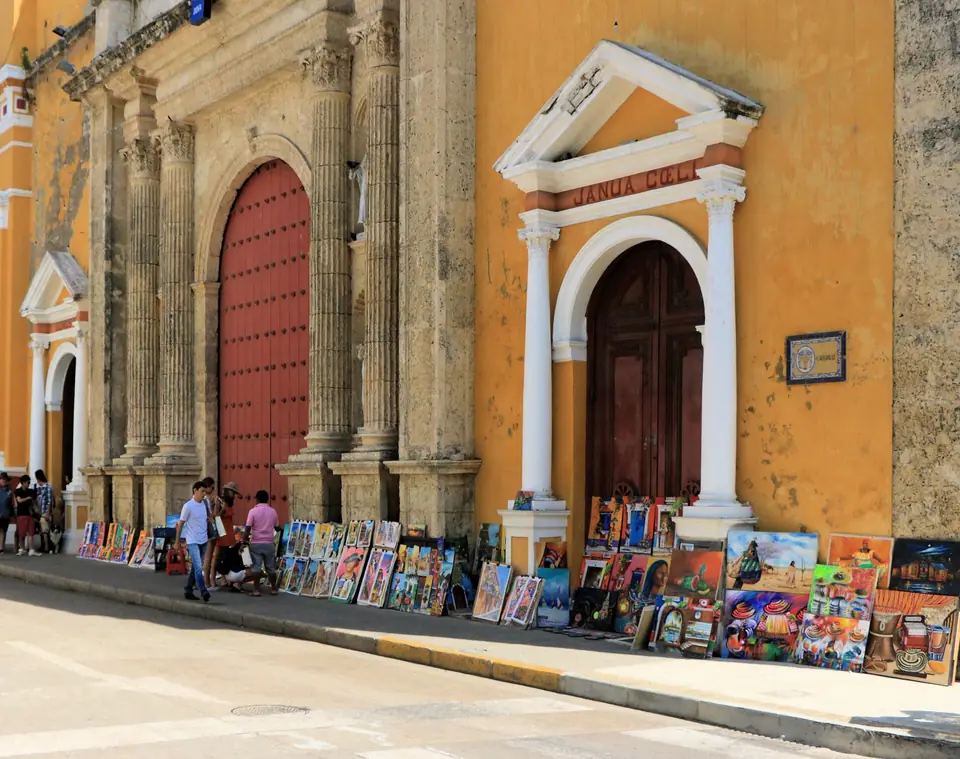
Its main facade does not face Parque de Bolívar but the narrow Calle de los Santos de Piedra, because in 1577 the townspeople voted not to turn the axis. And its tower, which looks colonial, is of 20th-century concrete and reinforced cement, the work of the French architect Gastón Lelarge.
Highlights
- Main doorway — four marble saints in the niches once held by stone ones
- Lelarge's tower — concrete and reinforced cement, topped with a dome and lantern
- Nave — seven pairs of Tuscan columns where the plan called for six
- Pair-and-knuckle roof — exposed since 1973 and rebuilt in 2014-2016
- Gilded high altarpiece — saved in 1943 from being replaced by marble
The story of the Cathedral of Saint Catherine of Alexandria begins with a temple of straw and reeds, built between 1535 and 1537, two years after the founding of Cartagena, in the block behind, facing Calle del Coliseo. The fire of 1552 left it in ruins. On 25 May 1575 the Dominican bishop Dionisio de los Santos wrote to the king that worship, served by two sacristy boys in undershirts and baggy breeches, was that of “a sad parish of Spain”, and Philip II ordered it rebuilt. The competition that year was won by the master builder Simón González; the start date of the works varies by source between 1575 and 1577, and the church was declared finished in 1612.
Between one date and the other fits almost everything that can happen to a building: Francis Drake’s cannon fire in 1586, a collapse at night in 1600, a 20th-century remodelling that covered the coral stone in stucco and false marble, and another in 1973 that left it bare again. How far what is seen today is colonial remains a matter of debate: some sources speak of a structure preserved almost intact and others lament what was lost in the 20th century, although they agree that the naves and columns survived. Pius XII granted it the title of minor basilica in 1953, and in 2025 it was a jubilee church of the Holy Year.
What to see at Cartagena Cathedral fits into five stops, from the doorway on Calle de los Santos de Piedra to the high altarpiece. The audio guide covers the history and architecture of the church in 30 minutes, documented and checked against historical sources, to read each porous stone as the mark of a fall.
A hundred metres away, the Palace of the Inquisition overlooks Plaza de Bolívar, and a few streets south the Sanctuary of San Pedro Claver holds another chapter of religious Cartagena.
A facade that turns its back on Parque de Bolívar
Cathedral of Saint Catherine of Alexandria
Summary of this stop
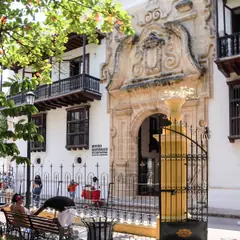
The cathedral stands beside Parque de Bolívar but does not face it: its main doorway opens onto the narrow Calle de los Santos de Piedra. It is no oversight. In 1577, with the foundations already under way, the councillor and captain Sebastián Pérez proposed turning the axis of the church 90 degrees and offered 200 pesos to buy the necessary houses; the townspeople voted to continue as begun, and the axis did not move.
The doorway, of two levels with paired Corinthian columns, a window and a triangular pediment, holds in its niches four marble statues: Saint Rose of Lima, Saint Catherine, Saint Sebastian and Saint Louis Bertrand. They replace the rough stone figures of Saint Peter, Saint Paul, Saint Gregory and Saint Sebastian that gave the street its name. One source attributes the change to Archbishop Pedro Adán Brioschi, who would have commissioned the new ones from the sculptor Mignone when Italy banned the export of some statues from Milan Cathedral; the restoration of 2000-2007 presents their addition as its own achievement.
Through this same door, every 16 July, after the solemn afternoon mass, leaves the procession of the Virgen del Carmen, patron of sailors, fishermen and members of the Navy, while in the bay the nautical procession sets sail towards the Stella Maris. The link between the cathedral and that marble image dates from 1958, and the narration tells it right there, in front of the facade.
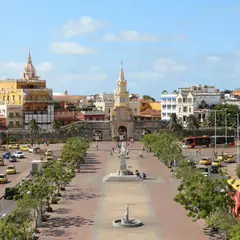
Plaza de la Proclamación and the 20th-century tower
Plaza de la Proclamación
Summary of this stop
The side facade, opening onto Plaza de la Proclamación, keeps the austere air of the church finished in 1612. High up, almost at the corner with Calle de los Santos de Piedra, there is a stone sundial; above the apse peek out small turrets like sentry boxes, with conical brick spires, which hold spiral staircases to the roof and the old flat roofs. That cathedral was finished thanks to the governor Diego Fernández de Velasco, the bishop fray Juan de Ladrada and the provisor Bernardino de Almansa, who often paid out of their own pockets.
It still lacked a tower, which Bishop Antonio Sanz Lozano (1661-1681) later raised: square and military in appearance. The one that now dominates the views of Cartagena, lit at night, is something else. Gastón Lelarge, a disciple of Charles Garnier, settled in the city in 1922 at the invitation of Archbishop Brioschi and transformed it into the present one, taller, of concrete and reinforced cement and topped with a dome and lantern. The exact date of that remodelling is not unanimous: one source places it in 1908.
The contrast between the sundial and the cement tower sums up the stop, and the narration explains what was military about the bell tower that Lelarge made disappear.
Seven pairs of columns and Drake’s shot
Columns of the Epistle aisle
Summary of this stop
The Epistle aisle is marked by smooth-shafted columns with Tuscan capitals, of ashlar drums on cubic pedestals, joined by semicircular arches. The plan called for six pairs; there are seven. Simón González saw mid-construction how little the stone could bear and added one more support per side.
In 1586, with the church almost finished, Francis Drake threatened to bring it down with cannon fire if the ransom was not paid. The first warning shot toppled a column that dragged down two others; four arches and part of the roof fell, mostly in this aisle. After six weeks of occupation, the city paid 110,000 ducats, and in 1591 the bishop fray Antonio de Hervías wrote to the king that the work was still unfinished and that it rained everywhere inside the church.
According to documented tradition, around then the master Benito de Morales passed through Cartagena on his way to Quito, examined the wounded cathedral at the governor’s request and recommended finishing it without changing the original plan. What he ruled about the foundations, and why the repair started so slowly, is heard among the very columns.
The pair-and-knuckle roof of the central nave
Roof of the central nave
Summary of this stop
The ceiling of the central nave is the latest version of a history of collapses. On the night of 7 August 1600, with the cathedral almost finished for the second time, the roofs of the main nave and of the Gospel aisle fell in under the weight of the flat roofs. The town council sued Simón González, who was cleared of charges, and the church was provisionally covered with straw.
In the 20th century the timber disappeared from view under a false vault, until in 1973 Archbishop Rubén Isaza Restrepo removed the premises attached to the church, took the stucco off the facades and walls and eliminated the vault, leaving exposed the coral stone and the pair-and-knuckle gabled roof, with circular skylights high in the walls.
A study of October 2014 found that of the 190 timbers of that roof only one was sound, eaten away by termites and damp. In January 2016 worship was suspended to restore the roof, the tower and the Sagrario Chapel, and the narration tells how the cathedral looked during that closure.
The high altarpiece that was to be marble
Gilded high altarpiece
Summary of this stop
In the late 18th century Bishop fray José Fernández Díaz de la Madrid, holder of the see between 1778 and 1792, brought the pulpit and the Italian marble pavement that remain in the nave. In the first half of the 20th century Archbishop Brioschi and Lelarge went much further: they wanted to make the cathedral a kind of Sistine Chapel, covered the interior in stucco, gave the coral stone the look of marble and commissioned the murals from the Venezuelan Miguel Ortiz, who had arrived in Cartagena as a bullfighter. Of that remodelling only the tower and the fourteen Stations of the Cross remain.
At the back, in the octagonal main chapel, gleams the altarpiece of carved and gilded wood, of uncertain author and date, believed to be from the 18th century. According to documented tradition, in 1943 the cleric Juan Semanati wanted to replace it with marble pieces, and a group of Cartagenans led by Gabriel Porras Troconis, president of the Academy of History, interceded with the archbishop for it to stay in place.
More than six decades later, that altarpiece of some 400 square metres of wood was about to collapse. Its restoration, which lasted six years, closes the route, and the narration tells who undertook it and why the gold of Cartagena came so close to becoming marble.