Colonial fortress
San Felipe Castle Audio Guide (Castillo de San Felipe de Barajas)
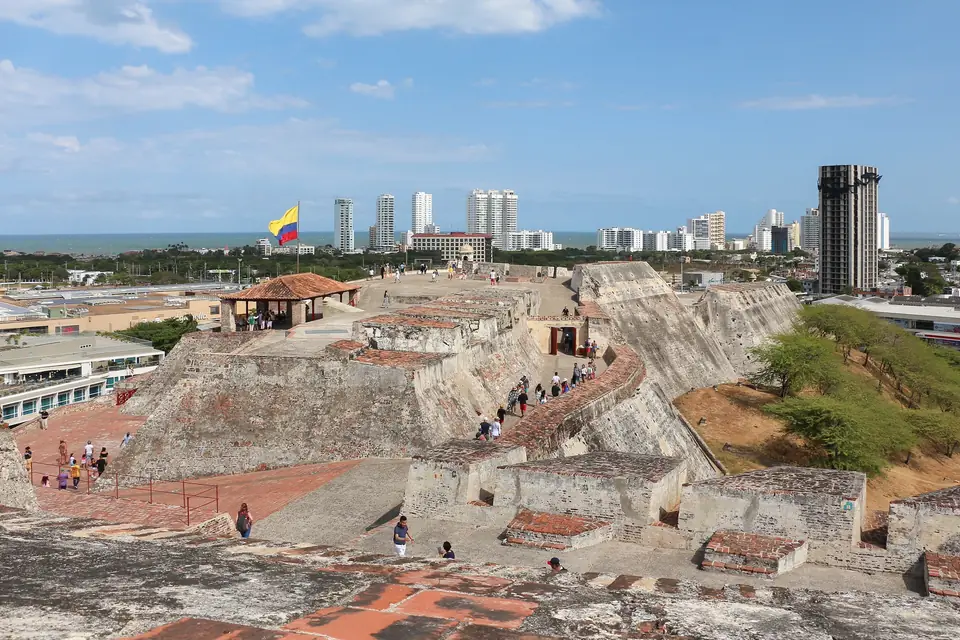
An entire hill turned into a stone trap: batteries that watch over each other, sloping walls built to deflect cannonballs and tunnels ready to blow up anyone who tried to climb. Here the British assault on Cartagena was stopped in April 1741.
- 90 min of audio
- Military architecture
The story of the Castillo de San Felipe de Barajas begins with a Royal Decree of 1647 ordering the hill of San Lázaro to be fortified. The first fort, finished in 1657 to plans by the Dutch engineer Ricardo Carr, was a small triangular “bonnet” on the summit. After the fall of Havana in 1762, Antonio de Arévalo wrapped it in seven stepped batteries that give it its present look.
Its layout, hugging the hill, did not follow European geometry, and in the late 18th century there were several plans to tear it down and build a new one. Cost and lack of funds saved it. Underneath, a network of about 600 metres of tunnels turned the whole hill into a weapon.
Highlights
- Statue of Blas de Lezo — surrounded by copies of the British medals that celebrated a victory that never came
- Ramps and sloping walls — the slope the grenadiers of Wentworth climbed on 20 April 1741
- Santa Bárbara battery — a platform designed to fall under the crossfire of La Cruz and La Redención
- Tunnels and sally port — about 600 metres of galleries with hammer-shaped branches for loading gunpowder
- Bonnet and Plaza de Armas — the triangular fortlet of 1657, at the highest point of the hill
The Castillo de San Felipe de Barajas is not a building on a hill: it is the whole hill of San Lázaro, clad in stone. A Royal Decree of 20 September 1647 ordered it fortified, and on 12 October 1657 a first fort was completed to plans by the Dutch engineer Ricardo Carr: a triangular bonnet with four sentry boxes, a cistern, a storehouse, quarters for 20 soldiers and four gunners, and 15 cannon. The sources disagree on the date of origin: some versions push it back to 1536 or 1639, although the institutional documentation on the fortifications keeps to the decree of 1647 and the completion of 1657.
The name joins King Philip IV, who reigned when work began, with the title of Count of Barajas, whose last holder was the father of the governor Pedro Zapata de Mendoza. The hill, for its part, is called San Lázaro, the saint of lepers, after the leprosarium built nearby in 1615 and later moved to Caño de Loro, on the island of Tierrabomba. And although everyone calls it a castle, its official name is Fuerte de San Felipe de Barajas, and some historians prefer to speak of a fortified hill.
What to see at San Felipe Castle is, above all, a way of reading stone: ramps in full sun, sloping walls, stepped batteries, low-roofed tunnels and, at the top, the city and the bay. At the foot of the hill wait the Botas Viejas, bronze shoes in tribute to the poet Luis Carlos López, installed in 1994; in July 2026 the city council announced their move to the new access roundabout at the Media Luna. The audio guide covers the site in 90 minutes, documented and checked against historical sources, from the statue of Blas de Lezo to the Plaza de Armas.
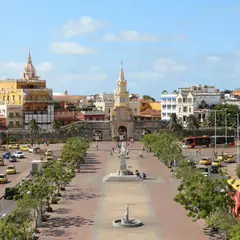
From the hill, the way back to the city crosses the Getsemaní quarter, and the other side of the defence, the work that closed the walled enclosure, is at Las Bóvedas.
The statue that laughs at some medals
Statue of Blas de Lezo
Summary of this stop
In front of the fortress stands the bronze of Blas de Lezo, cast in Madrid in 1956: wooden leg, sword raised and a stone pedestal bearing the shield of Cartagena. On the sides of the pedestal appear copies of some very particular medals. In Great Britain up to eleven different types were struck in 1741 to celebrate the capture of Cartagena in advance, and one of them shows Lezo, with both legs, kneeling before Admiral Edward Vernon and handing over his sword. A plaque on the ground explains the story.
The statue also had its night of glory. In 1968, with Carlos Lleras Restrepo as president, a Light and Sound show donated by Philips Colombiana opened at the fort: 12 loudspeaker towers, 1,236 spotlights and 18,000 metres of cable, with music by the Briton Ted Astley and a script by Emile de Harven based on research by the historian Eduardo Lemaitre. The show began by lighting up Lezo.
In 1971 the Light and Sound excursions left in as many as three minibuses full of tourists, and even so the show was lost. What turned it off was not a lack of audience, and the reason, rather unexpected, is told in front of the pedestal.
Three metres of ladder that were missing
Access ramps and sloping walls
Summary of this stop
Stone ramps climb between the levels of the hill, always under the cover of the batteries above, and the walls flanking them are wide at the base and narrow towards the parapet, sloped to deflect shots. The British column climbed a slope like this on 20 April 1741. The assault, led by General Thomas Wentworth, began at 4:00 in the early morning and not in the dead of night, and two Spanish deserters acting as guides led the grenadiers away from the lower-walled south side towards a slope swept by musket fire. At 8:00 Wentworth ordered the retreat.
Before the attack, Blas de Lezo had a moat dug around the wall, and the British ladders turned out to be some 3 metres too short to clear moat and wall. They were carried by unarmed North American colonial soldiers, and most dropped them to take cover. Of some 3,600 North American volunteers about 300 came back; among them was Lawrence Washington, who renamed his Virginia plantation Mount Vernon in the admiral’s honour.
Why the assault failed is still a matter of debate: the Spanish version stresses the moat and a bayonet charge; the British one, the delay of the attack and the deserter guides. Nor do casualty figures agree, which some sources put at around 600 of some 2,000 men and others raise to 1,500. And Cartagena’s memory has made Lezo the hero, although the commander of the place was the viceroy Sebastián de Eslava, with whom he clashed during and after the siege; Lezo died on 7 September 1741 without reward. That slope, climbed on foot, helps to understand both versions.
A battery built to fall
Santa Bárbara battery
Summary of this stop
After England took Havana in 1762, the engineer Antonio de Arévalo was ordered to reinforce the castle. Between 1762 and 1769 he raised seven stepped batteries adapted to the terrain: San Lázaro, Santa Bárbara, La Redención, the Hornabeque, La Cruz, San Carlos and Los Apóstoles. The result is not a closed box but a succession of platforms that cover and punish one another. How many cannon the complex came to hold depends on the source: 63, 66 or 68.
The Santa Bárbara battery, in the northeast sector with seven cannon, faces the hill of La Popa and was designed as a trap: if the enemy took it, it would be under the crossfire of La Cruz and La Redención. That irregular layout seemed so foreign to classical European geometry that in the late 18th century there were several plans to demolish everything and build a new San Felipe; cost and lack of funds prevented it, and the works were declared finished in 1798.
From here you can see the heights where, in November 1815, during the 105-day siege that General Pablo Morillo laid on pro-independence Cartagena, the battle for the Candelaria monastery was fought. According to documented tradition, the castle’s cannon supported the patriots at the most critical moment. The paradox of that episode, and how the siege ended, is told while looking towards La Popa.
The hill that could explode
Tunnels and sally port
Summary of this stop
Beneath the batteries, the hill is crisscrossed by a network of tunnels of about 600 metres. A Galería Magistral at sea level runs along the inner perimeter, and from it branches lead outwards, ending in a hammer shape, where barrels of gunpowder were loaded to blow up assault troops. Only part of the network is open to the public: low-roofed galleries with casemates.
The sally port is the cleverest tunnel. It climbs steeply from the second-level ramp to the Plaza de Armas, so that an enemy coming down from above could not see the other end, while riflemen posted below could see his movements. There is also a belief that some tunnel reaches the cathedral of Saint Catherine of Alexandria or even Bocachica, something local historiography denies. Legend also has it that the blood of animals and people was used in the mortar of some walls.
When it lost its military use, the fort was left covered in vegetation, with earth in its tunnels and moats. Carlos Crismatt Esquivia, a self-taught Cartagenero born in 1889, drove its recovery by anastylosis from the early 20th century, putting loose stones back in place, and saved it from demolition. How this buried network was emptied by hand is discovered by walking through it.
The bonnet, origin and flagpole
Bonnet and Plaza de Armas
Summary of this stop
At the summit, the highest point of the complex, the core of 1657 survives: the bonnet, so called for its resemblance to a bishop’s cap, with its stone sentry boxes at the corners and the esplanade of the Plaza de Armas. Everything else grew from this triangular fortlet. In 1697 it fell to the French expedition of Baron de Pointis, Jean-Bernard Desjeans, and the engineer Juan de Herrera y Sotomayor later repaired the damage by reinforcing it without changing its original design.
The fortress built to defend the Cartagena of the King of Spain is today the place where the city celebrates its own history. Every 1 June, the anniversary of the founding of Cartagena, the cuadrilonga is raised here at dawn, as Cartagenans call their flag: three concentric red, yellow and green stripes with an eight-pointed star. The ceremony is organised by the Escuela Taller Cartagena de Indias, which manages the fortifications, and is presided over by the mayor; in 2026, for the city’s 493 years, it began at 6:00.
The castle is also still a stage for affairs of state: it hosted the welcome dinner of the VI Summit of the Americas in 2012 and events of the Non-Aligned Movement in 1995 and the Rio Group in 2000. The route ends at the top, with Cartagena and the bay at the foot of the bonnet.