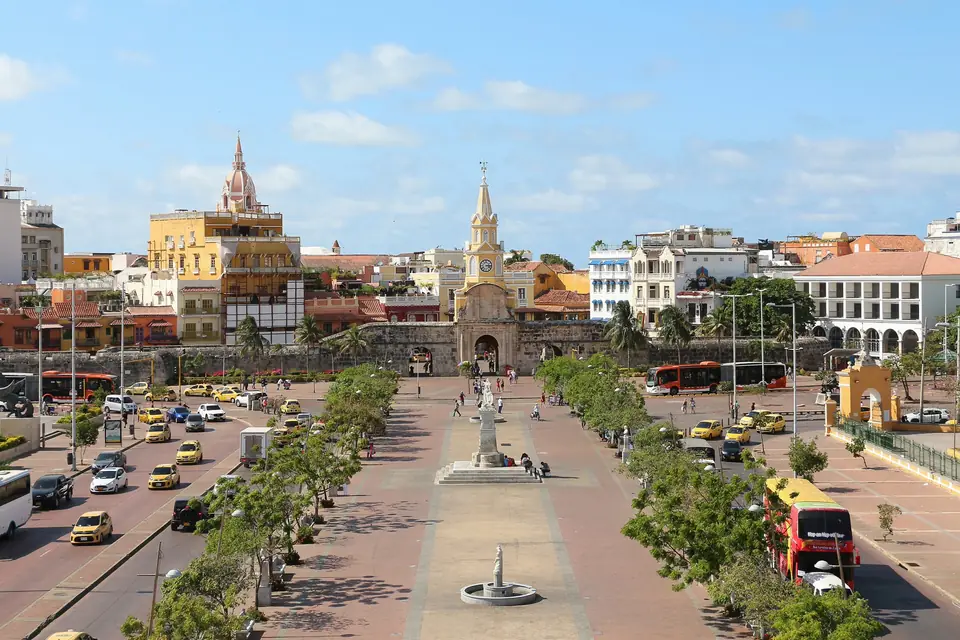
City wall gate
Clock Tower Audio Guide (Torre del Reloj)
Cartagena's most famous postcard is really a gate of war: it was born over a channel with a drawbridge, held weapons and prisoners in its vaults and only in 1888 received the tower that now tells the city's time.
- 20 min of audio
- Military architecture
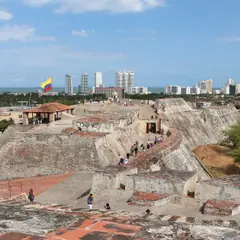
La Boca del Puente was built from 1601 to link the Getsemaní quarter with the city, and when the walls were closed in 1631 it became the main gate of Cartagena de Indias. After Baron de Pointis's assault in 1697, the military engineer Juan de Herrera y Sotomayor largely rebuilt it in the early 18th century. In 1888 the Cartagena architect Luis Felipe Jaspe Franco crowned it with two octagonal levels and a spire that raised the whole to 30 metres.
Where there is now a square and an avenue ran the San Anastasio channel, with boats mooring at the foot of the gate. And the clock that turned this military gateway into an emblem still depends on a pair of hands: in 2019, one man had been climbing up every morning for 25 years to wind it.
Highlights
- Central arch by Herrera y Sotomayor — the only original opening, with Tuscan columns and a triglyph frieze
- Octagonal tower by Luis Jaspe — two levels with a spire and neo-Gothic details that raise the whole to 30 m
- Side openings — former bombproof vaults that served as armoury, chapel, store and jail
- Camellón de los Mártires — the busts of the nine patriots shot in front of the gate in 1816
- Plaza de los Coches — the former slave square, with a plaque from UNESCO's Slave Route
The story of the Clock Tower begins long before its clock. From 1601 the Boca del Puente was built here, the link between the Getsemaní quarter and the city, and when the walls were completed in 1631 it became the main gate of Cartagena de Indias. By day it was the obligatory passage for everything entering the enclosure; at sundown, it was shut. In 1697 Baron de Pointis’s assault left it partly destroyed, and the gateway seen today is largely the reconstruction by the military engineer Juan de Herrera y Sotomayor, with works documented from 1704; the sources do not agree on exactly when that work began and ended.
What made it a postcard came in the 19th century. In 1874 a two-faced clock brought from the United States was installed in what was then a square tower, and in 1888, under governor José Manuel Goenaga, the Cartagena architect Luis Felipe Jaspe Franco replaced that tower with the present one, of two octagonal levels with a spire and Gothic elements. Most sources fix the work in that year, although one profile of Jaspe places it between 1876 and 1888. Nor is there agreement on the origin of the name Puerta del Reloj: some attribute it to a clock that would already have crowned the gate in the early 18th century, against the sources that place the first one in 1874.
What to see at the Clock Tower fits into a short, dense route: from the outer promenade to the central arch, from the side vaults to the square inside the walls and, at the end, the clock face. The audio guide covers it in 20 minutes, documented and checked against historical sources, to read the gate as what it was: a place of war, of punishment and of passage.
On the other side of the gate begins Getsemaní, the quarter that the Boca del Puente linked with the city; a few streets away, the Sanctuary of San Pedro Claver completes the memory of the slave trade, and the wall ends to the north at Las Bóvedas.
Nine posts in front of the gate
Camellón de los Mártires
Summary of this stop
The route starts at the beginning of the Camellón de los Mártires, from where the architecture of the Clock Tower can be read at a glance: below, the military gate, low and massive; above, Jaspe’s octagonal tower, which raises the whole to 30 metres. They are two eras layered together, that of the defence of the 17th and 18th centuries and that of the 19th-century republican city that wanted an emblem.
This front also has a grim date. On 24 February 1816, after Pablo Morillo’s siege, nine patriots condemned by a court martial were shot at wooden posts in front of the Clock Tower, then in ruins. Among them were Manuel del Castillo and José María García de Toledo; Manuel Anguiano was executed with his back turned, as a traitor.
Their busts now stand on the Camellón de los Mártires, a few steps from where they fell. Who designed them, and what link he has with the tower rising opposite, is one of the details the narration keeps for this point.
A drawbridge over vanished water
Central arch by Herrera y Sotomayor
Summary of this stop
In front of the central arch, what is now solid ground was water. Here ran the San Anastasio channel, which separated the island of Getsemaní from that of Calamarí, and over it stretched the drawbridge that gave the Boca del Puente its name: in an enemy attack it was raised to cut the way to pirates and buccaneers, while the bastions of San Pedro Apóstol and San Juan Bautista covered the gate. A 1910 photograph from the Fototeca Histórica de Cartagena still shows boats mooring at its foot; another, from before 1950, shows the train passing right in front of the tower.
The arch is the one from Herrera y Sotomayor’s reconstruction after the sack by Pointis, and it repeats the scheme of the church of the convent of San Francisco de Santo Domingo: a round Roman arch, two pairs of Tuscan columns at the sides and an entablature with a triglyph frieze. Of the three openings crossed today, this is the only original one.
In 1735 the scientific naval officers Jorge Juan and Antonio de Ulloa passed through and noted that the city was linked to the mainland by three wooden bridges, each tied to one of the old gates and watched by sentries day and night. One was a drawbridge, another fixed and the third, swinging; how that vanished landscape fits with today’s asphalt is told in front of the arch.
Weapons, chapel and jail under the tower
Side openings and Balmaceda gate
Summary of this stop
The two side passages that almost everyone crosses today were not passages. They were bombproof vaults that housed an armoury and a chapel, as well as provisions and munitions. The one now called the Balmaceda opening, opened in 1905, had been a store and jail, and before that the Chapel of Los Dolores; it owes its name to Francisco Balmaceda, a Cuban exile living in Cartagena who donated the vault.
The chronology of these openings is not as clean as it seems. Some sources give 1803 for one of the openings and 1905 for the other, others attribute both to Jaspe’s time, and not even the donor’s full name matches between texts. The narration sorts out those versions without treating any as settled.
Under the tower, where carts once passed, today one crosses only on foot. So much so that on 29 August 2023 a taxi driver who drove through beneath the tower became a viral scandal and ended up apologising publicly to the city council.
The former slave square
Plaza de los Coches
Summary of this stop
On the other side of the gate, now inside the walls, opens the Plaza de los Coches. The Boca del Puente was the obligatory passage for everything entering the city, including the enslaved African population, and this square, once called the slave square, was the epicentre of their sale. On the tower there is a plaque from the project “Cartagena as a site of Afro-descendant memory and awareness”, one of 19 spread around the city, Colombia’s contribution to UNESCO’s Slave Route.
It is a chapter often told in broad strokes. The story that the walls were raised “with the blood of the enslaved” coexists with research from the Slave Route, which confirms a significant enslaved participation, but alongside other populations, and with more enslaved people in the material kilns than on the works themselves.
The square also carries a long list of names. Officially it is the Plaza del Ecuador, after the boundary treaty between Colombia and Ecuador, but Cartagenans, out of old habit, still call it Los Coches. It was previously the Plaza del Juez, of the Merchants and of the Yerba, and it was also known as the Plaza del Rollo, of the Black Women and of the Clock; the pillory where offenders were displayed stood there. A plaque in the square itself records that succession, and the narration explains what each name says about the place.
An hour set by hand
Clock faces
Summary of this stop
The closing stop looks up, at the clock faces. The first clock, the American one of 1874, had a face turned towards the Plaza de los Coches; 63 years later it was replaced by the Swiss clock that tells the time today. Its tower is the work of Luis Jaspe, who also made the busts of the Camellón de los Mártires (1911) and the Teatro Heredia. When he died, on 13 May 1918, the departmental government decreed three days of mourning.
The mechanism does not move by itself. As Mariano Magallanes told it in 2019, he had been climbing up every morning at 9:00 for 25 years to wind it with his own hands and give it “its little drop of oil”. In 2021 the foundation Grupo Conservar took 20 days to adjust its 300 parts, replace the cables and preserve the bells, and at the end of January 2024 the hands stood still for several days because of technical problems.
That same year the city council contracted the mechanical maintenance of the Reloj Público for 68,715,931 pesos, led by the restorer Salim Osta, while the Escuela Taller Cartagena de Indias cleaned the walls and the wooden lattices of the facade. The route ends here, before the paradox of a gate of war whose time still depends on a pair of hands.