Afro-descendant memory site
Sanctuary of San Pedro Claver Audio Guide (Santuario de San Pedro Claver)
A Jesuit college set against the wall and the quay where slave ships docked, and beneath its altar, behind glass, the bones of the man who signed for three decades as “the slave of the Black people forever”.
- 45 min of audio
- Jesuit church and cloister
The Jesuits arrived in Cartagena in 1604 and built their college beside the port, the arrival point for galleons and for slave ships from Africa. Pedro Claver lived and died there, born in Verdú in 1580 and canonised by Leo XIII in 1888. Since 1950 the old cloister has been a museum, and today it presents itself as an Afro-descendant Memory Site.
The building clashed with the walls: the king ordered it demolished and the dispute between clergy and military engineers lasted more than thirty years. It was a hospital, a barracks and a church again, and the dome that now dominates the square is not colonial but from 1921, with an inner mesh that catches fragments of its iron, rusted by sea salt.
Highlights
- Urn of San Pedro Claver — gilded bronze and glass, a gift from Leo XIII, with his bones and skull on view
- Gastón Lelarge's dome — from 1921, with Claver's signature in Latin running around its interior
- Claver's quarters — the window onto the port, the mat of the enslaved and the infirmary where he died in 1654
- Cloister courtyard — three levels of stone arches around the cistern
- Upper choir — a 19th-century organ under the dome, reached from the museum
The story of the Sanctuary of San Pedro Claver begins in 1604, when the Jesuits arrived in Cartagena at the townspeople’s request to found a college. The authorities granted them a plot near the port, and that proximity explains almost everything: at that quay came in the galleons and also the slave ships from Africa. Pedro Claver, born in Verdú (Catalonia) in 1580 and ordained a priest in Cartagena in 1616, spent most of his life here going down into the holds of those ships, and here he died in 1654, paralysed and forgotten in his cell.
The chronology of the church is one of the confusing points: some guides have it built between 1580 and 1654, even before the Jesuits’ arrival, while a study by the Instituto Carlos Arbeláez Camacho places it half a century after the cloister. What is not disputed is the succession of uses: college, San Juan de Dios hospital after the expulsion of 1767, barracks from 1861, church recovered and, since 1950, museum. Its saint is not a comfortable one either: the figure of the “slave of the slaves” coexists with the enslaved interpreters the college bought, a debate that remains open.
What to see at the Sanctuary of San Pedro Claver fits into five points, from the square to the urn at the high altar. The audio guide covers them in 45 minutes, documented and checked against historical sources, to read the building as what it is: a memorial to Cartagena’s slave port a few metres from where the ships docked.
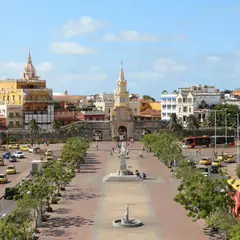
Very close are the Palace of the Inquisition and Cartagena Cathedral, and the Clock Tower rises beside the former slave square.
The square, the wall and the September procession
Plaza de San Pedro Claver
Summary of this stop
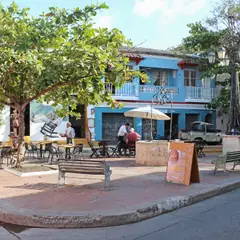
The facade faces Plaza San Pedro Claver: sober, of coral stone largely brought from the island of Tierra Bomba, with two square towers flanking a single portal. In the square wait the metal figures by Edgardo Carmona, representing everyday trades, and a little further south the bronze by Enrique Grau of Claver beside an enslaved African.
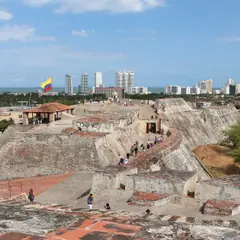
Behind it peeks out the wall, and with it a lawsuit. The college was first built over the line of defence, the king ordered it demolished for the risk to the defence, and clergy and the Crown’s military engineers litigated for more than thirty years. The solution was as practical as it was unusual: build a second stretch of wall in front of the first.
The square also has a living ritual. Every 9 September, the saint’s feast day and National Human Rights Day, Cartagena walks to this door with the image of San Pedro Claver, school bands and slogans for peace. How a 17th-century Jesuit became the emblem of that cause is told in front of the facade.
The cloister of four lives
Cloister courtyard with cistern
Summary of this stop
The cloister courtyard opens in three levels of stone arches, with trees and palms that reach the upper gallery; at the back, the cistern lets you see the building’s different levels at a glance. It is the heart of the old Jesuit college and the place where its layers are best read.
With the expulsion of the Jesuits from the Spanish dominions in 1767, the college became a hospital run by the Hospitaller Brothers of San Juan de Dios. In 1861 Tomás Cipriano de Mosquera evicted the religious and the complex, church included, became an army barracks; in 1884 Bishop Eugenio Biffi recovered it for the Church and the Jesuits returned in 1896. Some sources tell this period with other orders and other dates.
Since 1950 the cloister has housed the Museo Santuario San Pedro Claver, with pre-Columbian pieces, religious art and a collection donated by the Zapata Olivella family. Today it presents itself as an Afro-descendant Memory Site, with a room devoted to African legacy in the Colombian Caribbean, and the narration explains what that change of name means in this particular building.
The cell facing the slave ships
San Pedro Claver's quarters
Summary of this stop
On the second floor Claver’s quarters are preserved: period furniture, the mat where the enslaved slept and the window through which the ships could be seen arriving. When one was announced, Claver went down to the port with interpreters and a basket of plantains, oranges, lemons, bread, wine and tobacco, and descended into the bilge, where between 300 and 400 Africans had spent 40 to 50 days of crossing. Many arrived convinced they were being brought to be eaten.
Among his belongings is displayed the cloak, which according to the testimonies of the beatification process was his working tool: with it he wrapped dying new arrivals to carry them to a hospital, and during the smallpox epidemic of 1633 and 1634 it served as clothing, pillow and bed. His interpreter Andrés Sacabuche said that some days he had to wash it up to seven times. Those interpreters, among them Domingo Folupo, José Monzola and Ignacio Soso, were slaves bought by the college, and their use for other tasks prompted two letters of protest from Father General Vitelleschi.
The end came a few steps away, in the adjoining infirmary. Paralysed since 1650, Claver spent four years confined, forgotten and mistreated by the former slave the superior had hired to look after him. He died on 8 September 1654, and what the crowd did with his body that day is told in the cell.
Slave of the Black people forever
Upper choir with organ
Summary of this stop
From the museum’s third floor one reaches the upper gallery and the choir of the church, with a 19th-century organ and a stained-glass window above the main entrance. From here the dome and the Latin phrase running around it can be seen up close: “Petrus Claver, aethiopum semper servus”. It is the formula with which he signed on 3 April 1622, when making his solemn vows, and the one he used as a signature for three decades.
He took it to the confessional too, which he reserved for Black slaves: the gentlemen of Cartagena had to wait behind them, and to the ladies he said his confessional was too narrow for the guardainfantes, the bulky skirt in fashion in the 17th century.
The dome, however, is not colonial. In 1921, according to most sources, the old half-orange dome was removed and the French architect Gastón Lelarge raised the present one, now an icon of the city. Climate and sea salt rusted its iron despite a restoration in 1996, and in 2014 the parish installed a mesh on its inner face because it was shedding fragments; what that reveals about the building is heard under the dome itself.
The urn Cartagena would not leave in peace
Urn of San Pedro Claver
Summary of this stop
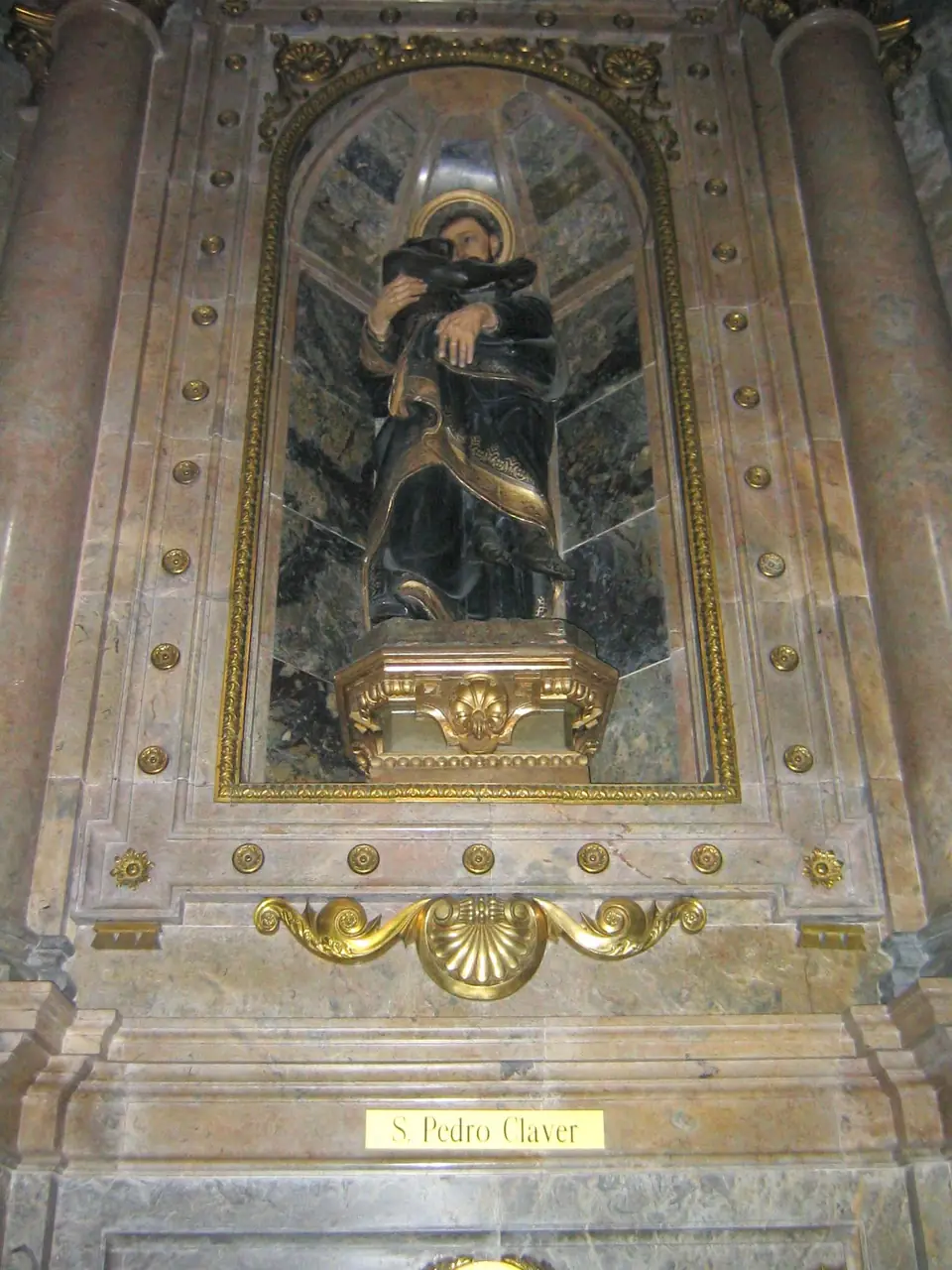
In front of the high altar, of marble brought from Italy by Bishop Eugenio Biffi, the gilded bronze and glass urn given by Leo XIII holds the remains of San Pedro Claver, right below the inscription on the dome; behind it, a stained-glass window. What is seen behind the glass is not an incorrupt body but his bones, with the skull in view. The same pope canonised him on 15 January 1888.
According to documented tradition, that body changed place more than once: first it was buried with honours in the chapel of the Cristo de la Expiración, the pilgrimage of the faithful turned that corner into a hive of activity and two years later it was moved to a niche in the wall. In 2022 the church dedicated a new two-storey mausoleum behind its resting place. The figure of some 300,000 baptisms that usually accompanies his name comes from the beatification process, and some historians consider it symbolic and exaggerated.
Law 95 of 1985 declared 9 September National Human Rights Day and Cartagena its seat. Before this tomb prayed John Paul II in 1986 and Francis, who prayed the Angelus here in 2017. The route closes at this point, with the question of why the saint tied to the memory of the slave trade remains, for the city, the saint of human rights.