Historic quarter
Getsemaní Audio Guide
The walled suburb of blacksmiths, shipwrights and freedmen that in 1811 pushed Cartagena towards absolute independence, and which today, among murals and a convent turned hotel, fights not to be left without residents.
- 60 min of audio
- Independence of 1811
Getsemaní was born outside the wall: in 1595 Bautista Antonelli's fortification plan left it on the other side, when it barely held the convent of San Francisco and the slaughterhouse. From 1631 the governor Francisco de Murga ringed it with bastions and its Puerta de la Media Luna became the only land entrance to the whole city. In 1777 a little over 4,000 people lived here, about 30% of Cartagena, almost all of them artisans.
From its workshops came Pedro Romero, the mulatto blacksmith who on 11 November 1811 marched armed with the Lanceros de Getsemaní to pressure the junta that declared independence. No reliable portrait of the national hero survives: the old bust in Plaza de la Trinidad actually bore the face of the painter Alejandro Obregón.
Highlights
- Plaza de la Trinidad: Nora Quintana's monument to Pedro Romero, fist raised, before the church finished in 1643
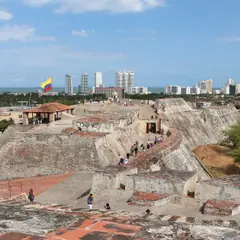
- El Reducto bastion: the only stretch of wall still at the water's edge, with a view of San Felipe Castle
- Former convent of San Francisco: about 940 skeletons buried between the 16th and 19th centuries under chapels and atriums
- Calle de la Media Luna: the site of the city's only land gate, forced in the French assault of 1697
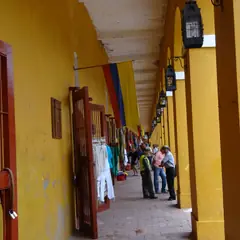
- Callejón Angosto: Cartagena's first street covered with colourful umbrellas, among graffiti
Getsemaní is usually presented as the quarter of murals, bunting and umbrella-covered alleys, but its history begins with a rejection. In 1595 the engineer Bautista Antonelli drew up Cartagena’s fortification plan and left the suburb out, which then held only the convent of San Francisco and the slaughterhouse. Some local guides place its birth in 1555, with the arrival of the Franciscans; what is documented is that settlement and walling came in the following decades, from 1631.
Since then Getsemaní has taken the blows of the city: it was the gate through which one entered from the mainland, the quarter of trades that kept the city standing and the one that in 1811 took to the streets armed. Today the challenge is different: according to the census of the Junta de Acción Comunal and the IPREG of the Universidad de Cartagena, native raizales have fallen from 5,378 in 2005 to 448 in 2025. The history of Getsemaní, its architecture and what to see in its streets can be covered on foot in 60 minutes, from the old convent to Plaza de la Trinidad, with the audio guide playing at each stop.
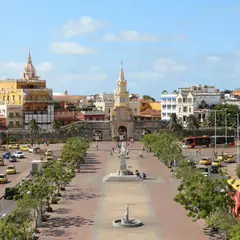
From the quarter, San Felipe Castle lies about 650 metres to the east, the Clock Tower opens the walled city and the Act of Independence of 1811 is kept in the Palace of the Inquisition.
An empty suburb and a luxury cemetery
Church of the Third Order
Summary of this stop
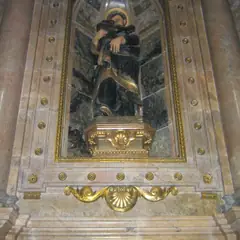
The route starts in the atrium of the church of the Third Order, still in use beside what remains of the old convent of San Francisco, now part of a hotel. It is the logical starting point: when Antonelli drew his walls, this convent and the slaughterhouse were almost all there was in the suburb, and the engineer left it on the other side of the defence.
Under those chapels and atriums, however, hundreds of Cartagenans lay. Excavations at the convent, with the participation of the archaeologist Mónika Therrien, the Fundación Erigaie and the Universidad del Norte, brought to light about 940 skeletons buried between the 16th and 19th centuries. Being buried here was not cheap: it cost the equivalent of 141 days’ wages, double that of the Cathedral. Why a convent on the outskirts cost more than the main church is one of the questions the narration answers right there.
The gate through which the sack came
Heredia Bridge
Summary of this stop
At the start of Heredia Bridge, Calle de la Media Luna keeps only a name. Here stood the Puerta and the ravelin of the Media Luna: since Francisco de Murga ringed Getsemaní with bastions from 1631, it was the only land entrance to the whole of Cartagena, a funnel through which anyone arriving from the mainland passed.
Attackers passed too. In April 1697, during the attack by Baron de Pointis and Jean Baptiste Ducasse, the gate was forced and the island of Getsemaní occupied; the governor Diego de los Ríos capitulated and the city suffered a month of plunder. At this point the stop works with an absence: what is heard is the city that came and went through a gap that no longer exists.
The last wall beside the sea
El Reducto bastion
Summary of this stop
The El Reducto bastion, next to that of San Miguel de Chambacú, is the preserved stretch of Getsemaní’s wall and the only one in the whole enclosure that still stands at the water’s edge as planned. From here San Felipe Castle can be seen, and one understands at a glance how the defence worked.
That landscape is the exception. Law 21 of 1883 authorised demolishing the fortified bridge and the ravelin of the Media Luna to build the Heredia Bridge causeway; in 1893 the bastions of San Antonio, Santa Teresa and Santa Bárbara fell, and in the early 20th century the Arsenal’s defences made way for public market galleries. What the city lost in those decades is best measured from the one stone that stayed in place.
The blacksmith before the national hero
Callejón Angosto
Summary of this stop
The entrance to Callejón Angosto, the first street in Cartagena covered with colourful umbrellas, serves to put a neighbour’s face on the quarter. The census of 1777 counted here a little over 4,000 inhabitants, about 30% of the city’s population, mostly masons, blacksmiths, shipwrights, barbers and fishermen. Among them, Pedro Romero: a mulatto blacksmith, master of the La Maestranza workshop in the Arsenal, able to arm a cannon, cast a bell and rig a ship.
For a long time he was thought to be Cuban, a native of Matanzas, and that explained his nickname “el matancero”. A letter of 6 August 1810, kept in the Archivo General de la Marina “Álvaro Bazán”, records in his own hand that he was “a native of Cartagena de Indias”, and the historian Sergio Paolo Solano Aguas concluded in 2016 that he was a Cartagenan. The nickname would have another origin: during a meat shortage, the local government tasked him with taking stock of which families raised pigs in their yards, the animals were seized and the neighbours began calling him that.
The memory of the quarter, however, sings something else. “El Getsemanicense”, the son pregón by Lucho Pérez that the Sonora Dinamita recorded in 1971, is Getsemaní’s anthem: it names this very alley and the composer’s fighting companions by their real nicknames, and in its last verse still speaks of “a glorious Cuban”. Who Titina, Canoles or Pelota el Cantantín were is told in the audio guide.
A hero without a face in Plaza de la Trinidad
Plaza de la Trinidad
Summary of this stop
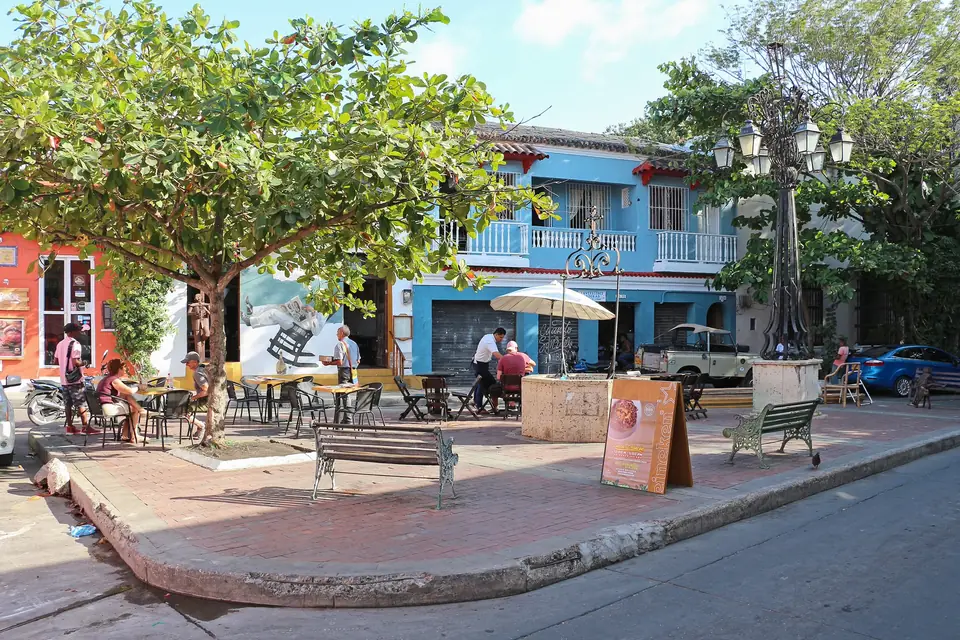
In the centre of Plaza de la Trinidad stands Nora Quintana’s monument, in fibreglass, resin and bronze patina: Pedro Romero with his fist raised, beside Father Umaña and a drummer. From here the day of 11 November 1811 is evoked, when Romero and the Lanceros de Getsemaní armed themselves and marched to the square of the government palace to pressure the junta, which that day declared the absolute independence of Cartagena. Popular memory places the outburst in this square, although the formal proclamation took place inside the walled enclosure, in what is now Plaza de la Proclamación.
That figure is the last of several invented faces. As no reliable portrait of the hero existed, the old bust by Héctor Lombana was made with the face of the painter Alejandro Obregón, who posed as a model. As the quarter tells it, that bust fell in a fit of passion: the poet Pedro Blas Julio Romero cried out that it had to be pulled down and people headed for the stone before he finished the sentence. Earlier, in the 1980s, the neighbours had gathered keys to cast a bronze of the hero. Around the square appear the poet’s own verses, the María Mulata mural by Yurika MDC and the memory of a freshwater well covered around 1860; what happened to the silhouette the quarter painted in 2011 is left for the narration.
The church where the parade ends
Church of the Santísima Trinidad
Summary of this stop
The church of the Santísima Trinidad, finished in 1643, gives its name to the square, which after the events of 1811 the town council renamed “Plaza de la Libertad”. In front of its facade, every November, ends the parade of the Cabildo de Getsemaní, which closes the Independence Festivities with more than seventy groups, led by its Queen for Life, Nilda Meléndez, and which has been held since the late 1980s.
The name carries a memory of centuries: colonial cabildos were associations of enslaved Africans of the same origin, with a king and queen, documented since at least 1693, which at carnival paraded as free people, up to a point, in their masters’ clothes. After the abolition of 1857 the cabildo became a neighbourhood cultural group, and since the mid-2000s each cabildo chooses two lancers, a man and a woman, in memory of those of Pedro Romero.
The closing measures what is at stake. Resolution 0350 of 5 June 2026 included the “Vida de Barrio de Getsemaní” in the national Representative List of Intangible Cultural Heritage, the first declaration to recognise neighbourhood life as a traditional practice, handed to the residents in this square on 3 July 2026. At the same time, of the quarter’s 825 buildings only 16% keep a residential use. What it means to protect a neighbourhood life that is running out of neighbours is the question with which the route ends.