Colonial architecture
Palace of the Inquisition Audio Guide (Palacio de la Inquisición)
A Baroque mansion of grilles and balconies on Plaza de Bolívar, with a slot in the wall for denouncing without signing and, inside, the act that left the house without inquisitors.
- 60 min of audio
- Colonial Baroque
The Tribunal of the Holy Office of Cartagena was born by Royal Decree in 1610, the third in Spanish America after Lima and Mexico, with a district stretching from Venezuela to Nicaragua, Panama and Santo Domingo. The palace that now overlooks Plaza de Bolívar was built around 1770, barely 40 years before Independence expelled the inquisitors, and it houses the Museo Histórico de Cartagena.
The machinery of this tribunal fed on anonymous scraps of paper and went after African healers more than heretics: in the largest slave market of Spanish America, more than half of the witchcraft cases of the American Inquisition were tried. And the building that kept those secrets now holds the Act of Independence of 1811.
Highlights
- Window of denunciation — a slot beneath a stone cross for informing without signing
- Plaza de Bolívar — the former main square of the autos-da-fé, with a layout from the late 16th century
- Dungeons — where the accused waited, from the witches of Tolú to the healer Paula de Eguiluz
- Act of Independence of Cartagena — the document of 11 November 1811
- Keys to the city — the replica that vanished and returned to the halls in 2019
The story of the Palace of the Inquisition begins with a Royal Decree of Philip III of 25 February 1610, which created in Cartagena de Indias a tribunal of the Holy Office with jurisdiction over the New Kingdom of Granada, Venezuela, Nicaragua, Panama, Santo Domingo and the Windward Islands. In September of that year it was set up in some houses on the main square. In 1626 the Suprema in Madrid approved buying the old houses of Captain and councillor Diego de Matute, and in 1628 the inquisitors sent Madrid plans for a new seat drawn by Lucas Báez, master of fortifications, who advised bringing the ironwork and nails from Seville; the Inquisitor General approved them on 1 May 1629.
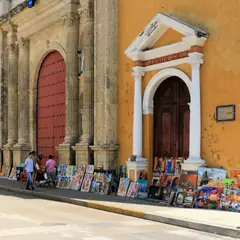
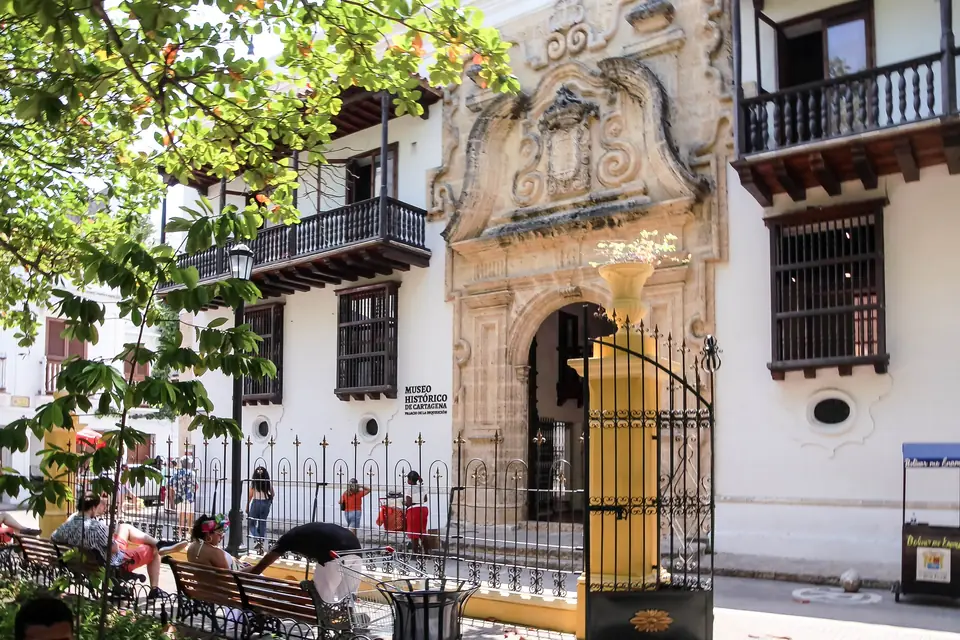
The building seen today is later: it was raised around 1770 on two dwellings the tribunal had rented since the early 17th century, bought and demolished to build a seat suited to its functions. Most sources give that date, although others place the end of the works in 1776. The architecture of the Palace of the Inquisition follows the scheme of the Cartagena colonial house, with a Baroque stone doorway of mixtilinear mouldings, grilles on the ground floor and wooden balconies on the upper one.
After Independence the house passed into private hands until the Colombian state appropriated it for use as a museum. The Museo Histórico de Cartagena, founded in 1924, occupies its rooms today, although one source dates its installation in the palace to 1953. Its recent history has its own mystery: when it reopened in April 2004, after two years of restoration, dozens of display cases were empty, and it is said that close to 90% of its some 2,500 objects had disappeared, among them a ruana given by Bolívar. What to see at the Palace of the Inquisition fits into four stops, from the square to the Independence rooms, and the audio guide covers them in 60 minutes, documented and checked against historical sources.
A hundred metres away stands Cartagena Cathedral; the Jesuit of the Sanctuary of San Pedro Claver lived a few streets away, and the independence recorded in the museum’s Act spilled into the street from the Getsemaní quarter.
The square where the autos-da-fé were held
Plaza de Bolívar
Summary of this stop
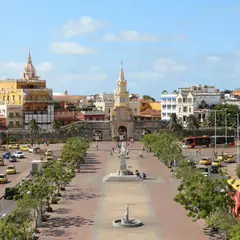
The route starts at Plaza de Bolívar, the former main square, in front of a facade that at first glance seems just another colonial house. A plan of 1630 already shows the Inquisition’s plot alongside the whole square, whose layout has not changed since the late 16th century. Behind those grilles and balconies, cases from half the Caribbean were tried.
In 1610 Cartagena became the third seat of an Inquisition tribunal in Spanish America, after those of Lima and Mexico, founded in 1569. It was a transit port, with Portuguese merchants suspected of crypto-Judaism, and its first inquisitors, Mateo de Salcedo and Juan de Mañozca, arrived with a mass in the cathedral in which they proclaimed their aim of pursuing Jews, Muslims, Protestants and witchcraft.
In this same square the tribunal’s first auto-da-fé was held in 1614, with six women condemned for sorcery. According to the documented tradition of those cases, the most unexpected was doña Lorenzana de Acereto, wife of the city’s royal notary, in a world of powdered donkey brains and prayers to the star. How she ended up there is told in front of the facade.
A slot for denouncing without signing
Window of denunciation
Summary of this stop
In one of the palace’s walls opens the so-called window of denunciation, or window of ignominy: a small slot topped by a stone cross through which the Holy Office received anonymous denunciations of heresy, witchcraft or superstition. Beside it, a plaque installed by the National Beauty Pageant sums up its function in a couple of lines.
That gap explains much of the tribunal’s history. Witchcraft marked it: of the 56 people tried for witchcraft in its first 50 years, 52 were of African origin, and of the 538 witchcraft cases tried by the Inquisition in America, more than half were heard in Cartagena, the largest slave market of Spanish America.
Between 1624 and 1634 the tribunal pursued the so-called witches of Tolú, an episode compared with that of Zugarramurdi. The testimonies feature a companion devil named Tongo and gatherings around a he-goat, and in one of the interrogations a name familiar from the altars comes up. Who stood next to the interpreter that day is revealed at the window.
The secret jails of Paula de Eguiluz
Inquisition dungeons
Summary of this stop
Behind the bright central arcaded courtyard wait the old dungeons, where the accused stayed until they were interrogated and tried. The rooms display a scale presented as the one used to weigh those accused of witchcraft, stocks and other instruments of torture whose authenticity is disputed: many look like modern replicas or generic reconstructions, with no proof that this tribunal used them.
A myth is also dismantled here. A widespread belief speaks of more than 800 people burned at the stake, but between 1610 and 1821 the tribunal tried between about 800 and 900 cases in all, and only about five were burned; most of the condemned received lashes, confiscation of property or prison.
Through these jails passed the healer Paula de Eguiluz, a former slave, who spent eight months in them before her first sentence in 1624: 200 lashes, two years of service in the hospital and banishment from Cuba. On 25 March 1638 she came out again in an auto-da-fé in the square, alongside eight Portuguese condemned as Judaizers, and the murmur of the crowd prevented her sentence from being read aloud. What she did afterwards, with the bishop and with her own judges, is the twist heard between these walls.
The act that left the house without inquisitors
Independence rooms
Summary of this stop
The route closes in the Independence rooms, where the Act of Independence of Cartagena of 11 November 1811 is kept, next to a bell cast by Pedro Romero and a canvas of the Independence by Cecilia Porras. It is the document that expelled the inquisitors, displayed inside their own house. They returned in 1815 with the troops of Pablo Morillo, and the tribunal operated until 1821.
The palace also hosted the Galería de Arte Moderno before it had its own seat, and today it is also the setting for the so-called “Aquelarres”, monthly gatherings of more than 40 women who take the name the Inquisition gave to witches’ assemblies to debate social problems and the defence of women’s rights.
These rooms also hold some keys to the city with a history of their own. The originals, handed over in 1821 to General Mariano Montilla, are in the Museo Nacional de Colombia; the replica this museum kept disappeared, and in 2019 a new one returned to the display cases. Why Cartagena had to ask twice for a copy of its own key is told at the end of the route.