Sri Lanka’s oldest museum
Colombo National Museum Audio Guide
A white palace of 1877, ringed by banyan trees, keeps the golden throne of the kings of Kandy: a Dutch gift that spent over a century in England and came home with crystals where amethysts once shone.
- 90 min of audio
- Kings of Kandy and archaeology
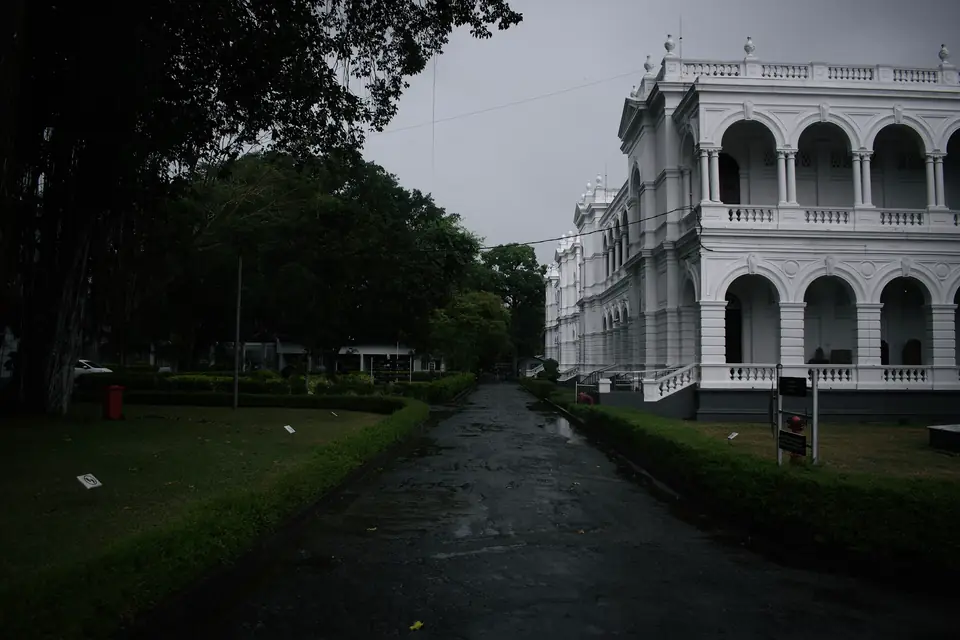
The Colombo National Museum is the oldest in Sri Lanka. It opened on 1 January 1877 as the Colombo Museum, driven by the British governor Sir William Henry Gregory, who in 1872 had proposed gathering in a single house photographs, casts and copies of the inscriptions of the whole island. The building, the work of James George Smither, architect of the Public Works Department, was finished in 1876: two floors around several courtyards that ventilate the rooms, a colonnaded veranda against the monsoon and the glare, and an Italianate façade now presided over by the bronze statue of its founder.
What it holds rarely arrived by the straight road. There is a granite Buddha found among the ruins of Anuradhapura, a slab of 1409 that turned up face down as a drain cover in Galle, a cannon returned by the Rijksmuseum in 2023 and a throne that served at Windsor Castle to invest Knights of the Garter. Many of its pieces were lost at some point and had to be reclaimed.
Highlights
- Throne of Kandy — wood covered in embossed gold, with lions on the arms and a sun on the back, used by six sovereigns until 1815
- Regalia of the last king — crown, footstool, sceptre and sword of Sri Vikrama Rajasinha, returned by England in 1934 and 1936
- Galle trilingual inscription — Chinese, Tamil and Persian of 1409, ordered placed by Admiral Zheng He
- Toluvila Buddha — 4th–5th century granite, 1.75 metres, seated in meditation before the main entrance
- Lewke’s cannon — gold, silver and rubies, back from the Rijksmuseum in 2023 together with five other weapons from Kandy
In Colombo, behind a curtain of banyan trees, stands a white palace that seems moved from an Italian city. It is the Colombo National Museum, the oldest in Sri Lanka, and its story begins with a speech: in 1872, in his first address to the Legislative Council, Governor Sir William Henry Gregory proposed creating a place to gather photographs, casts and copies of the inscriptions scattered across the island. With the support of the Ceylon branch of the Royal Asiatic Society, the Colombo Museum opened on 1 January 1877 with 808 pieces and another 384 specimens: inscriptions, stone carvings, jewels, coins and natural history samples.
Since then the building has been many things besides a museum. In 1942, after the fall of Singapore, the British installed the army headquarters in it while preparing the defence of the island. Generations of provincial schoolchildren have called it “Katu ge”, the house of skeletons, after the whale that hung from the ceiling. And on its upper floor rests the throne of the kings of Kandy, which left the island as booty in 1815 and returned in 1934. What to see at the Colombo National Museum runs from the façade and portico to the stones rescued from ruins and drains, and from there to the rooms of the Kandyan regalia and the fall of the last king.
The audio guide’s documented route follows that same order: it starts before the statue of Gregory, reads the building’s architecture as a response to the tropical climate, pauses at the Toluvila Buddha and climbs the great staircase to the throne and the display cases that tell how a kingdom was lost.
Less than a kilometre away, the Gangaramaya temple holds another collection, that of its monks’ donations, and the other face of colonial memory lies in the Fort, in the Old Dutch Hospital.
A British governor before the white palace
Colombo National Museum
Summary of this stop
In front of the façade stands the bronze statue of Sir William Henry Gregory, a tribute to the governor who turned his 1872 idea into a building. Behind it, the palace designed by James George Smither and finished in 1876: a portico with staircase, a columned vestibule and a balustrade with pediments that hides the roof. That roof was once tiled and later covered with corrugated fibre-cement, a change barely guessed at from below.
The architecture of this part of the museum has less of the European whim than it seems. The two floors are organised around several courtyards that create cross ventilation, and the colonnaded veranda shields from the monsoon and the glare. It is a machine against the tropical climate dressed as an Italian palace.
Why a British governor wanted to gather in Colombo copies of inscriptions from the whole island, and what that said about the way the empire looked at Ceylon, is the question with which the narration opens the route in front of the statue.
Wapchi Marikar’s free Fridays
Portico with staircase
Summary of this stop
At the foot of the staircase sits the museum’s best-loved anecdote. Its builder, Arasi Marikar Wapchi Marikar (1829–1925), who also built the General Post Office, the Customs House and the Galle Face Hotel, asked as his reward at the 1877 inauguration that the museum close on Fridays, the Muslim holy day. The carpenter S. M. Perera, for his part, asked for and received a local rank. Decades later, when Prime Minister D. S. Senanayake wanted to display the throne of the last king of Kandy, he sought the consent of Sir Razik Fareed, Marikar’s grandson, to open on intermediate Fridays.
The story has, however, its sceptical version. For the architect and historian Ismeth Raheem, the figure of Marikar as builder of the museum is “a legend and a tale”: it is not clear whether he built the whole building or only part of it, and the Fridays business would be a story that spread over time. A museum devoted to separating history from myth would thus have its own myth at the door.
The first director, Amyrald Haly, received those first collections, although sources do not agree on when his term ended. How the 1877 scene fits with the historian’s doubt is left for the foot of the staircase.
A jungle Buddha and a drain slab
Toluvila Buddha
Summary of this stop
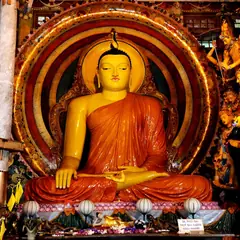
Right in front of the main entrance the Toluvila Buddha meditates, carved from a single block of granite between the 4th and 5th centuries. It is 1.75 metres tall and was found in 1900 by H. C. P. Bell at Anuradhapura. It has unusual features: it lacks the long earlobes these figures usually have and shows three lines on the neck.
It is the first sign that this museum is a house of rescued things. Inside waits the trilingual Galle inscription, in Chinese, Tamil and Persian, dated 15 February 1409 and placed by Admiral Zheng He with offerings to Buddha, Vishnu and Allah. In 1911 it turned up face down, used as a drain slab on Cripps Road, in Galle, and it still bears the wear of that job. Specialists debate whether the date marks the carving in Nanjing before the third voyage or its placing in Galle on the return from the second.
The nickname “Katu ge” comes from another rescue: a blue whale of some 65 feet that the sea threw onto the beach at Ambalangoda in September 1894. Its skeleton was mounted in the museum in 1910 and in 2017 moved to the osteology gallery of the National Museum of Natural History, now separate. What the taxidermist had to do on that beach, with heavy seas and sharks all around, is the scene the audio guide reserves for this point.
The throne that travelled to Windsor
Throne of Kandy
Summary of this stop
On the upper floor, at the end of the great staircase, stands the throne of the kings of Kandy: a wooden armchair covered in embossed gold sheet, with lions at the ends of the arms and a sun on the back flanked by deities. The minutes of the Dutch Council of October 1692, under Governor Thomas van Rhee, include a “throne with accessories” among the gifts for the king of Kandy; Joseph Pearson described it as a Louis XIV design with oriental decoration, and six sovereigns used it until 1815. On its exact recipient and origin the sources do not agree.
After the sack of the Kandy palace in February 1815, the throne travelled to Carlton House and then to Windsor Castle, where it served in the Garter Throne Room to invest Knights of the Garter: Victor Emmanuel II of Italy in 1861, Haakon VII of Norway in 1906 and Manuel II of Portugal in 1908. A motion by George E. de Silva in the State Council, presented in 1933 and passed in 1934, led George V to return it together with the crown; the Duke of Gloucester handed them over in September 1934 at the King’s Pavilion in Kandy. The sceptre, sword and belt arrived in 1936. Even so, the throne left again to preside over the opening of Ceylon’s first Parliament in 1948, and in 1954 Elizabeth II delivered the speech from the throne on it.
In 1849, Charles Pridham described the eyes of the lions on the arms as whole amethysts larger than a musket ball. In the 1980s thieves entered the museum, damaged the throne and tore out several stones; Roland Silva restored it, and today cheap crystals shine in their place. What that false glitter says about the island’s history is the narration’s closing note before the display case.
A clock, a cannon and a night without cameras
Lewke’s cannon and the last king’s clock
Summary of this stop
The display cases on the fall of Kandy hold small objects with enormous stories. A gold pocket watch, of Dutch make and with Sinhala hours and numerals, that Sri Vikrama Rajasinha carried when captured on 18 February 1815; the king gave it to the mudaliyar Don Adrian Wijesinghe Jayewardene, who escorted him to Colombo, and a descendant, T. F. Jayewardene, donated it to the museum in 1948. Nearby, the jackets of the king and his chief consort, displayed as those they wore when captured, still stained with their blood.
Since 5 December 2023 they have been joined by six weapons from Kandy looted by the Dutch East India Company in 1765 and returned by the Rijksmuseum. The most striking is the cannon that Lewke Dissawe decorated in 1745–46 with gold, silver and rubies, and which spent centuries in Holland under the wrong name of “Michiel de Ruyter’s cannon”.
This same floor also holds the museum’s darkest chapter. According to what is documented, on the night of 16 to 17 March 2012, 221 pieces vanished from the central vestibule, among them gilded Kandyan-era swords, 93 gold coins and the ceremonial sword of Nugawela Adikaram, while the security cameras had been off for weeks. What happened to the suspect and why what was recovered still has not returned to the display cases is the twist with which the route ends.