Catholic shrine
St. Anthony’s Shrine Audio Guide
A white church by Colombo’s port that was born from the hut of a priest hiding among fishermen. Every Tuesday, Catholics, Buddhists, Hindus and Muslims queue before the same glass.
- 30 min of audio
- Shared faith and memory
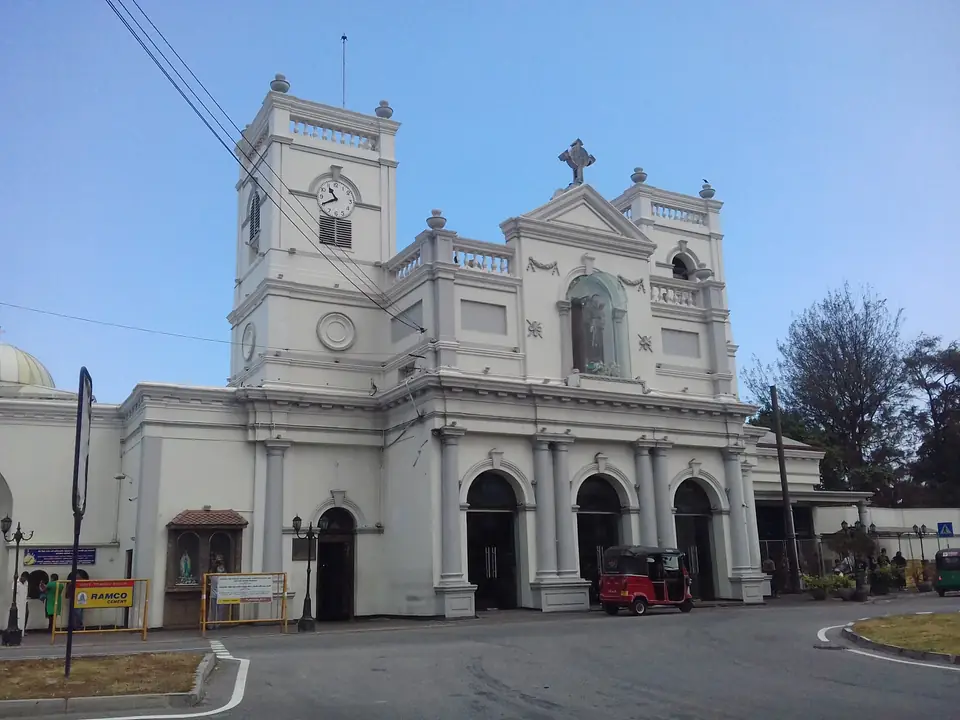
St. Anthony’s Shrine in Kochchikade is the great Catholic church of Colombo’s port. Its origin is an adobe chapel raised by Fr. Antonio, a priest from Cochin who, in the days of the Dutch ban on Catholic worship, lived disguised as a merchant among the fishermen of Mutwal. The present church, neoclassical with two bell towers, was begun in 1828 and consecrated on 1 June 1834.
In 1912 the British governor Henry McCallum wanted to buy the church and its land to expand the port, and gave up after warnings from his own administrators. More than a century later, on Easter Sunday 2019, a suicide bomber blew himself up inside during morning Mass; the Navy, based in the adjoining port, rebuilt it in under eight weeks.
Highlights
- Miraculous statue from Goa — brought in 1822 by Mana Mudaliyar, on the left side altar
- Relic of St. Anthony’s tongue — arrived from Padua in 2010, in a display case at the entrance
- 2019 memorial — 54 names, the time 8.45 and the floor marks left on purpose
- Tuesdays of devotion — worshippers of every religion touch the glass and light candles
- Tombs under the nave — Fr. Antonio, the founding priest, and Bonjean, first archbishop of Colombo
On Kochchikade street, a step from Colombo’s port, a white façade with two bell towers looks like that of any colonial church. The story of St. Anthony’s Shrine begins, however, in hiding: under Dutch rule Catholic worship was banned on the island, and a priest from Cochin, Fr. Antonio, kept the faith of local Catholics alive by living disguised as a merchant among the fishermen of Mutwal. The authorities ended up granting him a plot to preach on, and there he raised an adobe chapel dedicated to St. Anthony of Padua. Sources do not agree on the dates of his arrival or of that first chapel, but the rest of the chronology is documented: in 1822 the statue considered miraculous arrived from Goa, in 1828 work began on the neoclassical church and on 1 June 1834 it was consecrated. In 2025 its 191st annual feast was celebrated.
The building kept growing. In 1938 a choir gallery, large side wings and a mission house behind the high altar were added, and the enlarged church was consecrated on 16 February 1940. In 1990 Archbishop Nicholas Marcus Fernando officially proclaimed it a shrine: it has no fixed parish and depends directly on the Archbishop of Colombo. Tuesday is its big day, and in June the saint’s feast fills the neighbourhood with bunting bearing petitions, novenas in Sinhala and Tamil and a procession accompanied by Navy sailors.
What to see at St. Anthony’s Shrine runs from the façade to the relic display case, from the 2019 memorial chamber to the small Goa statue beside the high altar. The audio guide’s documented route takes in those four points and tells how a church born from a hidden priest became the place where a divided island prays together.
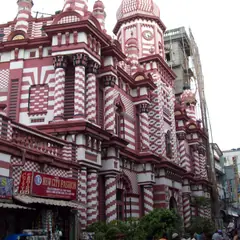
A kilometre to the south, in the Pettah bazaar, merchants from southern India pray at the Jami Ul-Alfar Mosque, and beside Beira Lake the Gangaramaya temple is the city’s great Buddhist shrine.
The shop of the priest from Cochin
St. Anthony's Shrine
Summary of this stop
Before the neoclassical façade, with its statue of St. Anthony looking out to the street, the first secret lies in the name of the district. According to tradition, Kochchikade comes from “Kochiyage Kade”, “the shop of the man from Cochin”, after the hut-shop that Fr. Antonio raised on the land granted to him. Who gave the place that name, whether the neighbours, the supporters of the Dutch or the memory of the elders of Kotahena, depends on the version.
The founding story is a documented tradition kept by the shrine. When the Dutch discovered the priest, disguised as a fishmonger on Maliban Street, they sent soldiers to arrest him; he fled towards Mutwal and there some fishermen asked his help because the sea was eating their village. The soldiers let him try, convinced he would fail. It is told that Antonio drove a great wooden cross into the shore and prayed three days and three nights fasting, until the waves withdrew and a sandbank formed. The frightened governor gave him a piece of land beside the spot.
Much later the threat came from the British side: in 1912 Governor Henry McCallum wanted to acquire the church and its land to expand the port. Why he ended up giving up, and what Antonio asked for according to another version of the legend, is what the narration tells before the two bell towers.
A glass that every religion touches
St. Anthony’s relic display case
Summary of this stop
Beside the entrance, a display case holds a statue of the saint and a reliquary with a fragment of his tongue, which arrived on 7 March 2010 from the Basilica of St. Anthony of Padua, on the church’s 175th anniversary. Here touching the glass is itself an act of prayer. Whoever makes a vow lights yellow candles and leaves them in a trench inside the compound, and every day there are worshippers who cross the nave on their knees to the altar.
Devotion knows no creed. Buddhists, Hindus and Muslims pray alongside Catholics, and in June 2010 the case was even opened so that a Buddhist woman from Hettipola could leave a gold chain and a ring, in thanks for fourteen years of work without mishap in Oman and Cyprus. Among the customs devotees take home is a pinch of blessed salt in food, which they say keeps peace in the home.
Tuesday is the day of greatest attendance. The reason lies in Padua: the saint died in Arcella in June 1231 and was buried on Tuesday the 17th, four days later, although in Kochchikade there is also the explanation that he died on a Tuesday. What that devotee told about her vow is one of the moments the audio guide reserves for this glass.
The marks of Easter 2019
2019 victims’ memorial chamber
Summary of this stop
The bright white nave keeps, near the last rows of pews, some marks in the pavement that were left on purpose. They are the memory of 21 April 2019, Easter Sunday, when a suicide bomber blew himself up inside the shrine during morning Mass. A small permanent memorial chamber lists the names of the 54 worshippers killed there and the time, 8.45, with the verse Genesis 4:10 written on both sides in Sinhala, Tamil and English. Other sources give higher figures for the church.
The reconstruction was swift. The Sri Lanka Navy, based in the adjoining port, rebuilt the church in under eight weeks, and on 12 June 2019 the church reopened with the rite of reconsecration: Cardinal Malcolm Ranjith anointed the altar, the walls and every column while the bells rang.
In April 2025, at the memorial for the sixth anniversary held in Kochchikade, it was announced that the 167 Catholics killed in the attacks at St. Anthony’s and St. Sebastian’s in Negombo were entering the Vatican’s list of “Witnesses of the Faith”. How the nave reads after seeing those marks is what the narration tells beside the names.
The Goa statue above the origin
Miraculous statue of St. Anthony of Goa
Summary of this stop
On the side altar to the left of the high altar stands the image everyone wants to touch: a small statue of St. Anthony some 200 years old that Mana Mudaliyar brought from Goa in 1822, after travelling there with a group of worshippers. It is the shrine’s main focus of veneration. On the other side, the Blessed Sacrament chapel glows with a blue light behind glass, and above the high altar the saint occupies a niche ringed by brass suns and moons.
The church’s memory places this point at the origin of everything, although it does not agree on how: for some, the statue stands where Fr. Antonio drove in the cross that made the sea retreat; for others, over the place where he was buried, or at the exact point of the miracle, where the altar stands. What is documented is that the founding priest rests inside the church, as does Christophe Ernest Bonjean, first archbishop of Colombo, who died in the city on 3 August 1892.
On the first floor, a small museum reproduces in wax figures the scene of Antonio praying before the fishermen. Which of those versions holds up the floor the visitor stands on is the question with which the route says goodbye beside the Goa statue.