Historic mosque in Pettah
Jami Ul-Alfar Mosque Audio Guide
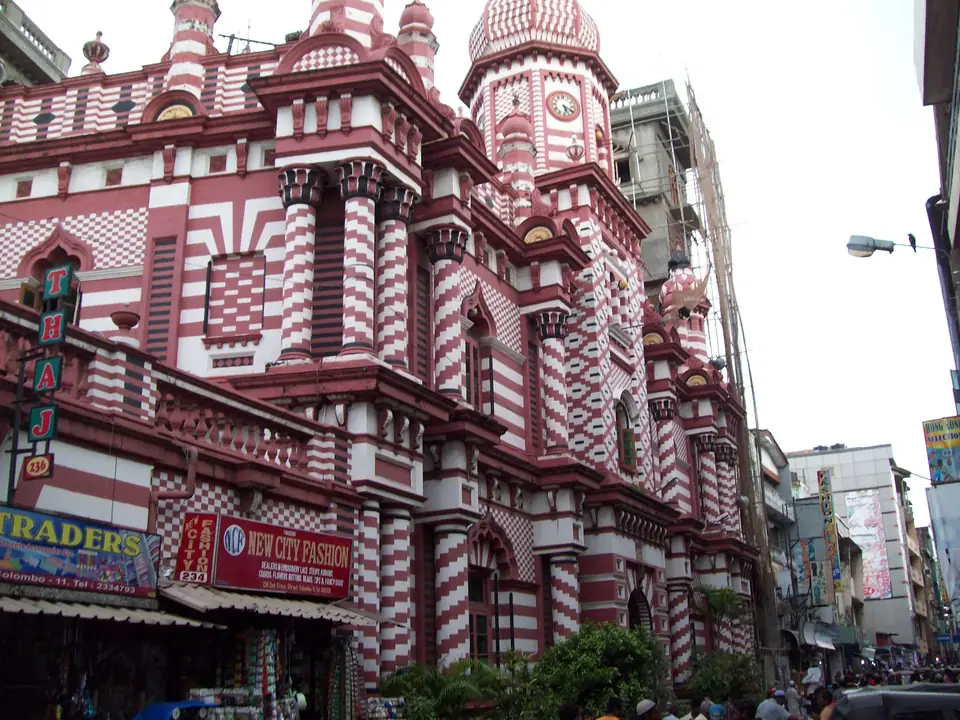
On a warehouse street in Pettah, among bales and stalls, a red and white striped mosque suddenly appears. It was drawn in 1908 by a master mason with no architectural training, copying black-and-white photographs, and not a single portrait of him survives.
- 30 min of audio
- Architecture and the Muslim community
The Jami Ul-Alfar Mosque was begun in 1908 and finished in 1909, commissioned by the Muslim merchants from southern India who worked in Pettah and needed to pray near their businesses. They bought the plot for 500 rupees, donated it and set up a trust that descendants of those donors still run today. Its author, Habibu Lebbe Saibu Lebbe, was a master mason who in the afternoons taught the Quran to his clients’ children: with no architects or engineers, he drew it from photos of Indo-Saracenic buildings, with pomegranate-shaped domes and every brick hand-painted red or white.
In the street it has as many names as languages. For the Sinhalese it is Rathu Palliya, the red mosque, just as for travellers it is the Red Mosque; for the Tamil community, Samman Kottu Palli, a nickname that the builder’s family derives from Samaan Kottai, the “fortress of goods”, as the street itself was called, although it is often translated otherwise. And that merchants’ building, designed for 1,500 worshippers when about 500 came, has become Sri Lanka’s largest congregational prayer hall.
Highlights
- Second Cross Street façade — two storeys of striped red and white brick, with its 1909 clock tower
- Hand-painted bricks — stripes, checkerboard, zigzag and spiral on walls, arches and minarets
- Pomegranate-shaped domes — and 49 minarets with crescents pointing towards Mecca
- Puttalam teak columns — four whole trunks running through both floors of the original building
- New wing since 2007 — four floors for 10,000 worshippers and views over Pettah and the port
The story of the Jami Ul-Alfar Mosque begins with a very practical problem. In the early 20th century, Muslim merchants from southern India filled the streets of Pettah, Colombo’s bazaar district, with goods, and needed a place near their businesses for the five daily prayers and the Friday one. In 1908 they entrusted the work to a man they trusted, Habibu Lebbe Saibu Lebbe, master mason and Quran teacher to their children. By 1909 the mosque stood: two floors, a clock tower and a red and white façade painted brick by brick.
More than a century later it is still Pettah’s most recognisable building. It is even said that sailors entering the port steered by it, although that idea circulates with no documentation to back it. What is documented is its growth: since 2007, a new four-floor wing wraps around the original building so that up to 10,000 people can pray at once. What to see at the Jami Ul-Alfar Mosque runs from the Second Cross Street façade to its drawn bricks, from the 1909 interior held up by teak trunks to the upper floors with views of the port, a walk of about 30 minutes that the audio guide accompanies stop by stop.
Women visitors may tour the mosque with hair, arms and legs covered. For decades women got no further than its open-air courtyard, and in 2016 a Muslim neighbour was still refused entry while foreign women tourists were shown the building; today there is a women’s prayer hall, open Saturday to Thursday from 9:00 to 19:00.
The mosque stands in the very grid of Pettah Market, and a kilometre to the north, in the port district of Kochchikade, another community prays at St. Anthony’s Shrine.
The fortress of goods on Second Cross Street
Jami Ul-Alfar Mosque
Summary of this stop
Second Cross Street is a narrow Pettah street packed with shops, and the mosque’s façade emerges among them almost without warning. That location is no accident. Here the merchants from southern India stored their goods, which is why in Tamil it was called Samaan Kottai, the “fortress of goods”. From that name, according to the builder’s family, comes the mosque’s Tamil nickname, Samman Kottu Palli, although the most widespread translation explains it as the mosque of the Muslims of Indian origin.
Those same merchants bought the plot for 500 rupees, donated it and set up a trust; the current trustees are still chosen from the descendants of those donors. Work began in 1908 and ended in 1909, and it was born with a striking ambition: a building with room for 1,500 worshippers, according to most sources (others say 1,000), when about 500 came to prayer.
Why merchants built so far beyond their needs, and how this street of bales became the Muslim heart of Pettah, is what the narration unpicks in front of the façade.
Brick pomegranates copied from photographs
Pomegranate-shaped domes
Summary of this stop
At the foot of the façade, the eye learns to read the wall. Every brick is hand-painted, red or white, and the whites draw four motifs that repeat across walls, arches and minarets: stripes, checkerboard, zigzag and spiral. Above them peep the domes, often described as onion-shaped, although the mosque itself claims another fruit: Saibu Lebbe shaped them like pomegranates and took the building’s red and white from the inside of the pomegranate, instead of the traditional green and white of the island’s Muslim community.
The most surprising thing is the method. Saibu Lebbe had no architectural training and no engineers: he drew the mosque from black-and-white photographs of Indo-Saracenic buildings handed to him by his clients. According to his family’s memory, he chose the bricks in person and went to the site to lay them himself so that all the joints were equally spaced, and he solved the irregular shape of the plot by mixing short minarets with the domes. The result is a forest of 49 minarets topped with crescents pointing towards the Kaaba in Mecca.
The teak trunks of the faceless builder
Puttalam teak columns
Summary of this stop
Inside the original building, four whole teak trunks run through the two lower floors and hold up the 1909 structure. Saibu Lebbe travelled to Puttalam to choose that timber, and also the satinwood for doors and windows. Around them open the central courtyard, with its great marble pool for ablutions, and the prayer hall, with red carpets, a great chandelier and the raised minbar of the sermon.
The builder charged only for materials and the labourers’ wages. As thanks, the merchants gave his only daughter, Ummu Ayman, a 24-carat gold chain and a plot with ten houses in Panchikawatte. His end is told as tradition, and in more than one version: according to his family, on the day of the inauguration he died run over by a runaway cart on Reclamation Road while gazing at the finished mosque; another account places the accident at the door of the mosque, and no documentary source dates it.
Not a single photograph of Saibu Lebbe survives. What remains is a plaque with his name inside the compound and the memories that Ummu Ayman passed on to a granddaughter born after his death. What, according to that family memory, happened a week after the burial is the most unsettling episode of the story, and the audio guide saves it for this point, beside the teak.
Ten thousand worshippers above Pettah’s rooftops
The mosque’s new wing
Summary of this stop
The merchants’ mosque never stopped growing. In 1975, with the help of the Haji Omar Trust, it bought several adjoining plots and began an extension designed for 10,000 worshippers. Since 2007 a new four-floor wing of some 4,600 square metres has been rising around the original building, with escalators for the elderly, so that nobody has to pray in the street. Capacity figures vary by source: most speak of 10,000 worshippers and some of about 12,000. From the top, the view opens over Pettah’s rooftops and the port.
During construction, a board in the lobby invited “brothers” to donate 5,000 rupees for every square foot built, in exchange for a place in eternal paradise. Today that extension fills up: in Ramadan the mosque feeds 2,000 people every day at the time of breaking the fast, and on special days it gathers almost 15,000 worshippers, also from outside Colombo.
Only once in 112 years has it closed its doors: in 2021, during the Covid-19 lockdown. How the call to prayer sounded then over an empty Pettah is the closing note the narration reserves for the upper floors.