Historic bazaar
Pettah Market Audio Guide
Behind the din of carts, sacks and signs in Pettah beats a plan drawn more than two centuries ago: five cross streets where each one sells its own thing, from onions to gold. Here everything ended up a market, even the houses, the cemetery and the town hall.
- 60 min of audio
- Colonial bazaar and guilds
Pitakotuwa, the Sinhala name of the district, means “outside the fort”. The Dutch called it oude stad, the old town, and it was the British who imposed Pettah, an Anglo-Indian term taken from the Tamil pettai. Already in Dutch times (1656-1796) there was a daily market beside the wall of the church cemetery: Moors and Persians sold silks, cloth and linen, and Malabars, Maldivians and Sinhalese, fruit, dried fish, onions, sugar and rice. By the early 19th century the district had five parallel streets crossed at right angles by another five, a grid that lives on in the Cross Streets between Main Street and Olcott Mawatha.
Before it was a bazaar, Pettah was a residential district: houses with gardens for the well-off descendants of the Portuguese and Dutch, painted bright yellow with red or orange stripes on doors and windows. After the British took Colombo in 1796 it lost that character and became the city’s great market. Commerce swallowed everything, and the communities that built it still sell in it despite fire and violence.
Highlights
- Khan Clock Tower — the fountain-tower that the sons of a Parsi merchant from Bombay dedicated in 1923 at the bazaar’s entrance
- Five Cross Streets — the early 19th-century grid, with one guild per street: hardware, bridal lace, textiles, onions and spices
- Kayman’s Gate bell tower — the curfew bell beside the fort’s old crocodile moat
- Old Town Hall — Colombo’s first town hall outside the Fort, neo-Gothic from 1873, with 16 effigies of a 1906 council session
- Sea Street — the gold street, with its coloured kovils and the Murugan procession of the month of Aadi
At first sight, Pettah is pure disorder: lorries unloading, porters with bundles on their shoulders, pavements taken over by vendors and façades vanishing under signs. But the chaos has a plan. This bazaar was born at the gates of Colombo fort and keeps the grid of straight streets that already existed in the early 19th century: five parallel half-mile streets cut at right angles by another five. The five Cross Streets joining Main Street and Olcott Mawatha are, still today, that drawing.
The story of Pettah Market is that of a district that kept yielding everything to commerce. Under the Dutch (1656-1796) there was already a daily market beside their church’s cemetery, where Moors, Persians, Malabars, Maldivians and Sinhalese mixed. Later the yellow houses of the descendants of the Portuguese and Dutch disappeared, then the cemetery itself and even the city’s first town hall, which also ended up as a market. Along the way came the fire of Black July in 1983 and, a few steps from the stalls, the car bomb that on 21 April 1987 exploded at rush hour at the central bus station and killed at least 113 people, in one of the bloodiest attacks of the civil war.
What to see in Pettah runs from the clock tower at the entrance to the gold street, passing the old King’s street, the bell tower of Kayman’s Gate, the onion street and the neo-Gothic town hall. The audio guide’s documented route walks that grid on foot, street by street and guild by guild, with a history checked against historical sources.
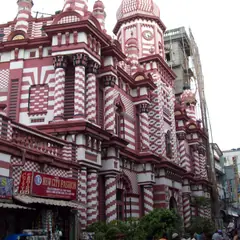
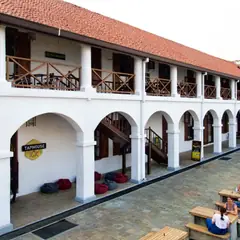
On Second Cross Street the red and white domes of the Jami Ul-Alfar Mosque peep out, and a kilometre away, in the old Fort, the Old Dutch Hospital still stands.
A Parsi tower at the bazaar’s gates
Khan Clock Tower
Summary of this stop
On a landscaped roundabout, a clock tower of about four storeys marks the border between the rest of Colombo and the bazaar. It is the Khan Clock Tower, and its plaque holds the dedication: it was raised by the sons of Framjee Bhikhajee Khan, a Parsi merchant from Bombay and owner of the Colombo Oil Mills, on 4 January 1923, the forty-fifth anniversary of his death. It was also a fountain, although it no longer works.
The place makes sense: the tower stands right where what lay outside the fort began, the Sinhalese Pitakotuwa. Even the name foreigners use has its debate. The usual explanation derives it from the Tamil pettai, “suburb outside a fort”, the equivalent of Pitakotuwa; TamilNet maintains instead that it comes from the Tamil Peaddai, a market or trading town beside a fort, a colonial term documented in English since 1630.
Why it was a merchant from Bombay who left his mark at the gate of Colombo’s great bazaar is the first thread the narration pulls in front of the tower.
The King’s street that sells saris
Main Street
Summary of this stop
Main Street is the district’s straight artery, flanked by shops of saris, sequins and housewares; at number 98, Titus has stayed in the same family since 1924. Under the signs a stubborn layout shows through. The Portuguese already called it “Straight”, Roa Directo; the Dutch, who swapped narrow, crooked streets for straight, wide roads, renamed it Konings Straat, the King’s street, and by it one went from the old town to the fort, ending at Kayman’s Gate.
This district was once a neighbourhood of gardens and houses painted bright yellow, with red or orange stripes on doors and windows. The British takeover of 1796 ended that world and opened the way to the great market. Not even the dead kept their place: when the Dutch cemetery grounds gave way to the new shopping centres, almost fifty gravestones were recovered from a side alley of Prince Street, and today they are kept in a room of the Dutch Museum, on that same street, which is called the “Hall of Death”.
How the old King’s street can still be read among sari shop windows, and what remains of that district of yellow houses, is told while walking along Main Street.
Crocodiles, bell and gallows at Kayman’s Gate
Kayman’s Gate
Summary of this stop
At the crossing of Main Street with 4th Cross Street rises a freestanding tower that looks out of place among shopkeepers and lorries. It is the Kayman’s Gate bell tower, a protected archaeological monument, standing where the fort’s old gate was. Its name comes from the Dutch kaaiman, “crocodile”: according to the most widespread explanation, the marsh crocodiles of Beira Lake gathered in the moat to eat the rubbish the inhabitants threw. A more disturbing, and disputed, version holds that the Dutch bred them in the lake to prevent their slaves from escaping.
The tower held the curfew bell, which marked the closing of the castle gates and the lights-out. Around 1870, with the fort almost demolished, the bell came to call worshippers to the Wolvendaal church, and the place served for public hangings until the late 19th century. About its origin circulates an attribution with no documentary proof: it is said that the Dutch found it among the ruins of a Portuguese church of St. Francis in Kotte.
Where exactly the walled city ended, and how a crossing of shopkeepers was once a moat, a gate and a gallows, is what the audio guide reveals at the foot of the tower.
Onion sacks over a burnt market
4th Cross Street
Summary of this stop
In Pettah every street has its guild: Main Street saris and fabrics, 1st Cross Street electrical goods and hardware, 2nd Cross Street Bombay lace for brides, 3rd Cross Street and Keyzer Street wholesale textiles, Maliban Street wedding invitations and Sea Street jewellery. 4th Cross Street is the grain one: a good part of the country’s onions, potatoes and spices are unloaded here, and the smell arrives before the sacks.
Those sacks are moved by sheer arm power. The nattamis, porters who carry bundles on their shoulders or pull handcarts between lorries and warehouses, hold up the market’s logistics. K. Subramaniam started as a nattami on 22 May 1970, when a bundle paid one or two rupees; today it pays about twenty.
On 25 July 1983, during Black July, Pettah’s wholesale grain market, almost entirely in Tamil hands, burned on 4th and 5th Cross Street and on Keyzer Street. On the motives there is no agreement: many Tamil traders believe the aim was to ruin them and replace them with Sinhalese traders; other witnesses think the chaos was used to damage old buildings that the authorities wanted to expropriate and demolish. What happened afterwards to that trade, and the figure that sums it up today, is heard at the mouth of the street, among the carts.
The town hall that also ended up a market
Old Town Hall
Summary of this stop
At the crossing of Main Street with Dam Street appears a two-storey neo-Gothic building, with spires above the roof frieze, a double carriage porch and pointed doors with carved lattice. It is the Old Town Hall, Colombo’s first town hall outside the Fort, built in 1873 under Governor William Henry Gregory in the so-called “native quarter”. It was designed by J. G. Smither and built by the master builder Arasi Marikar Wapchie Marikar.
Its fate fits that of the district. When the municipal corporation moved to Cinnamon Gardens in the 1920s, the building served as a public market until 1979; sources do not agree on the exact year of the move. Restored on the orders of Ranasinghe Premadasa, it reopened in 1984 as a museum, with 16 effigies reproducing a 1906 council session on the upper floor, while the Edinburgh Hall annexe is today rented to street vendors. In the forecourt wait municipal relics: a gas lamp from the 2,000 that lit Colombo in 1872, the original stone of Galle Face Walk, carts and old machinery.
Which 1906 session was frozen on the upper floor, and what it says about the city that its first town hall ended up surrounded by stalls, is the story the narration tells in the stillness of the courtyard.
The gold street and Murugan’s chariot
Sea Street
Summary of this stop
Pettah’s streets carry their history in their names: Keyzer Street honours the emperor of the Dutch, Barber Street the trade practised in it, Chetty Street and Moor Street the Chetty and Moor communities that lived there, and Messenger Street, the Dutch “Rue de massang” for its massang trees, the errand runners of the colonial firms. Sea Street, the Tamil Chettiar Theru, is the gold street: goldsmiths’ workshops and two kovils, Hindu temples with blue, yellow, red and green gateways.
From them each year, in the Tamil month of Aadi, sets out the Aadi Vel procession in honour of Murugan, the god Kataragama. Its origin is a ban: in 1874 the British colonial government prohibited the pilgrimage on foot to Kataragama because of a cholera outbreak, and those who could not travel began their own festival around the city’s Murugan temples. Today the Vel Ratham, a carved wooden chariot with the gilded image of the god, his consorts Valli and Theivanai and a gold replica of his spear, goes from the Kathiresan Kovil on Sea Street to the one in Bambalapitiya amid thavil drums, nadaswaram and firecrackers, while devotees shout “haro hara” and break coconuts before the chariot to fulfil their vows.
How that festival ends, and why its last gesture coincides with another ceremony far from Colombo, is the detail with which the route says goodbye in front of the kovils.