Historic esplanade by the Indian Ocean
Galle Face Green Audio Guide
Half a kilometre of lawn facing the Indian Ocean that began as a firing range for Dutch cannon and ended up as Sri Lanka’s main square. Horses have raced here, independence has been celebrated and the protest village that brought down a president in 2022 was raised.
- 45 min of audio
- Colonial history and politics
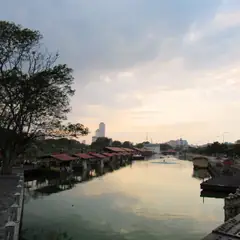
Galle Face Green is the long esplanade stretching between Galle Road and the ocean, closed to the north by the old Parliament and to the south by the Galle Face Hotel. It was born empty on purpose: the Dutch East India Company cleared it south of Colombo fort as an open field of fire so its cannon could batter the Portuguese. That original Green reached Beira Lake and the fort walls, far larger than today’s 5 hectares. From 1821 it was a racecourse, in 1856 it gained a Victorian seaside walk and in 1879 it saw the first official rugby match and the first Royal–Thomian cricket match in Ceylon.
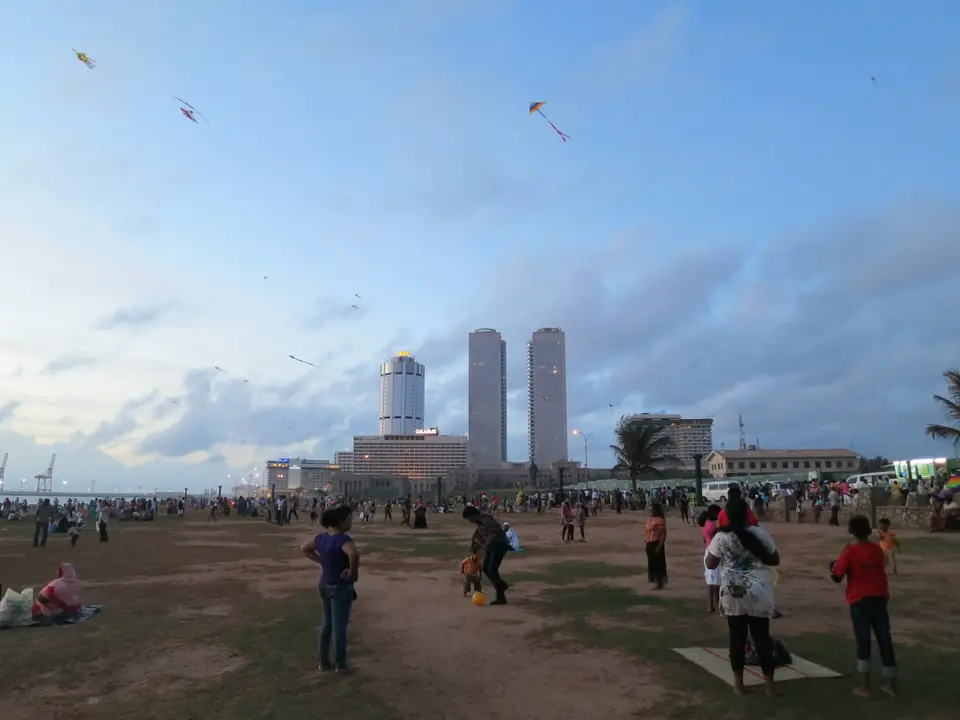
The contrast lies in the use given to the emptiness. The same grass that hosts the Independence Day parades, every 4 February, was in 1956 the place where a mob beat the Tamil satyagrahis who were sitting in protest against the Sinhala Only law, and in 2022 the ground of GotaGoGama, the camp with a kitchen, library and cinema that helped bring down Gotabaya and Mahinda Rajapaksa. At sunset, by contrast, it is all kites, picnics and food stalls.
Highlights
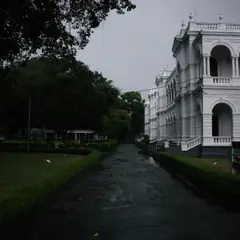
- Old Parliament — neoclassical façade with Ionic columns, seat of the legislature since 1930 and backdrop to the 1956 and 2022 protests
- Bandaranaike statue — bronze gifted by the USSR in 1976 on the knoll of Lutyens’ cenotaph, dismantled in 1939
- Ward’s pillar — the 1856 inscription dedicating the seaside walk to the ladies and children of Colombo
- Old Colombo Club — the pavilion of the former racecourse, today the Crystal Ballroom of the Taj Samudra hotel
- Sunset on the Green — kites, parasols and isso vadai stalls facing the Galle Face Hotel
In the very centre of Colombo, between the traffic of Galle Road and the waves of the Indian Ocean, opens a strip of grass without a single tree. It looks like an unfinished park, but that emptiness is the oldest thing about it: the Dutch cleared it in front of the fort so that nothing would get in the way of their cannon. The story of Galle Face Green goes on with a British cemetery opened in 1803, a racecourse from 1821, a seaside walk dedicated in 1856 to the ladies and children of the city and a public protest that in 1875 forced the railway to be rerouted. Even the origin of the name is disputed: some derive it from the Gal Gate, the fort gate that faced Galle; others from Gal Bokka, the Sinhala name for the rocky coast, because gal means “rock”. Neither version has prevailed.
In the 20th century the esplanade became the country’s political stage: Lutyens’ cenotaph in 1923, the Tamil satyagraha of 1956, the Independence Day parades and, in 2022, GotaGoGama, the village of tents raised in front of the old Parliament. Since 2016 it has been run by a state body of the Ministry of Ports, after its management passed in 2014 from the Urban Development Authority to the Sri Lanka Ports Authority.
What to see at Galle Face Green runs from end to end: from the old cannon facing the old Parliament to the Bandaranaike statue, Ward’s pillar halfway along the walk, the racing pavilion across the street and the food stalls facing the Galle Face Hotel. The audio guide’s documented route covers the Green on foot, from north to south, and reaches the white hotel at the hour when it fills with kites.
At the northern end of the walk the old Fort begins, with the Old Dutch Hospital a kilometre away, and inland, on the shore of Beira Lake, rises the Gangaramaya temple.
The cannon that still points at the sea
Old cannon on the Green
Summary of this stop
At the northern end, facing the neoclassical façade of the old Parliament, an old cannon still looks out to the ocean. It is the best clue to why not a single tree grows on the Green: the esplanade was an open field of fire that the Dutch East India Company cleared so its cannon could batter the Portuguese. Back then it reached Beira Lake and the fort walls.
That northern edge holds less friendly layers. In 1803 the British opened beside Beira Lake a cemetery exclusively for Britons, nicknamed “Padre Bailey’s Godown” after the archdeacon who officiated the burials; the last grave dates from 1877 and the remains were moved to Kanatte after the First World War. According to documented tradition, the open ground in front of the fort’s South Gate was also a place of military executions, and nearby stood a sentry box and a great wooden block, the “whipping post”, where prisoners were flogged in public.
That Colombo’s most cheerful corner began as a public warning in plain sight is the starting point of the route, and the narration places each of those layers on the ground.
Bandaranaike on the cenotaph knoll
S.W.R.D. Bandaranaike Statue
Summary of this stop
Beside Galle Road, on a small knoll, stands S. W. R. D. Bandaranaike, former prime minister of Ceylon, in bronze. The statue was a gift from the Soviet Union in 1976, in time for the 5th Non-Aligned Summit held in Colombo, although the USSR did not belong to the movement. It occupies the place of another monument: Sir Edwin Lutyens’ Victory Column, a granite cenotaph some 120 feet high inaugurated on 27 October 1923 for the Ceylonese fallen of the First World War. In 1939 it was dismantled for fear that it would serve as a landmark for enemy aircraft and rebuilt in today’s Viharamahadevi Park.
The grass around the knoll is that of power and of its contestation. On 5 June 1956, the Tamil satyagrahis of the Federal Party, led by S. J. V. Chelvanayakam, sat down here against the “Sinhala Only” law on finding Parliament closed to the public; a mob beat them and threw several into Beira Lake without the police intervening.
On 9 April 2022, protesters against President Gotabaya Rajapaksa occupied the Green and raised GotaGoGama, with a kitchen, library, cinema and medical post. On 9 May a pro-government mob attacked the camp. The movement contributed to the resignations of Gotabaya and Mahinda Rajapaksa, and the site was cleared on 10 August 2022. How one knoll went from honouring the fallen of the Empire to dominating the encampment that brought down a president is what the audio guide threads together at its foot.
A walk saved for ladies and children
Ward’s pillar
Summary of this stop
Halfway along the seaside walk, on the breakwater where the Indian Ocean breaks, stands a pillar with an English inscription: “Galle Face Walk completed in 1856 and recommended to his successors in the interest of the Ladies and Children of Colombo”. It is the charge of Governor Sir Henry George Ward to those who would come after him. Ward authorised in 1856 a walk one mile, 1.6 kilometres, long on the ocean side “so that ladies and children could stroll and take the air”. The dates do not quite add up: the inscription speaks of 1856, other sources give the end of the works as 1859 and one even has it built already in 1853.
That Victorian dedication ended up having very practical consequences. Between 1873 and 1875 the line of the southern railway was going to skirt the Green along the beach, and public protest and that of the Legislative Council invoked precisely Ward’s words. On 13 March 1875 the Government announced an alternative route and the Observer headlined “GALLE FACE SAVED”.
Where the train runs today, far from the Green’s beach, is the finishing touch of this stop.
The racing pavilion still stands
Old Colombo Club
Summary of this stop
Across Galle Road, facing the Taj Samudra hotel, a colonial building appears that was the sporting heart of the Green. The esplanade, formerly marshy ground filled in and levelled under Governor Edward Barnes, served as a racecourse, the Colpetty Race Course, from the first recorded race meeting in 1821 until racing moved to the Colombo Racecourse in 1893; another source pushes the start back to 1829. The circular cadjan-roofed pavilion built for watching the races became the “Race Bungalow”, in 1871 became the seat of the Colombo Club and today still stands as the Crystal Ballroom of the Taj Samudra.
1879 was the Green’s great year. Some British expatriates founded the Colombo Golf Club here with no clubhouse or course of its own, on 30 June Ceylon’s first official rugby match was played and from 15 to 17 July the first Royal–Thomian cricket match. Golf left in July 1896 for the Alfred Model Farm in Borella, because the ground was already overcrowded.
Tradition recalls that, at that first Royal–Thomian, Beira Lake still reached close to St. Sebastian’s hill and the schoolboys of the Colombo Academy and S. Thomas’ had to row across it in boats to reach the ground. Who won that three-day match, the first of its kind between Ceylon schools, is revealed by the narration in front of the pavilion.
Kites and isso vadai facing the white hotel
Galle Face Hotel
Summary of this stop
The southern end is closed off by the Galle Face Hotel, a white Victorian building of 1864, and facing it runs a row of concrete stalls where food is sold. Until February 2024, itinerant carts of isso vadai, a chickpea-flour fritter topped with prawns, roamed the whole Green; after Independence Day 2024 they were prevented from returning and sales were concentrated in these stalls, which many vendors could not afford.
The afternoon follows a fixed ritual here: few people at midday, a trickle towards sunset and crowds on holidays, with kites all over the sky, picnics and couples sheltering from prying eyes under a parasol along the edge between the grass and the sea. In the background, the glass towers and reclaimed land of Port City contrast with the colonial buildings.
The name “Green” has its local joke, tied to the COVID-19 lockdowns, when the esplanade stood empty almost for the first time in anyone’s memory. What happened then to the grass, and why locals still joke about it, is the note on which the route says goodbye at sunset.