Buddhist temple and museum
Gangaramaya Temple Audio Guide (Sri Gangaramaya Maha Viharaya)
A hermitage on a Beira Lake marsh that collector and entrepreneur monks turned into Colombo’s most crammed temple: rows of Buddhas, tusks, a Rolls-Royce and a Geoffrey Bawa pavilion that seems to float on the water.
- 60 min of audio
- Buddhism, collections and Bawa’s architecture
The story of Gangaramaya begins in 1885, when the learned monk Hikkaduwe Sri Sumangala Nayaka Thera began building the temple on a small shrine by the shore of Beira Lake. Later, Devundara Sri Jinaratana Thera bought the surrounding land, got the temple freed from municipal rates and set up a printing press with the Scot J. Holmes Pollock to spread the Dhamma. From 60 perches, about 1,500 m², the compound grew to nearly three acres with more than 30,000 square feet of buildings.
It is not an ancient temple but the work of enterprising monks. In 1959, at 16 and still a novice, Galboda Gnanissara Thera, the “Podi Hamuduruwo” or “little monk”, had to take charge of the temple; he ran it until his death in 2024 and took it out onto the street with the Navam Maha Perahera, which began in 1979 with five elephants. President J. R. Jayewardene once said that, had he been a layman, he would have made him a minister.
Highlights
- Atalo Dahama mural — the eight vicissitudes of life, at the entrance of a temple born on a marsh
- Temple museum — thrones, tusks, keepsakes of British kings and what passes for Sri Lanka’s smallest Buddha, visible only with a magnifying glass
- Elephant replicas — a life-size Ruwan Raja, with his real skull and tusks, beside Navam Raja and Athula Raja
- Geoffrey Bawa’s Seema Malaka — three blue-roofed pavilions over Beira Lake, built after the old hall on stilts collapsed
- Shrines of Shiva, Vishnu, Kataragama, Ganesha and Guanyin — around a bodhi tree grown from the sacred tree of Anuradhapura
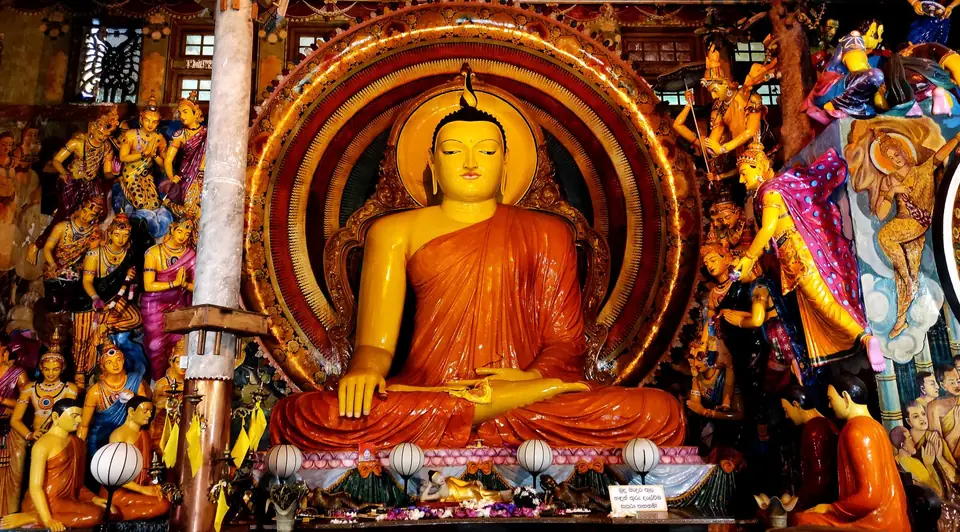
In the centre of Colombo, between the traffic and Beira Lake, stands a temple unlike any other in Sri Lanka. Gangaramaya impresses not by its age but by its excess: rows of seated Buddhas in different mudras, miniature stupas arranged like a staircase, a relic chamber, a museum where not one more object will fit, life-size elephant replicas and, some 200 metres away, three blue-roofed pavilions over the water. The story of Gangaramaya is that of a hermitage on swampy ground that kept gaining land, buildings and fame thanks to monks who collected, printed and organised processions.
Its foundation also carries a curious confusion. The temple’s website and the Colombo press attribute it to Hikkaduwe Sri Sumangala around 1885, while some guides, following English Wikipedia, speak of a shipowner who supposedly bought the land from three Moors; everything suggests that story belongs to another temple of the same name, the Gangaramaya of Magalle, in Galle. Something similar happens with the Buddhist flag: Gangaramaya presents itself as the first place in the world where it was raised, and although it was designed in 1885 by a committee chaired by its founder, the first public raising, at that year’s Vesak, took place at Dipaduttaramaya, in Kotahena.
In the relic chamber, inside a carved wooden cabinet, a crystal lotus holds a small bone venerated as a relic of the historical Buddha, surrounded by fresh white jasmine. It is said that from time to time the relic reproduces itself so that part of it can be taken to other places. The temple lives in the present too: on 11 May 2017 Narendra Modi and Ranil Wickremesinghe lit up the whole complex with a switch for International Vesak Day, and in February 2026 it exhibited for a week, open 24 hours, the Devnimori Buddha relics, never before taken out of India.
What to see at Gangaramaya runs from the entrance mural to the museum, the elephant replicas and Geoffrey Bawa’s Seema Malaka. The audio guide’s documented route takes in those five points in the order they are discovered and ends over the lake.
Less than a kilometre away, the Colombo National Museum keeps the throne of the kings of Kandy, and following Beira Lake towards the sea leads to Galle Face Green; another shrine visited by worshippers of every religion is St. Anthony’s Shrine, by the port.
The mural of the eight vicissitudes above the marsh
Atalo Dahama mural
Summary of this stop
On the entrance wall, a large mural depicts the Atalo Dahama, the eight vicissitudes of life: gain and loss, fame and infamy, praise and blame, pain and pleasure. It is the first image of the compound and works as a key to reading it, because this temple did not inherit its grandeur: it won it inch by inch.
Until the arrival of Devundara Sri Jinaratana Thera, Gangaramaya was a hermitage on swampy ground by the lake, built from 1885 by Hikkaduwe Sri Sumangala Nayaka Thera, a native of Hikkaduwa, on a smaller shrine. Jinaratana bought up the surrounding land, got the temple to stop paying rates to the municipal council and opened a printing press with the Scot J. Holmes Pollock.
The figures sum up the transformation: from 60 perches, about 1,500 square metres, to around three acres and more than 30,000 square feet of buildings. How one goes from a marsh to a compound like this, and what that mural has to do with the character of the place, is what the narration unpicks in front of the wall.
The hall a monk never stopped filling
Temple museum
Summary of this stop
The Gangaramaya museum makes no secret of its origin: it grew from the habit of Sri Jinaratana Nayake Thera of collecting antiques, relics, elephant tusks and palm-leaf manuscripts, inside and outside the island. Today it is a hall crammed with donations, with great thrones, tusks, keepsakes of British kings, old coins and conch shells, and also antique clocks, gramophones and Dutch coins.
Amid so much accumulation, the hardest piece to find is the smallest. A glass case holds what is taken to be Sri Lanka’s smallest Buddha statue, so tiny that it can only be made out with a magnifying glass. Outside, the excess goes on: a Rolls-Royce, a garage of vintage cars with Austin, Ford and Morris Minor and, beside the street, an old steam roller and a printing press from another era.
Why a Buddhist temple piles up period cars, and what this collection says about those who gathered it, is the thread of the audio guide inside the hall.
Ruwan Raja, with his own skull
Replicas of the temple’s elephants
Summary of this stop
The life-size figures of the tusked Ruwan Raja, Navam Raja and Athula Raja recall the temple’s elephants. Ruwan Raja arrived as a gift in 1996, carried the Tooth casket in Kandy’s Dalada Perahera until 2002 and died in 2003; his replica uses his real skull and tusks. Navam Raja, with crossed tusks, came from India, where a maharaja of Mysore had given two calves to a doctor monk; he died on 8 July 2011 and his replica is the work of the artist Kasun Wickremesinghe.
Behind those elephants stands the Podi Hamuduruwo. In 1959, at 16, Galboda Gnanissara Thera took over the temple because his teacher, Devundara Vachissara Thera, had gone practically blind and disabled, and he raised 500 rupees to pay his medical costs. In 1979, with Prime Minister Ranasinghe Premadasa, he launched the Navam Maha Perahera with just five elephants (some article brings it forward to 1978); by the mid-eighties it reached a record 169, and in 2026 it celebrated its 48th edition. He set it in February, the month of Navam, because it is the tourism low season, and in it Buddhist, Hindu, Muslim and Christian artists parade together, while monks walk chanting pirith.
Against that glory stands a disputed story: that of Ganga, a young elephant registered as “Permit No. 198” and kept at the temple, alone and chained. Conservationists maintain she was taken from the jungle as a calf with a fraudulent permit; in 2016 a court ordered her placed in protective custody, the order was not carried out and months later it was revoked. What that lawsuit reveals about Sri Lanka’s relationship with its elephants is told in the audio guide in front of the replicas.
The hall that sank into the lake
Seema Malakaya Temple
Summary of this stop
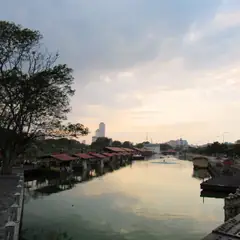
A raised walkway leads from the shore to the Seema Malaka, the temple’s monastic assembly hall. Its present form stems from an accident: the first hall, on timber stilts, needed constant repairs and, according to the Geoffrey Bawa Trust, in August 1954 it collapsed into the water with a group of monks inside. Other sources date that building to the late 19th century and speak of a slow sinking in the 1970s.
The answer came from Geoffrey Bawa, who designed it between 1976 and 1978, inspired by the forest monasteries of Anuradhapura and Ritigala. It is three pavilions resting on great beams in the lake, joined to the shore by walkways; at first they were roofed with pyramidal clay tiles and later with the blue glazed tiles that now identify them. The date is not unanimous either: one source places its opening on 10 February 1979.
Gangaramaya’s architecture reaches its most serene point here, with rows of seated Buddhas on the platforms and a Buddha footprint carved in marble. What Bawa took from the forest monasteries so that this hall would never again fall into the water is what the narration explains on the walkway.
Shiva and Guanyin in a Buddhist pavilion
Bodhi tree and Seema Malaka shrines
Summary of this stop
On a side platform of the Seema Malaka grows a bodhi tree born from a branch of the Jaya Sri Maha Bodhi of Anuradhapura. At its four corners stand small shrines dedicated to Shiva, Vishnu, Kataragama and Ganesha, and a figure of Guanyin waits at the entrance. The 1976 reconstruction was financed mainly by the Muslim businessman S. H. Moosajee and his wife, in memory of their son Ameer.
Every May this corner is transformed by the Buddha Rashmi, Colombo’s national Vesak festival, an idea of the Podi Hamuduruwo that the temple began to organise when the city’s Buddhist tradition was fading because of terrorism. A simple ceremony in the Seema Malaka switches on the lights, thoranas painted with the life of the Buddha are raised, free meals are handed out and the Navy choir sings devotional hymns from a decorated barge on Beira Lake. In 2023, after four years without doing so, the temple celebrated it on a grand scale again, with three days of festivities.
A Buddhist pavilion paid for by a Muslim family and surrounded by Hindu gods sums up the spirit of Gangaramaya well. How all that fits into a single temple is the idea with which the route says goodbye over the water.