Historic quarter
Al Shindagha Museum Audio Guide
At the mouth of the Creek, the quarter where Dubai’s ruling dynasty settled in 1833 was almost entirely demolished and then rebuilt house by house from the photos and memories of its former residents. Today it is a museum of 22 pavilions that smells of oud.
- 90 min of audio
- Coral-stone architecture
In 1833 the Al Maktoum family, the dynasty that still rules Dubai, settled on the Shindagha peninsula, a narrow strip between the sea and the creek that became the main residential quarter. Its most notable house, that of Sheikh Saeed, built of coral stone with four wind towers, was the home of the ruling family until 1958. Since March 2023 the Al Shindagha Museum has brought together 80 of the quarter’s 162 historic houses in 22 themed pavilions.
What looks old is, in large part, reconstructed memory. In the early 1990s the quarter was demolished and only the trees, six mosques and the foundations survived, buried under about 80 cm of sand. Fifteen years of work with traditional techniques, relying on the memories of master builders and of some 80 people who had lived there, restored around 95% of the look it had in the 1950s.
Highlights
- Sheikh Saeed House — Coral stone, four wind towers and an upstairs majlis overlooking the Creek
- A ruler’s birthplace — The house where Mohammed bin Rashid Al Maktoum was born and where he opened the museum in 2023
- A quarter rebuilt from memory — 15 years of work guided by the recollections of some 80 former residents
- Sikkas and mosques — Alleys with carved doors and the six mosques that survived the demolition
- Perfume House — The home of Sheikha Shaikha, the family’s perfumer, with a 1.2-metre, 28-kilo oud
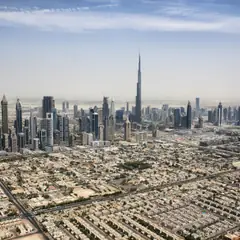
Facing the skyscrapers of Dubai, at the mouth of the Creek, stretches a quarter of low coral-stone houses, wind towers and shaded alleys. It is the Shindagha peninsula, the place to which, in 1833, the head of the Al Maktoum family brought his people. That narrow strip between the sea and the creek became the city’s main residential quarter and the cradle of the dynasty that still rules it.
The history of the Al Shindagha Museum has a twist that cannot be guessed at a glance. After Port Rashid was built the quarter was abandoned, and in the early 1990s the government demolished most of its structures. What is walked today is the result of 15 years of reconstruction with traditional techniques and materials, guided by interviews with master builders (the ostads) and with some 80 people who had lived there. In March 2023 the renovated museum opened: 80 of the quarter’s 162 historic houses arranged in 22 themed pavilions, from governance to pearls, poetry or ceramics. The figures for the whole complex shift depending on the source, from the number of houses to the museum’s surface area.
As for the architecture of Al Shindagha, the great protagonist is Sheikh Saeed’s house, home of the ruling family until 1958 and birthplace of the current ruler, Mohammed bin Rashid Al Maktoum. To learn what to see at the Al Shindagha Museum, the audio guide covers it in five stops and 90 minutes: from the edge of the Creek to the upstairs majlis, the quarter’s alleys and the courtyard of the Perfume House. The thread that links them is a quarter erased and raised again from its residents’ memories.
Upriver, the coral houses and wind towers of the Al Fahidi Historic District complete the portrait of old Dubai, and the museum’s shore looks out over the mouth of Dubai Creek, the port where the city was born. The story of the Al Maktoums continues at the Etihad Museum, where the Emirates were born in 1971.
Four wind towers between two waters
Mouth of the Creek
Summary of this stop
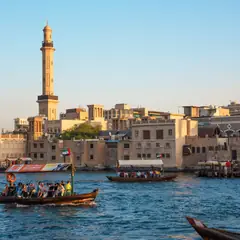
From the waterfront promenade the first image is that of a two-storey domestic coral house, with facades of arched niches and four wind towers (barajeel), planted opposite a vertical city. Across the water lie Deira and Al Ras; to one side, the mouth of the creek opens to the sea, with abras and dhows in motion. It is the strip the dynasty chose in 1833 and on which, by the most cited date, this residence was built in 1896. Sources do not agree on who built it: some attribute it to Saeed bin Maktoum, others to his father, Maktoum bin Hasher, who was ruling in those years, and one places it around 1894.
This stone Shindagha hides a more fragile one. In 1948, a boy from Sharjah, Sultan bin Muhammad Al Qasimi, today ruler of the neighbouring emirate, spent a few days here with his grandmother. By his own account, they arrived by crossing the Creek in an abra and wading, knee-deep in water, across a plain that the tide covered and uncovered. His grandmother’s house was made of palm leaf, in an alley of palm-leaf houses, with sea on every side.
From those days there remain a night of north wind, some unexpected visitors and a wave that slipped in where it should not have. In front of the house, the audio guide tells what that palm-leaf quarter was like before the rebuilt coral, and what the boy looked at from the beach in the mornings.
Coral stone over reinforced concrete
Sheikh Saeed Al Maktoum House
Summary of this stop
In the courtyard of Sheikh Saeed’s house the feeling is one of antiquity: high vaulted ceilings, carved windows, arched entrances and shaded galleries, with the wind towers cut against the sky. Several sources describe it as having three courtyards surrounded by 30 rooms, although the architectural record speaks of a single central courtyard with two levels around it. Today it works as the Al Maktoum Residence pavilion, with display cases holding the khanjar, the binoculars, the barometer and the radio of Rashid bin Saeed, and the pocket watch of Maktoum bin Hasher.
What feels ancient under the hand is, however, a work of the 1980s. It was the first building in Shindagha that Dubai Municipality rebuilt: works began in 1981 and were considered finished in 1986, although some sources place the initial push at the end of the 1970s. It was presented as a restoration, but technically it was the reconstruction of a ruined house: a reinforced-concrete skeleton on concrete foundations, clad with stone from the old building, and a concrete roof in which the original wooden beams were put back only as decoration.
That coral skin over concrete bones leaves open a question that accompanies the rest of the quarter: what is authentic in a rebuilt place. In the courtyard, the audio guide explains how those layers are read and what the house keeps of the original.
The hand that was not let go in 1958
Upstairs majlis
Summary of this stop
Upstairs, the majlis opens onto the creek: from the reception room one overlooks the traffic of the Creek and the shore of Deira. This house was home to three generations. Sheikh Saeed bin Maktoum lived here until his death in 1958, and here his grandson Mohammed bin Rashid Al Maktoum, the current ruler of Dubai, was born and spent the first decade of his life within these walls. It is said of Saeed that he rose before dawn to carry water to the mosque himself, and his grandson remembers him as the kindest man he has ever known.
The family keeps an episode from that 1958. The sheikh died shortly after the dawn prayer, with his son Rashid at his side, and a crowd accompanied the body to the grave. When the coffin left the house, Rashid took Mohammed, who was almost nine years old, by the hand and did not let go of it throughout the procession.
That boy returned to this same house in March 2023 to open the renovated museum with a ceremony. In the majlis, the audio guide tells what happened during that procession and the question Mohammed himself kept asking decades later.
Six mosques that survived the wrecking ball
Sikkas and neighbourhood mosque
Summary of this stop
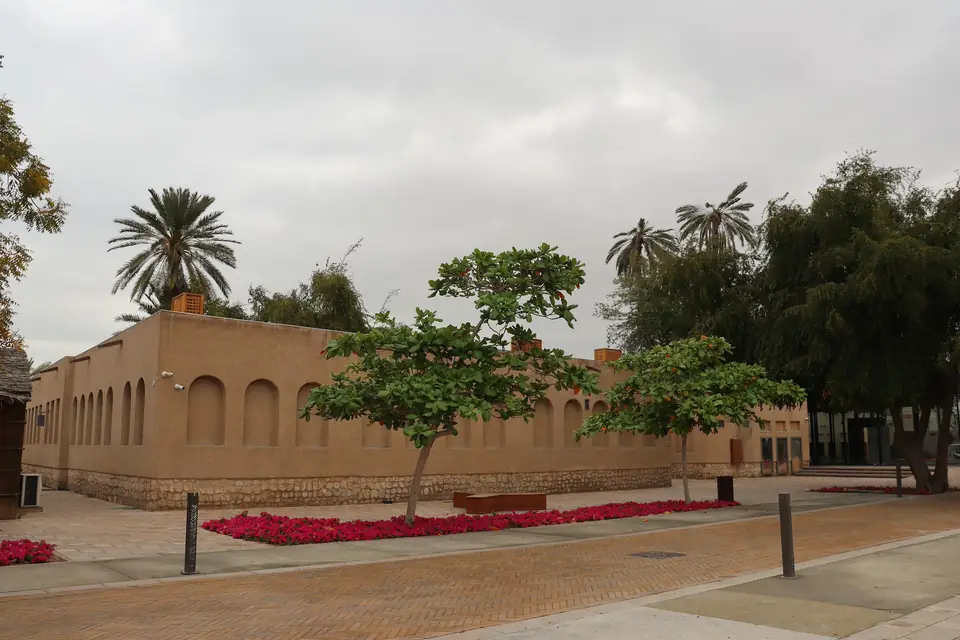
Outside the house begin the sikkas, narrow alleys between coral-stone walls and carved wooden doors. The neighbourhood mosques, like that of the sheikhs, are among the little that held out. When Port Rashid emptied Shindagha and the government demolished most of its structures in the early 1990s, only the trees, six mosques and the foundations were saved, left covered by about 80 cm of sand.
The quarter that is walked today was rebuilt over 15 years, with traditional techniques and materials and with the memory of the ostads and of some 80 people who had lived here before the demolition. The result recovers around 95% of the look Shindagha had in the 1950s.
And the quarter is not just scenery. Every year, in the middle of the month of Shaaban, before Ramadan, these alleys celebrate Haq al-Laila, a documented festival in which children in traditional dress and with cloth bags go from house to house singing popular verses and collecting sweets. Among the sikkas, the audio guide explains how a quarter was put back together from memories and what games return to its streets that night.
Perfumes buried in Shaikha’s courtyard
Perfume House courtyard
Summary of this stop
The tour ends with the sense of smell. The Perfume House occupies the home of Sheikha Shaikha bint Saeed Al Maktoum (1918-2017), a gift from her brother Rashid bin Saeed. In the entrance courtyard, myrtle, rose, musk and saffron are on show, and in front of the house a display case shows how many oud shavings are needed for one tola, about 12 grams of perfume.
Shaikha was an accomplished perfumer: she made her blends in her bedroom, buried them in her private courtyard to ferment and then kept them for months under the bed. A few weeks before her death, in 2017, she donated to the museum a piece of oud of 1.2 metres and 28 kilos from her collection, today one of the house’s central pieces, alongside traditional incense burners.
Here the memory of the quarter is not rebuilt in stone, but in scent. In the courtyard, the audio guide closes the tour with the secrets of Shaikha’s method and the story of that oud.