Guinness record viewpoint
Dubai Frame Audio Guide
A golden frame 150 metres tall planted in Zabeel Park that shows nothing inside itself except the city: to the north the Dubai of fishermen and pearl divers, to the south the towers of Sheikh Zayed Road. And behind the glitter, an architect who cannot set foot in his own work.
- 60 min of audio
- Contemporary architecture
The Dubai Frame came out of an international competition called by Dubai Municipality and ThyssenKrupp Elevator: in 2008 the Mexican architect Fernando Donis, based in Rotterdam, won among 926 entries with an idea that ran against the grain. In a city saturated with emblem skyscrapers he did not propose another icon, but a void: a white, slender frame without ornament, 150 metres tall, that would frame all the other landmarks. It opened on 1 January 2018 and in 2019 Guinness World Records verified it as the largest picture-frame-shaped building.
The building that went up is not the one that was drawn. The smooth white facade disappeared under more than 15,000 m² of gold-coloured stainless steel stamped with the circles of the Expo 2020 logo, and its author was left out: in 2013 he rejected the Municipality’s contract, which built the frame without him, and in 2016 he sued it in the United States. Authorship remains in dispute.
Highlights
- The hollow of the frame — 150 metres of void that frame the skyline from Zabeel Park, a Guinness record in 2019
- Golden skin — More than 15,000 m² of stainless steel with the Expo 2020 circles in place of the original white facade
- Sky Bridge — A 93-metre bridge at 48 storeys with 116 m² of glass that turns transparent when stepped on
- Two Dubais in one glance — Deira, Umm Hurair and Karama to the north; the skyscrapers of Sheikh Zayed Road to the south
- Galleries of past and future — Holograms, mist and smells of old Dubai and a neon tunnel towards the city of 50 years from now
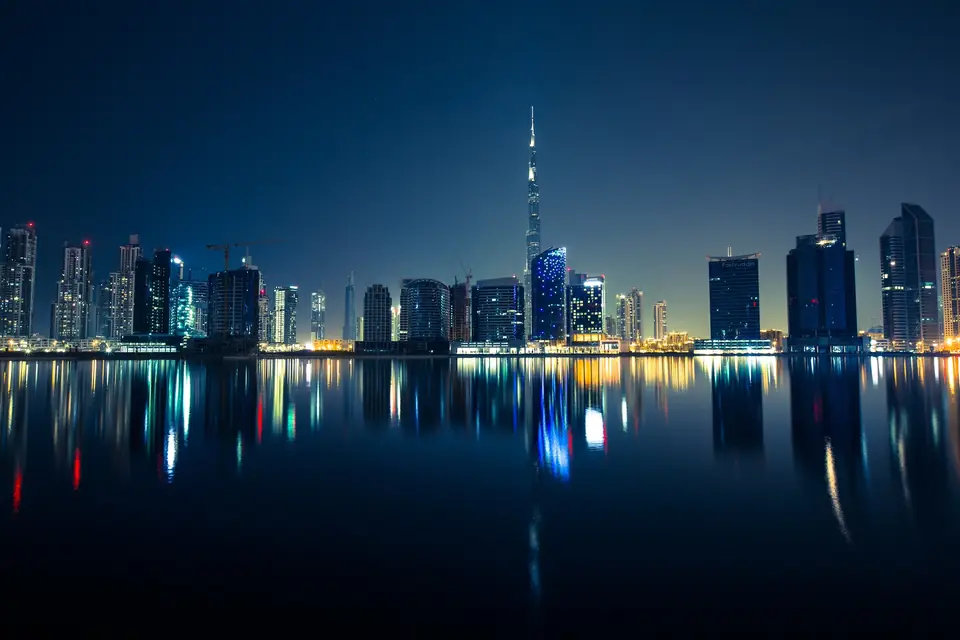
In a city that competes to have the tallest tower, the most improbable island or the most luxurious hotel, the Dubai Frame bets on the opposite: a hollow. Two concrete towers 150 metres tall and a bridge at the top draw an empty rectangle in Zabeel Park, oriented to frame two cities at once: to the north, the low-rise districts of Deira, Umm Hurair and Karama, the old Dubai; to the south, the row of skyscrapers of Sheikh Zayed Road.
The history of the Dubai Frame begins in 2008, when Dubai Municipality and the German ThyssenKrupp Elevator called an international competition. It was won, among 926 participants and with a prize of 100,000 dollars, by the Mexican architect Fernando Donis, based in Rotterdam, with his idea of a white, minimalist “anti-icon”. Works began in 2013 with the opening planned for 2015; after several postponements, the frame opened on 1 January 2018, presented as a New Year’s gift to residents and managed by Emaar, the developer of Burj Khalifa.
The architecture of the Dubai Frame has more numbers than it seems: proportions that follow the golden ratio, some 9,900 m³ of reinforced concrete, 2,000 tonnes of steel, 2,900 m² of laminated glass and a design adjusted after wind-tunnel tests. In May 2019, Guinness World Records verified it as the largest picture-frame-shaped building, at 150.23 by 95.53 metres, although the Municipality’s official record speaks of 150 by 93. The figures for its cost do not agree either: those published range from 160 to 250 million dirhams.
To learn what to see at the Dubai Frame, the audio guide covers it in five stops and 60 minutes: from the park lawn at the foot of its golden skin, and inside, from the old Dubai gallery to the glass bridge and the tunnel that leads into the Dubai of the future. The thread that links them: a viewpoint that is a hinge between the city of pearl divers and that of glass towers, and a void with a disputed owner.
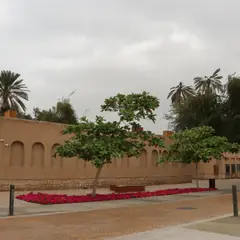
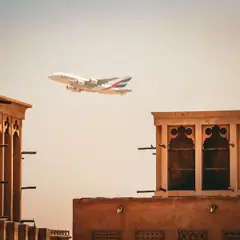
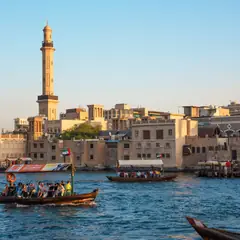
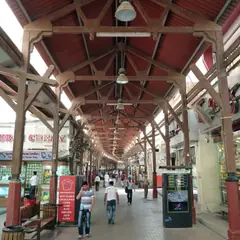
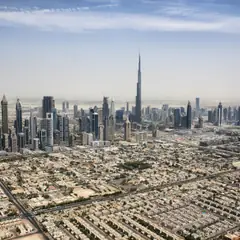
To the south, among the towers of Sheikh Zayed Road, rises Burj Khalifa, the tallest skyscraper in the world; to the north, towards old Dubai, lies the Al Fahidi Historic District, with its wind towers.
An empty frame for a city of icons
Dubai Frame
Summary of this stop
From the lawn of Zabeel Park, the protagonist is not the building but what it lets you see. The hollow of the frame frames the skyline like a giant painting and has become one of the most popular selfie backdrops in the city. It was exactly Fernando Donis’s intention in 2008: not to raise another emblem skyscraper, but a slender, unornamented void that would put a frame around all of Dubai’s other landmarks.
That competition idea ended with a record of its own. In 2019 Guinness certified it as the largest picture-frame-shaped building, an important nuance: the record is not for the “largest frame in the world”, as is often repeated, but for a building of that shape.
When night falls, the picture changes canvas. The frame has been tinted with the colours of Oman for its 50th National Day, with the Kuwaiti flag for Kuwait’s 60th, yellow beside the Burj Al Arab on the eve of Expo 2020 and with the Emirati flag for the 50th Union Day. In front of the frame, the audio guide tells what is special about New Year’s Eve here, far from Burj Khalifa.
Expo circles over a white dream
Golden cladding of the frame
Summary of this stop
At the foot of the tower, beside the entrance, the glitter becomes suspicious. The frame is clad in more than 15,000 m² of gold-coloured stainless-steel sheet, stamped with rings taken from the Expo 2020 logo. Of the smooth white frame that won the competition nothing remains on the facade. The change of cladding to a fireproof golden steel, defended by the Municipality’s director general, Hussain Nasser Lootah, was in large part the reason the opening was postponed from 2015 to 2016, then to 2017 and finally to 2018.
With the white facade its author disappeared too. In 2013 Donis rejected the final draft of the contract and the Municipality commissioned the project to Hyder Consulting, a subsidiary of the Dutch group Arcadis, which built it without him. In December 2016 the architect sued the Municipality and ThyssenKrupp Elevator before a US federal court, a case that never reached any conclusion.
Authorship remains disputed. Donis maintains that his design was taken and changed without compensation beyond the prize, and points out that the structure keeps its 150 metres of height and is only 12 metres narrower than his plan; the Municipality replies that the current Frame is very different and that he lacked the necessary local licences, and ThyssenKrupp called it a “commercial disagreement”. In front of the golden skin, the audio guide relates, as a disputed story, the dinner and the contract that left the architect looking at his work from afar.
Mist, smells and the father of Dubai
Old Dubai gallery
Summary of this stop
On the mezzanine, the old Dubai gallery opens with a tribute to Sheikh Rashid bin Saeed Al Maktoum, the “father of Dubai”. Then, the room recreates the city of fishermen and pearl divers of the Creek with holograms, mist effects, sounds, chants and smells: a return through the senses to the Dubai before oil and towers.
This was also the setting for its coming-out. The frame opened on 1 January 2018 with capacity limited to 200 visitors per hour and tickets sold at gate 4 of Zabeel Park. Days earlier, in late December 2017, the ruler of Dubai, Sheikh Mohammed bin Rashid Al Maktoum, toured it with the crown prince and visited the museum on the ground floor.
That visit left an irony documented in the chronicles of the time. Among the mist and holograms, the audio guide tells what name appeared beside the building in those days and why it was not the first time it had happened.
A floor that vanishes at 150 metres
Sky Bridge
Summary of this stop
Four ThyssenKrupp panoramic lifts rise in 75 seconds to the Sky Bridge, 48 storeys above the ground. Here the frame stops being an object and becomes a lens: through the north windows stretches the low fabric of Karama, Umm Hurair, Bur Dubai and Deira; through the south ones, the vertical wall of Sheikh Zayed Road.
The bridge measures 93 metres, and 116 m² of its floor is smart glass that turns from translucent to transparent when stepped on, revealing the foundation slab and Zabeel Park 150 metres below. For those who do not want to cross over the void there is a concrete walkway beside it.
What holds up that floor has its own feat: the upper bridge, of steel and 750 tonnes, was not built up high. Over the glass, the audio guide explains how it got there and how long the operation lasted.
A neon tunnel to the Dubai of tomorrow
Future Dubai gallery
Summary of this stop
After going down the opposite tower, the tour enters a vortex tunnel of neon lights and sound effects that simulates a journey through time. On the other side waits the future Dubai gallery: a virtual city projected 50 years ahead, with flying taxis, Hyperloop and 3D-printed buildings. The journey that began among pearl divers ends here.
Along the whole route runs a detail that easily goes unnoticed: a railing with braille inscriptions totalling 319 metres and 11 centimetres. It is the building’s second Guinness record, achieved by the Municipality: the longest braille handrail in the world.
Among the neon and the projections, the audio guide closes the tour by tying together the two ends of the frame, the Dubai that was and the one that is imagined, and the question the building leaves open about who signed it.