Tallest skyscraper in the world
Burj Khalifa Audio Guide
The tallest skyscraper in the world is a desert flower and an echo of the Samarra minaret raised on brackish sand: 828 metres that were a secret until the day of its opening and a name changed by surprise that same night.
- 90 min of audio
- Contemporary architecture
Burj Khalifa was born as Burj Dubai. Skidmore, Owings & Merrill won the design competition in 2003 and in January 2004 more than 190 piles began to be driven into a subsoil of sand and brackish water. On a three-winged Y-shaped plan, inspired by the Hymenocallis flower, the tower rises in 27 spiral setbacks that disorganise wind vortices, a form refined in the wind tunnel by the team of Adrian Smith and Bill Baker, who took as a reference the Malwiya, the helical minaret of Samarra.
Its height was a secret throughout construction and was only revealed at the opening on 4 January 2010: 828 metres. That same day, in the middle of the debt crisis, the tower was renamed by surprise to honour the emir of Abu Dhabi, the emirate that a year earlier had injected some 25 billion dollars into Dubai. And above the highest occupiable floor there remain 244 metres of spire with no usable space.
Highlights
- Spiral silhouette — A Y-shaped desert-flower plan and 27 setbacks that confuse the wind, with an echo of the Samarra minaret
- Dubai Fountain — 270 m of choreographed jets reaching 150 m high in the lake at the foot of the tower
- Steel from Berlin — More than 35,000 tonnes from the Palace of the Republic in the former GDR
- At the Top viewpoint — Outdoor terrace on floor 124, at 452 m, and floor 148, at 555 m
- Vanity height — 244 m of spire with no usable space and a 143 m pinnacle assembled from inside
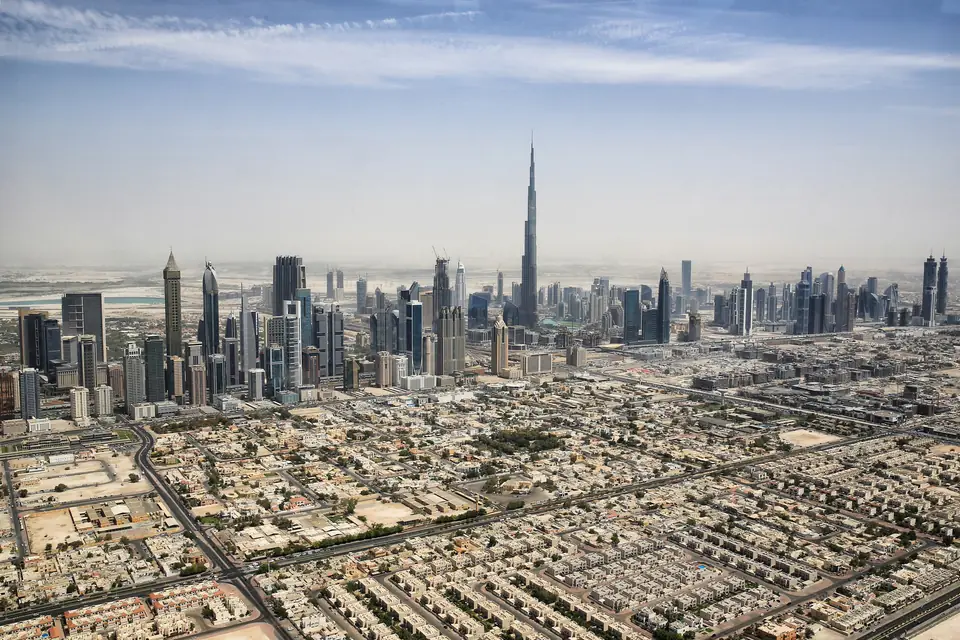
From any point in Downtown Dubai the spire sharpens until it is lost in the sky. It is Burj Khalifa, the tallest skyscraper in the world, at 828 metres of architectural height. But that figure was not known until the last moment: throughout construction, the developer Emaar Properties would admit only “more than 700 metres” and the architects “more than 600”. The exact number was revealed at the opening ceremony on 4 January 2010, the same one at which the tower, until then Burj Dubai, was renamed by surprise.
The history of Burj Khalifa begins in 2003, when Skidmore, Owings & Merrill (SOM) won a limited design competition. In January 2004 more than 190 piles 1.5 metres in diameter began to be driven down to a depth of 50 metres, into a subsoil of sand and brackish water. What grew on top is a piece of engineering and symbols at once: a three-winged Y-shaped plan inspired by the Hymenocallis flower, and a rising spiral that looks to the Malwiya, the helical minaret of the Great Mosque of Samarra, in Iraq.
The architecture of Burj Khalifa is also understood by what cannot be seen: more than 35,000 tonnes of steel from Berlin, a pinnacle assembled from inside and pushed upwards, and a structure raised by thousands of workers whose conditions were denounced by organisations such as Human Rights Watch. To learn what to see at Burj Khalifa, the audio guide covers the tower in four stops and 90 minutes: two from the lake and the promenade at its foot, and two already up high, at the At the Top viewpoint, with the whole of Dubai beneath the windows.
Another viewpoint, the Dubai Frame, frames from Zabeel Park the Dubai of the towers and the old one at the same time, and the Etihad Museum tells how in 1971 the federation was born that unites Dubai with Abu Dhabi, the emirate whose emir gives the tower its name.
A desert flower watered by its air conditioning
The Dubai Fountain
Summary of this stop
The lakeside promenade, in front of the Dubai Fountain, is the best place to learn to read the silhouette. The three wings of the Y-shaped plan shorten in 27 steps arranged in a spiral, which from below look like ever narrower terraces. They are not an aesthetic whim: that changing profile disorganises wind vortices, and the SOM team led by Adrian Smith and Bill Baker adjusted the form practically in the wind tunnel. Baker also incorporated a reference from regional Islamic architecture, the spiral of the Malwiya of Samarra.
The water closes the circle. The tower’s air-conditioning system condenses some 68 million litres a year, which water the 11-hectare park that surrounds it, designed by SWA Group on the same Hymenocallis flower that inspires the tower’s three-petal plan. In the lake, the fountain by WET Enterprises, which cost 800 million dirhams, measures 270 metres and shoots jets to a height of 150 metres to the rhythm of classical, Arabic and contemporary music; its name came out of a contest announced by Emaar in October 2008.
This lake is also the stage of a living ritual: since 2010, every 31 December the tower launches fireworks from its own facade, with lights, lasers and the fountain dancing in time. One of those nights, that of 2015, had an impossible backdrop on the other side of the water. In front of the fountain, the audio guide tells what happened that New Year’s Eve and why the countdown did not stop.
Berlin steel and a night of rage
Glass skin and steel fins
Summary of this stop
In front of the base, the tower’s skin takes in everything: more than 26,000 panels of reflective glass, aluminium, textured stainless steel and vertical tubular fins that shine in the sun and, at night, serve as a screen for the facade’s LED shows. Beneath that glitter lies another story. The foundations were driven into sand and brackish water, and among the structural steel are more than 35,000 tonnes from the Palace of the Republic in Berlin, the seat of the People’s Chamber of the former GDR, shipped to Dubai after its demolition was completed in 2008.
There was rage too. In March 2006, some 2,500 labourers of the contractor Al Naboodah Laing O’Rourke, who were working on the buildings around the tower, smashed cars and offices in a night of protest and refused to go back to work: they demanded overtime, medical care and humane treatment. Damage was estimated at one million dollars. Officially only one death related to the work was reported, although Human Rights Watch warns that workplace injuries and deaths in the Emirates are poorly documented, and the BBC and HRW described wretched lodgings, long hours, low wages and withheld passports.
When the tower was still a building site and was called Burj Dubai, someone sneaked into it before dawn disguised as a European engineer, climbed it on foot and waited for sunrise on a balcony. Beside the base, the audio guide rounds off the stop with the story of that clandestine jump and how it came to be known.
Two hundred and forty-four metres of vanity
At the Top viewpoint
Summary of this stop
On the outdoor terrace of floor 124, at 452 metres, the At the Top viewpoint opened on 5 January 2010. In 2014 floor 148 was added, at 555 metres, and after losing the record to the Shanghai Tower in 2016, the tower regained it in February 2019 with The Lounge, at 585 metres. From here the fountain, the lake, Downtown and the coast can be seen, but the most revealing thing is above.
The spire that continues upwards holds an assembly secret: the 143-metre steel pinnacle was built inside the tower. Its 5-metre sections were hoisted to floor 156, welded inside and the whole was raised with hydraulic jacks in eight pushes of 9 to 12 metres; 30% of its length was left hidden inside the building as an anchor. The highest occupiable floor is at about 585 metres, so the remaining 244 metres hold no usable space. A 2013 CTBUH study called it “vanity height”: by itself it would be the eleventh tallest building in Europe.
This summit soon had its fragile side. The lifts, the tower’s pride, gave a serious scare between floors 124 and 125 barely a month after the debut, and the viewpoint had to close for weeks. On the terrace, the audio guide reconstructs that afternoon and what the developer preferred not to say.
Burj Dubai renamed at the last minute
Viewpoint window over Sheikh Zayed Road
Summary of this stop
In front of the window towards Sheikh Zayed Road it is understood that the tower’s name is a political document. On 4 January 2010, in the middle of the debt crisis, the emir Mohammed bin Rashid Al Maktoum announced by surprise that Burj Dubai would be renamed Burj Khalifa, after Khalifa bin Zayed Al Nahyan, emir of Abu Dhabi and president of the United Arab Emirates. Abu Dhabi had injected some 25 billion dollars into Dubai the year before. The act was presented as a tribute; a good part of the international press and analysts read it as a quid pro quo for the bailout.
The change had very earthly consequences. The Roads and Transport Authority (RTA) had to rename the tower’s newly opened metro station, today Burj Khalifa/Dubai Mall, and replace dozens of signs, while the sellers of Karama were left with boxes of “Burj Dubai” souvenirs marked down from 20 to 15 dirhams.
And the tower even reorders time. A fatwa of August 2011 by the mufti Ahmed Al Haddad divided the building into three Ramadan timetables according to the floor, because from above the sun takes longer to set. In front of the window, the audio guide closes the tour by explaining how many minutes separate the fast at the base from that of the highest floors.