Historic souk of Deira
Dubai Gold Souk Audio Guide
A covered souk in Deira, beside the mouth of the Creek, where hundreds of jewellers display some ten tonnes of gold in full view of the street: the shop window of a trade route of dhows, Gujarati families and smuggling to Bombay that made Dubai the “City of Gold”.
- 45 min of audio
- Gold trade and the souks of Deira
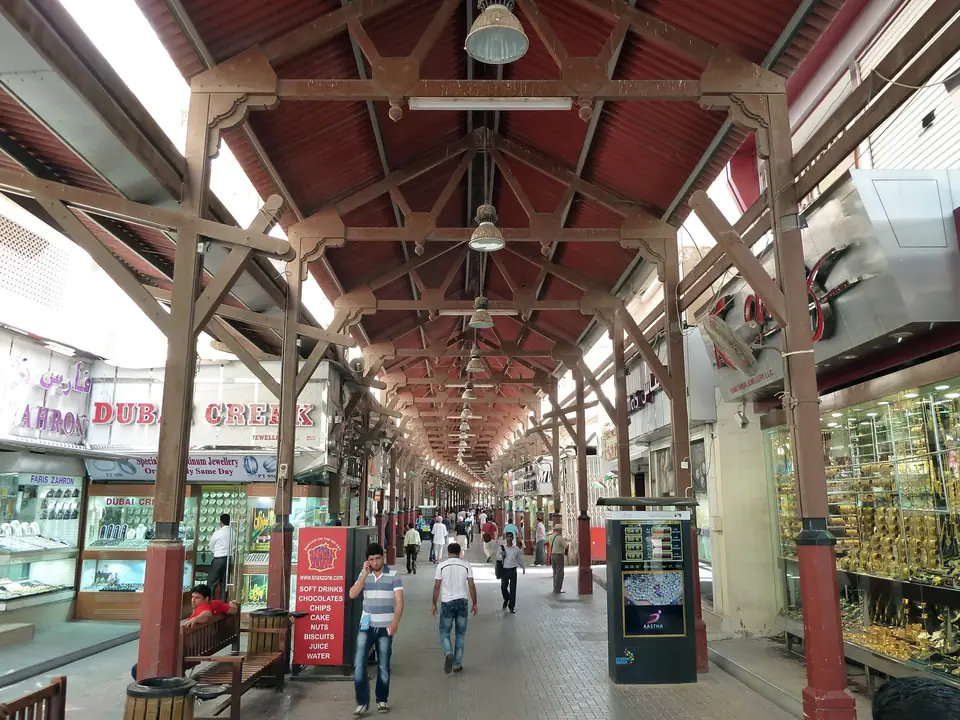
The Gold Souk was born, by the most cited version, in the early twentieth century, when a handful of merchants opened shop beside the Creek drawn by a tax-free regime, and it grew towards the 1940s with the arrival of businessmen from India and Iran. Today it gathers more than 380 jewellers along a pedestrian street covered by a roof of carved wood and lattice that filters the light, restored in the Old Suq programme begun in 1998 and again in 2025.
Here gold is not kept in the back room to be brought out piece by piece: it is piled up in the shop windows, under purity and scale inspections, in cascades of bridal necklaces, bracelets and ingots. And a few steps away, behind doors with cameras and locks, work the goldsmiths’ workshops, many of them from Gujarat, who solder and repair those same jewels.
Highlights
- Najmat Taiba — The largest gold ring in the world according to Guinness: about 64 kg of 21-carat gold behind glass
- Central axis with wooden lattice — The souk’s covered street, with wooden columns and arches and more than 380 jewellers
- Cascading windows — Some 10 tonnes of gold in view of the street, among bridal necklaces, bracelets and ingots
- Gold price boards — The official price of the day per gram and carat: bargaining is done on the workmanship
- Spice souk — More than 200 shops with sacks of saffron, turmeric, incense and dried rose, on the way to the abra
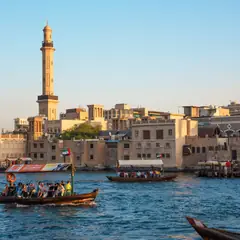
In Deira, beside the mouth of the Creek, a pedestrian street covered by a carved wooden roof concentrates at any moment, by a 2018 estimate, some ten tonnes of gold. It is the Dubai Gold Souk: more than 380 jewellers, many belonging to families who came from India, who display the metal in heaps in the window, without the slightest modesty. The count of shops changes depending on the source and the perimeter counted, from those 380 to more than 400, more than 500 and even 800.
The history of the Gold Souk has no fixed date either. The most cited versions place its informal origin in the early twentieth century, when a few merchants opened shop near the Creek drawn by the absence of taxes and wooden dhows brought and took gold along the inlet; there is hardly any official record before 1971, other sources speak of the gold business from the 1940s and many present-day shops are about forty years old. What is documented is that, around the 1940s, free-trade policies attracted businessmen from India and Iran, and that after the Partition of 1947 Dubai and Bombay became the two poles of a gold economy that made this emirate the “City of Gold”.
The architecture of the Gold Souk is that of a traditional market touched up without losing its character: wooden columns and arches, a central axis with lattice that filters the light, awnings and shades of wood restored in 2025. When the municipality announced its renovation in 2018, the merchants asked for toilets and control of the sellers of imitations, but feared that, if the roofs were touched, the souk would end up looking like a mall.
To learn what to see at the Dubai Gold Souk, the audio guide covers it in four stops and 45 minutes, from the largest ring in the world to the smell of saffron in the spice souk. The thread that links them: this calm cascade of gold is the visible counter of a route of dhows, Gujarati families and smuggling to Bombay, and the old souk is still alive because people also come here for the scene.
The gold came in and out through Dubai Creek, a few steps away, and across the water the Al Fahidi Historic District keeps the coral houses and wind towers of the merchants who came from Bastak, in southern Iran.
A 64-kilo ring at the door
Najmat Taiba ring
Summary of this stop
Just past the main entrance from Old Baladiya Street, behind the glass of the Kanz Jewellers showroom, the first impact awaits: Najmat Taiba, “Star of Taiba”, the largest gold ring in the world according to Guinness, accompanied by its certificate. It weighs about 64 kilos, is made of 21-carat gold and was manufactured by the jeweller Taiba in the year 2000: 55 workers laboured for 45 days, ten hours a day. It has not always been here: in 2018 it was exhibited at the Sahara Centre in Sharjah, and descriptions of its gemstones do not agree between sources either.
Its price tells another story. It cost 547,000 dollars, with gold at about 250 dollars an ounce, and by 2018 it was already valued at about 3 million. A record that is both a curiosity and a thermometer of how much the metal has risen.
One afternoon a year this entrance changes its look. On Dhanteras, the day that opens the Hindu festival of Diwali, the souk fills with Indian families keeping the custom of buying gold or silver, which according to belief brings prosperity and good luck. In October 2025, with gold above 500 dirhams a gram, the access streets jammed and many families kept to their budget by taking lighter pieces. In front of the ring, the audio guide tells how that afternoon is lived among marigolds, little lamps and the goddess Lakshmi.
Gold without fear in the window
Central axis with wooden lattice
Summary of this stop
Beneath the wooden lattice of the central axis, the display cases overflow with bridal necklaces, bracelets and ingots of an intense yellow. In other countries jewellery is kept in a warehouse and brought out piece by piece; here the shops, subject to purity and scale inspections, display it in enormous quantities directly in the window. In 2021 tourists were more than 70% of the clientele, and the wooden columns of the gallery are their favourite backdrop for photos.
Behind many of those signs are surnames from Gujarat. The goldsmith Dhanji Motiram, who arrived in the early 1950s, opened his first shop in the souk in 1958, and one of his premises he leased for 100 Indian rupees with a contract written in Gujarati, approved in writing in Arabic by the owner and sealed with the fingerprints of both.
A few steps away, in the narrowest alleys at the back, there is another souk that almost nobody sees: workshops behind doors with cameras and sophisticated locks, where the pieces the shops sell are repaired, adjusted or made. In 2013 it was estimated that 90% of the workforce came from Gujarat, and many goldsmiths had learned the trade by watching their fathers. On the central axis, the audio guide reveals what those closed rooms are like and what veteran sellers know the moment the door opens.
The price of the day and the route to Bombay
Gold price board
Summary of this stop
Scattered around the souk, screens and signs announce the official gold price of the day per gram and carat. The metal has a fixed price; bargaining is done on the workmanship. That luminous figure is the tip of a story that begins on the water: in the early twentieth century, wooden dhows brought and took gold along the inlet under the shelter of a tax-free regime.
In the second half of the century, after the Partition of 1947 and the arrival of Indian merchant capital, Dubai and Bombay became the two poles of a gold-smuggling economy sustained by merchants, dhows and migrants, which took advantage of India’s restrictions on gold imports. The circuit was so profitable that in 1957 alone India paid the equivalent of 92.4 million dollars for the rupees returning from the Gulf, and in 1959 it responded with a monetary invention.
Until the early 2000s this souk was the main reason for the nickname “City of Gold”; since 2002 a good part of that role passed to the Dubai Multi Commodities Centre, and in 2011 1,200 tonnes of gold passed through Dubai, a quarter of world demand. In front of the board, the audio guide explains what the Gulf rupee was and why it failed to cut the route.
From gold to Iranian saffron
Dubai Spice Souk
Summary of this stop
Towards the Deira Old Souk abra station, the shine gives way to scent: alleys with tiny shops and open sacks of saffron, turmeric, incense and dried rose. The spice souk, whose first nucleus formed around the 1850s, had barely six shops in 1967, with no electricity or running water, and a gram of saffron cost one Indian rupee. Today it has more than 200 shops and 90% of its saffron comes from Iran.
In August 2025 the municipality finished the Gold Souq Trail, a 995-metre heritage route within a 9.5-million-dirham project in the souks of Deira: it restored the wooden shades, applied sarooj, a lime plaster, to structures and facades, and installed 38 signs on columns and 154 markers on the ground.
The old souk had already passed a harder test. When the Dubai Mall opened its own air-conditioned gold souk, with more than 200 shops, the jewellers of Deira feared the worst, and the opposite happened. Among the spice sacks, the audio guide closes the tour with the story of that duel and why heat and wood beat air conditioning.