Penang’s Blue Mansion
Cheong Fatt Tze Mansion Audio Guide
The indigo courtyard house that a Hakka tycoon dressed in Glasgow iron and English tiles, raised on a pretend hill and bound with a will that almost doomed it.
- 60 min of audio
- Chinese courtyard house with feng shui
Cheong Fatt Tze, Chinese consul in Penang from 1890, built on Leith Street between 1897 and 1904 a house that was at once home, office and vice-consulate, and the home of his seventh wife, the favourite. With 38 rooms, 5 granite courtyards, 7 staircases and 220 louvred windows, it is the largest surviving Chinese courtyard-garden style residence in Malaysia, and its restoration received in 2000 the Most Excellent Project award of the UNESCO Asia-Pacific awards.
Beneath the Chinese plan, materials from half the British empire show through: encaustic tiles from Stoke-on-Trent, cast-iron columns from MacFarlane’s in Glasgow and Art Nouveau stained glass. And beneath the blue of the postcards lies another house, the one that families of tenants shared in the years of ruin and that in Penang, the legend goes, was called the haunted blue house.
Highlights
- Indigo façade — lime wash tinted with Indian indigo that kept the walls cool
- Chien nien porcelain eaves — figures rebuilt from thousands of Fujian bowls broken by hand
- Main hall — Stoke-on-Trent tiles, Glasgow ironwork and Art Nouveau stained glass
- Central courtyard open to the sky — two steps in front and three behind, a feng shui slope
- First-floor gallery — openwork iron railings and 220 Gothic louvred windows
The Cheong Fatt Tze Mansion went up over seven years, from 1897 to 1904, according to the date most sources give, although some place the work in the 1880s. Its owner, the Hakka tycoon Cheong Fatt Tze, had been appointed Chinese consul in Penang in 1890, and he wanted a house that would serve for everything: home, seat of his businesses, Chinese vice-consulate and home of his seventh wife, the favourite. The result occupies a plot of some 53,000 square feet, with 34,000 built up, and is today the largest surviving Chinese courtyard-garden style residence in Malaysia, known to everyone as the Blue Mansion.
The history of the Cheong Fatt Tze Mansion is also that of its survival. The house passed from generation to generation within the family until it fell into ruin in the 1980s; a group of Penang conservationists bought it when Cheong’s last son died, in 1989 according to some sources and 1990 according to others, and the architect Laurence Loh led from 1990 a restoration that was awarded in 1995 by the Malaysian Institute of Architects and in 2000 by UNESCO. What to see at the Cheong Fatt Tze Mansion, and how to read in its architecture the portrait of a man who dressed himself in British industry without ceasing to be Chinese, is what the audio guide unfolds over an hour, from the indigo façade to the hall, the central courtyard and the first-floor gallery.
The same Glasgow iron and the same English tiles dress the Pinang Peranakan Mansion, the green house of another Hakka tycoon, and a few minutes away, on the cape where the city was born, Fort Cornwallis awaits.
A lime-wash blue against the T-junction
Cheong Fatt Tze Mansion
Summary of this stop
The tour begins on Leith Street, in front of the walls that give the house its name. That blue is not paint: it is a lime wash mixed with natural indigo dye, imported from India to Penang by the British. The lime absorbed damp and cooled the interior, so the colour of the postcards was also an air-conditioning system. Why that shade was chosen is still disputed: written sources explain it as a prestigious colour of the colonial era, preferred to the more common white, while other accounts hold that the house was born white and disagree on which of the two colours was associated with mourning.
Next to the main door, a low block juts out in front of the façade. It is the servants’ annex, and its position is no accident: feng shui required avoiding a street forming a T-junction facing the house, and the annex was built in front to prevent it. Opposite, across the street, a row of five terraced houses lodged Cheong Fatt Tze’s staff.
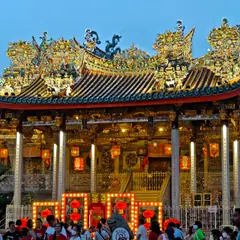
Up above, on gables, doors and roof edges, human figures, animals and scenes from Chinese mythology shine, made of cut porcelain in the chien nien technique. Much of it had been lost, and to rebuild it the restoration brought craftsmen from China and, according to documented tradition, more than ten thousand bowls from Fujian, although another account speaks of twelve thousand. How and why those bowls were broken, made on purpose to be smashed, is the detail with which the narration closes this stop.
Glasgow iron for a Chinese consul
Main hall
Summary of this stop
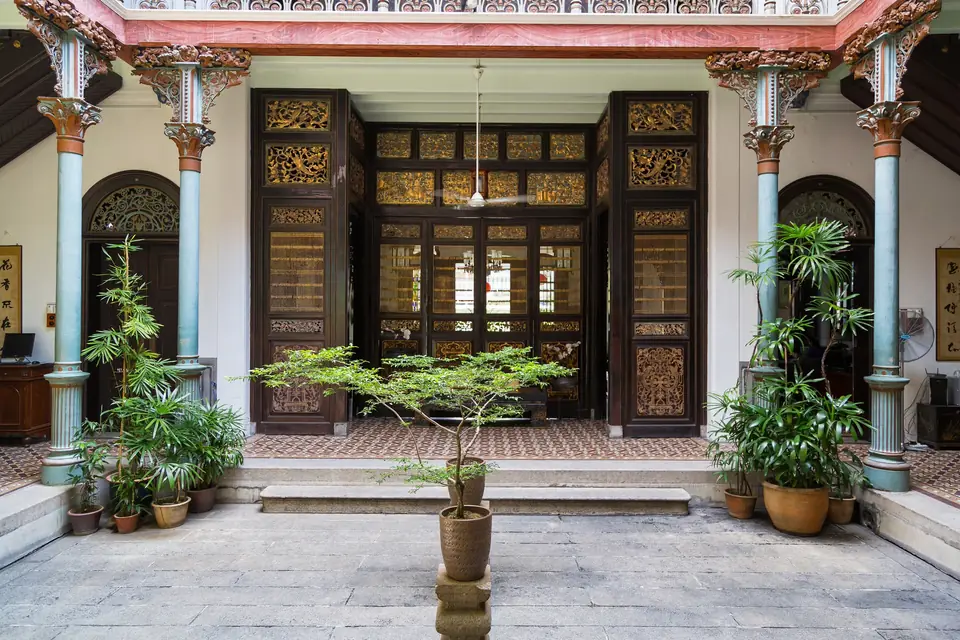
In the main hall the house shows its double identity. The plan is that of a Chinese courtyard house, built by craftsmen whom Cheong had brought from southern China, but the materials came from far away: the floor is of encaustic tiles from Stoke-on-Trent, geometric clay pieces that fit together to form perfect squares; the columns and railings are of cast iron from the MacFarlane’s firm of Glasgow, and in the windows the Art Nouveau stained glass acts as a European counterpoint to the Cantonese wooden lattices.
It was the room of a man with power. Here the consul received, here the businessman dealt with his affairs and here the Chinese vice-consulate operated, in the same house where his favourite wife lived. That power was measured at his death too: Cheong Fatt Tze died of pneumonia in Jakarta on 11 September 1916, and the British and Dutch authorities ordered flags lowered to half-mast. What each material in this hall said about him, and who the man was who could mix them, is what the audio guide tells among these columns.
Two steps in front, three behind
Central courtyard
Summary of this stop
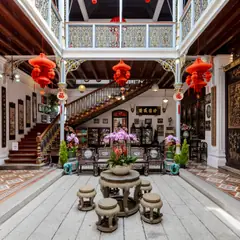
At the heart of the house opens the central courtyard, paved in granite and open to the sky. By feng shui, rainwater runs down from the eaves through pipes to this courtyard before leaving beneath the floor. Around it is arranged a house of 38 rooms, 5 courtyards, 7 staircases and 220 louvred windows, and also an entire family by rank: the favourites lived in the central range and in the first-floor rooms, and those fallen from grace and the younger relatives were relegated to the wings.
The courtyard also keeps a secret that, according to local tradition, goes unnoticed by thousands of visitors every year, and even by architects. Feng shui asked of the perfect house that it face the sea, have hills behind it and sit on a slope. In Penang the sea and the hills are everywhere, but the centre of George Town is flat. What Cheong Fatt Tze did to solve this is hidden in a set of steps that is hard to see if nobody points it out, and it is the revelation the narration keeps for the centre of the courtyard.
The will that almost killed it
First-floor iron gallery
Summary of this stop
From the first-floor gallery, leaning over the courtyard behind the openwork iron railings, the wound of the house becomes clear. Cheong Fatt Tze left in his will that the mansion should stay in the family, with funds for its upkeep. Even so it fell into decline after 1916, and it could not be sold until the death of his last son. According to the telling, in those years its halls were rented to poor families who divided them into small rooms, and the layer of dust that built up over the Stoke-on-Trent tiles helped preserve them.
Around that will circulates a disputed theory: that Cheong deliberately built an old-style Chinese house, hard to sell, while his neighbours moved to fashionable bungalows, and that he wanted it for nine generations. The version speaks of oil lamps, of plumbing that was never installed and of an annual rent that inflation reduced to nothing. To what extent the house was saved precisely because it could not be sold, and what it lost along the way, is the story the audio guide unpicks from this railing.
A floor from the Gulf War
Gothic louvred windows
Summary of this stop
The tour ends among the floorboards and windows of the first floor, where the restoration can be read louvre by louvre. The windows, 30 × 72 inches with Gothic finials, are of wood, and a third of their louvres were remade in chengal during the work led by Laurence Loh from 1990. The floor of this storey was replaced with dark red meranti, and the way that timber was obtained has to do with a war thousands of kilometres away.
The work finished at the end of 1995 and almost at once came the scare: in 1996 hammer piling for a nearby multi-storey car park cracked the mansion, and the lawsuits that followed ended with that technique being banned in the city and next to Penang’s heritage buildings. Today the award-winning house has operated since 1995 as a hotel-museum and has served as a set for films such as Indochine, with Catherine Deneuve, and Crazy Rich Asians (2018). What the shooting of Indochine left on the courtyard walls is the last twist of the narration.