Historic Tamil quarter
Little India Audio Guide
A quarter of saris, gold and spices that was born almost with the city: dockers, Chettiar moneylenders and merchants of two faiths from South India, and a silver chariot that landed here in 1894 through a mistake of port.
- 45 min of audio
- Hindu temples and a Sufi shrine
Little India occupies a piece of the founding grid that Francis Light laid out in 1786. Its southern limit was Malabar Street, renamed Chulia Street in 1798 because almost all the Indians who settled on it came from Tamil Nadu, and its heart is Market Street, the Tamils’ Kadai Teru or “street of shops”, which the British nicknamed Little Madras. Among shophouses with covered walkways rise the Sri Mahamariamman Temple, on a plot granted in 1801, and the Sufi shrine of Nagore Durgha, built around 1800 by Tamil Muslim merchants.
On Penang Street, the old street of the Chettiar moneylenders, a temple house keeps the silver chariot that every Thaipusam travels some 9 km drawn by oxen. It arrived from Tamil Nadu in January 1894 and, according to a documented tradition, was not even meant for Penang: it was ordered for Singapore, unloaded at the first port on the route and nobody wanted to undo the swap.
Highlights
- Market Street, the Kadai Teru — an entrance arch and shophouses of saris, silks, spices and gold under the covered walkways
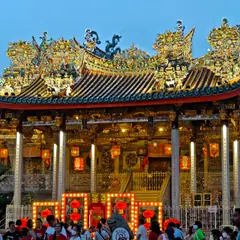
- Sri Mahamariamman Temple — an entrance tower of 1933 with 38 statues of gods and goddesses, 4 swans and five kalasam
- Gedung Rumput sculpture — a cow and a fodder cart in steel rod recalling the old Malay name of Queen Street
- Kovil Veedu on Penang Street — the house of the Thaipusam silver chariot, arrived from Tamil Nadu in 1894
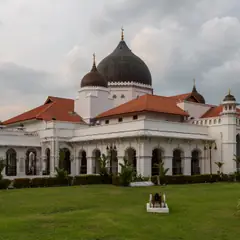
- Nagore Durgha shrine — a white Sufi memorial of around 1800, with four minarets and two bulbous domes
In April 1789, barely three years after Francis Light founded the British outpost of Penang, a fire broke out on Malabar Street. Light recounted it in a letter of 18 July that year to his superiors in Calcutta, and that street, the southern limit of the settlement, is today Chulia Street: in 1798 it changed its name because almost all the Indians who settled on it came from Tamil Nadu. The story of Little India begins that way, almost at the same time as George Town’s, and not as a postcard quarter but as a place of work: dockers from the port, Chettiar moneylenders, goldsmiths, spice and onion merchants.
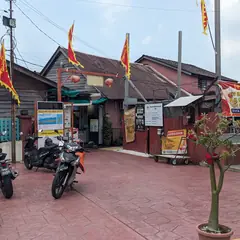
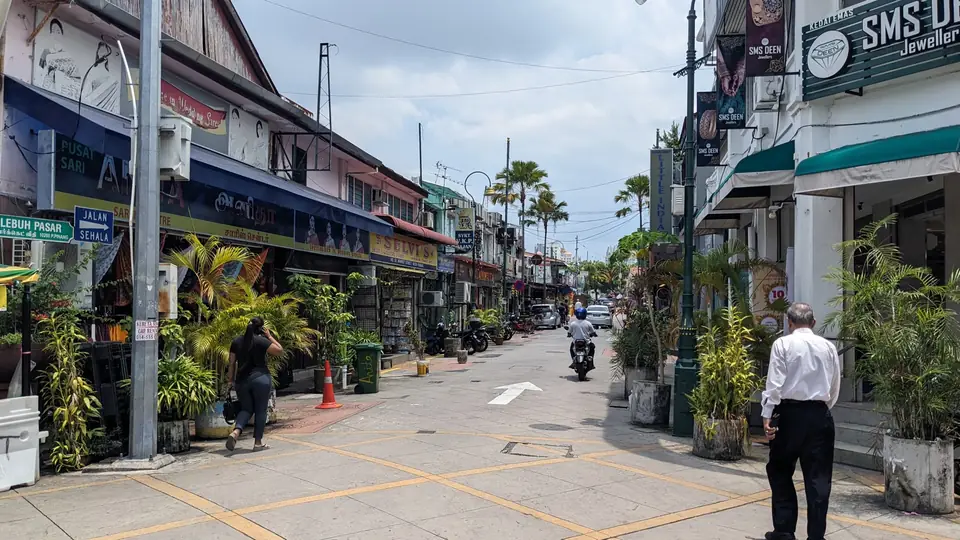
That past is still in view across a few blocks. The street signs carry subtitles in English, Jawi and Tamil; on Market Street the shophouses sell saris, silks, gold and devotional articles under the covered walkways, and a few steps apart sit a Hindu temple with a tower covered in gods and a white-painted Sufi shrine. What to see in Little India, and how to read in its streets the mix of faiths and trades that built it, is what the audio guide unfolds over 45 minutes of walking, from the Market Street arch to the corner of Chulia Street.
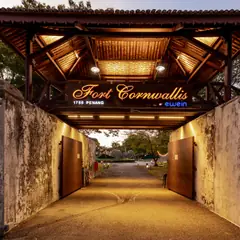
Around the corner, the Kapitan Keling Mosque is the great house of worship of the Tamil Muslims, and the quarter’s grid starts at the cape where Francis Light landed in 1786, today Fort Cornwallis.
Kadai Teru, the street of shops
Little India arch
Summary of this stop
The tour starts under the arch that marks the beginning of the Indian stretch of Market Street, Lebuh Pasar in Malay. The street owes its name to a market founded by Indian emigrants beside the old shoreline. In Tamil it was called Kadai Teru, “street of shops”, and the British nicknamed it Chola Place or Little Madras. On both sides follow the shophouses with their covered walkways, the five-foot ways, with displays of saris, silks, spices, gold and objects for worship.
In the 1940s and 1950s the spice and onion merchants carried notable weight here, and the streets were covered with rows of betel nut and spices drying in the sun. In the late 1970s all the narrow streets of the quarter became one-way, but the commercial pulse has not faded: a week before Deepavali 2024 the crowd overflowed Penang Street, Market Street and King Street despite the rain. What this street keeps of its first market is better understood by listening to the narration at the foot of the arch.
A tower of 38 gods on a plot of 1801
Sri Mahamariamman Temple
Summary of this stop
On Queen Street, the entrance tower of the Sri Mahamariamman Temple rises some 7 metres (23.5 feet) above the pavement. It brings together 38 polychrome statues of gods and goddesses and 4 swans around the goddess Mahamariamman in her different incarnations, and five small kalasam crown it. It all began with much less: in 1801 the British granted this plot to Betty Lingam Chetty, Kapitan or head of the Tamil community, and a small shrine arose there. Its present form came in 1933, when the community bought two buildings to the north to extend the compound, raised the tower and consecrated the temple on 12 June.
The temple’s date of birth is disputed. Worship goes back to the plot of 1801, but the official tradition takes 1833 as the founding year, a date documented only in the consecration notice of 1933, a hundred years later; Captain James Low confirms a temple in George Town in 1835.
The temple’s great festival is Navarathri, according to a documented tradition: it begins with the raising of the lion flag and, after nine vegetarian nights recalling the goddess Parasakthi’s battle against the demon king Mahishasuran, culminates on the tenth day with the image of the goddess aboard a chariot through the streets of Little India. In 2025 a new teak chariot of 7.2 metres made its debut, carved by craftsmen from Karaikudi, taller than the Thaipusam chariots. How that procession used to end, at dusk and with arrows, is one of the scenes the audio guide keeps for this spot.
Gedung Rumput, the street that smelled of fodder
Gedung Rumput sculpture
Summary of this stop
Queen Street is named after Queen Charlotte, wife of George III, but in Malay it was known as Gedung Rumput, “grass warehouse”, for the fodder granaries for cattle that stood on it. A steel-rod sculpture installed in 2013 on a wall of the street, near China Street, recalls that name with a cow and a fodder cart drawn in the air.
Around it stretched the quarter’s working life. Some 2,000 Indian dockers lived in the rectangle formed by Lebuh Queen, Lebuh King, Lebuh Penang, Lebuh Pasar and Lebuh Gereja, an area called Ellammuchanthi in Tamil and Simpang Lelong in Malay. They organised themselves in gangs, the kootam, each with its boss, the thandal. How those harbour men fitted into these blocks, under the name of a British queen, is told by the narration in front of the sculpture.
The silver chariot that was meant for Singapore
Kovil Veedu of the silver chariot
Summary of this stop
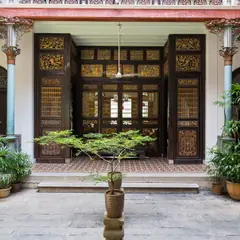
The stretch of Penang Street between Market Street and Chulia Street was the street of the Tamil Chettiar moneylenders, who had their office here, the Kattangi: Tamils call it Kattangi Teru and the Hokkien, Cet-tiah Kay, “street of the Chettiar”. On the southern stretch stands the Kovil Veedu, the temple house that keeps the Thaipusam silver chariot. It was built in Tamil Nadu and reached Penang in January 1894. Since 2017 it has been accompanied by a golden chariot that leaves the Queen Street temple, and both travel some 9 km drawn by oxen that take turns.
According to a documented tradition, the chariot was not meant for Penang. In Karaikudi two chariots were ordered at the same time, a small one for Penang and a larger one for Singapore; the parts travelled by sea and, since Penang was the first port, the parts of the large one were unloaded here. When the mistake was discovered, nobody wanted to undo it. So a five-tonne chariot stayed on this street, while its predecessor of Burmese teak ended up in another country, where it still rolls.
In 2021, with the Thaipusam festival cancelled because of COVID-19, the chariot came out of the Kovil Veedu all the same, with permission from Putrajaya and the police, at 3.00 in the morning, and reached its temple at 5.55. The sources do not agree on the age of this procession: one dates it to 1857, with 164 years of uninterrupted tradition until that cancellation, and another presents it as almost as old as the founding of 1786. Why the Singapore temple gave up its chariot, and what the two Penang chariots later did with the worshippers’ coconuts, is heard in front of this door.
A Sufi saint who is not buried here
Nagore Durgha Sheriff
Summary of this stop
The tour ends at the corner of Chulia Street and King Street, on the old Malabar Street of the Chulias, the one that already burned in 1789. There stands the Nagore Durgha shrine, small and painted white, with four slender minarets, two bulbous domes and a side arcade with shops selling songkok caps and prayer articles. It was built around 1800 by Tamil Muslim merchants from Thanjavur settled in Penang, and it is dedicated to the saint Syed Shahul Hamid of Nagore.
Its name misleads. According to a documented tradition, the saint rests in the mother shrine in Tamil Nadu and this one in Penang is a memorial: the tomb it holds belongs to someone else, linked to the family that kept the shrine for generations. The saint’s anniversary was celebrated with a kandoori, a fourteen-day feast with green flags, ghee rice for everyone and a parade of decorated chariots on the last day. Who is really buried beneath these domes is the closing the narration keeps for the corner where Little India was born.