UNESCO heritage
Chew Jetty Audio Guide
A village of wooden houses on stilts that reaches out to sea from Weld Quay: the boatmen’s jetty of the Chew clan, which lives on one-year licences, among souvenir shops and the fear of fire, and which one night a year becomes the altar of the Jade Emperor.
- 30 min of audio
- Chew clan stilt village
Chew Jetty is the largest and most populated of the seven Clan Jetties that survive on Weld Quay, the shore that George Town won from the sea in 1882. It was built by the Chew clan, from Xinglinshe, in Tong’an district (Xiamen, Fujian), a family of boatmen who carried cargo in their boats from the steamers anchored offshore to land. Today it holds some 75 wooden houses with zinc roofs, lined up along plank walkways and framed between two temples, one at the entrance and one at the far end, facing the strait.
Its residents have never quite owned their homes: since Malaya’s independence in 1957 they have lived on Temporary Occupation Licences that they renew every year, although the British had promised to recognise them. UNESCO halted in 2008 the demolitions that had already taken two neighbouring jetties, and the tourism that came afterwards turned about a third of the houses into shops. And even so, every Hokkien New Year some 40,000 people crowd the entrance to watch the clan celebrate the Jade Emperor.
Highlights
- Chau Yuan Kong Temple — at the entrance, dedicated to Baosheng Dadi and the altar of the Jade Emperor’s night
- Main plank walkway — the boatmen’s jetty turned into a street of souvenirs, food and drink
- Residential back lane — shopless houses where domestic life continues for about 66 families
- Wooden stilts — reinforced every five years and not allowed to be swapped for concrete
- End of the jetty — the Xuantian Shangdi temple and new planks facing the strait
In 1882 the government of the Straits Settlements reclaimed land from the sea along George Town’s old coast, and so Weld Quay was born. On the new shore landing jetties were built, and little by little each fell into the hands of a Chinese clan: the Chews, the Lims, the Lees, the Tans, the Yeohs. Around those jetties whole villages of wood on the water grew up, the Clan Jetties. When exactly they began is disputed: some sources take them back to the mid-nineteenth century, while the chronology of the Weld Quay reclamation places their formation between the 1880s and the 1960s. Nor is there agreement on how many once existed, nine according to some, more than twenty at their peak according to others; what everyone agrees on is the seven still standing.
Chew Jetty is the largest of them and the most visited. The history of Chew Jetty is that of a village that has survived the loss of the free port, the wrecking ball, fires and its own tourist success, and that keeps renewing its licence, its planks and its festival every year. What to see at Chew Jetty goes beyond the shops at the entrance: the architecture of Chew Jetty, with its stilts, zinc roofs and two temples, tells of a way of life that the audio guide unpicks over half an hour of walking, from the temple at the head to the end of the jetty, facing the strait.
The hall of another Hokkien clan, covered in gold and hidden behind its houses, is the Khoo Kongsi, and following the seafront north you reach the point where George Town was born, Fort Cornwallis.
A small temple for forty thousand people
Chew Jetty
Summary of this stop
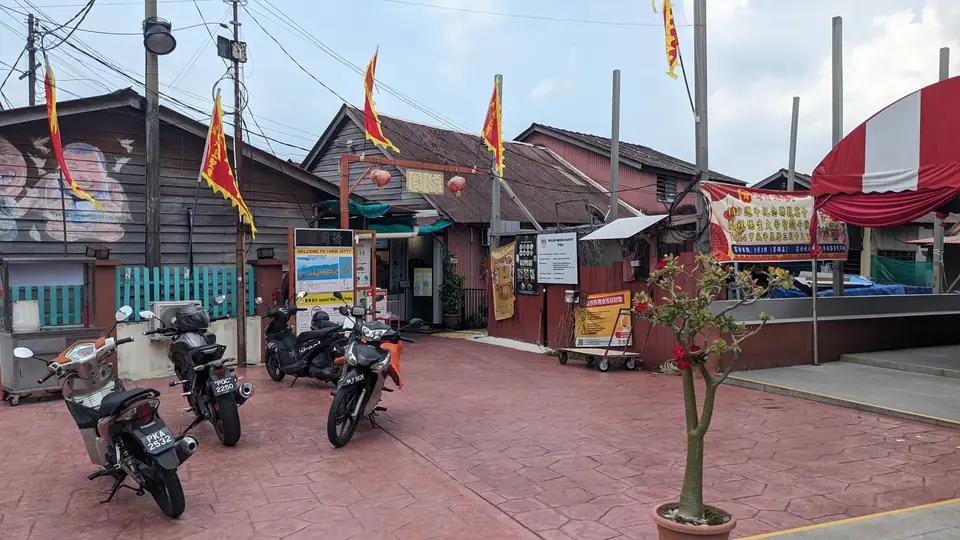
The tour begins in front of the Chau Yuan Kong Temple, beside the Weld Quay road. It is dedicated to Baosheng Dadi, and at the far end of the jetty another shrine honours Xuantian Shangdi: the whole village is framed between two temples. For most of the year it is a modest shrine at the entrance to a walkway of shops, but one night a year it becomes the centre of George Town. Chew Jetty is the main stage of the Jade Emperor’s birthday, the Thnee Kong Seh or Hokkien New Year, held on the night of the eighth to the ninth day of the Chinese New Year, which on the Weld Quay jetties reached its 119th edition in 2026.
That night some 40,000 people fill Weld Quay in front of the jetty, while the residents set up long tables before the temple with roast pigs, huat kuih cakes and pineapples. According to the clan’s documented tradition, at eleven at night a member of the family goes along walkways and alleys beating a drum, and every Chew house comes out with its offerings, which must include five elements. At midnight, the most respected member of the clan, chosen because his family is considered complete, throws two crescent-shaped wooden blocks on the ground to find out whether heaven accepts the offerings. In 2021, because of the pandemic, the festival was not held for the first time in 113 years. What each combination of the blocks means, and who has had the honour of throwing them more times than anyone, is what the narration tells in front of the temple.
The souvenir street that was a boatmen’s jetty
Main plank walkway
Summary of this stop
From the temple starts the main walkway, an axis of planks that goes out into the sea flanked by houses on stilts. Today a good part of them sell souvenirs, food and drink, and at first sight the place looks like one more commercial street. Beneath the counters, however, the jetty of a clan from a single Fujian village, Xinglinshe, in Tong’an district, near Xiamen, carries on.
The Chews, like the Lims and the Lees, were harbour boatmen: they carried cargo in their boats from the big steamers anchored offshore to the shore, while other clans, like the Tans and the Yeohs, lived off charcoal and firewood. That trade shaped the village, with houses hard against the water and the jetty as main street. After UNESCO’s listing, heritage tourism changed the balance: by about 2017 nearly 30% of the houses had become commercial premises, and in 2018 the Penang government studied limiting shop space per dwelling, because the neighbouring jetties remained almost entirely residential. Whether what is preserved is a living village or a stage set is an open debate, and the audio guide raises it without taking sides as the walkway advances toward the sea.
Wooden stilts and the fear of footsteps
Residential back lane
Summary of this stop
Behind the main walkway runs a second street of planks, narrower and without shops. It is the residential lane, with back porches where domestic life goes on and, beneath the floors, the wooden stilts showing above water or mud depending on the tide. They have to be reinforced every five years, a single pile can cost up to 2,000 ringgit, and since the UNESCO listing residents cannot replace them with concrete-filled pipes. All this in houses whose ownership has never been recognised: since 1957 they have been lived in under Temporary Occupation Licences renewed every year.
The other threat is fire. In the early hours of 4 February 2009, a day after some 10,000 people had celebrated the Jade Emperor, a fire destroyed five houses on the jetty and left at least 30 people homeless. On 5 September 2026 another night fire destroyed five workshops and shops in Pengkalan Weld, less than 20 metres from the jetty; residents wet their roofs to hold back the embers and Chew Jetty was left intact. From that memory comes a local custom that few visitors know and that explains why this lane is walked in a very particular way; the narration reveals it here, among the houses.
The strait that gave work and took it away
New planks on the seafront
Summary of this stop
The walk ends at the end of the jetty, beside the Xuantian Shangdi temple and facing the strait. That water fed the clan for generations, until in 1969 Penang lost its free-port status and the coolies and sampan boatmen of the jetties were left without work; many residents had to look for other trades on land. Even so, Chew Jetty remains the most populated of the Clan Jetties: in 2019 some 66 families lived there, spread across about 75 houses.
From here you can also see how close it came to disappearing. In 2006 the Koay and Peng Aun jetties were pulled down to build blocks of flats, and only George Town’s inscription as a World Heritage Site in 2008 stopped further demolitions. The seafront also carries its own scars: in September 2024 waves damaged the walkway, and in October rotten beams and planks were replaced with new, paler ones, still distinguishable underfoot. How the residents defended their festival when an official celebration threatened to overlap with it is the episode with which the audio guide closes the tour, looking out to sea.