UNESCO heritage
Kapitan Keling Mosque Audio Guide (Masjid Kapitan Keling)
A Tamil mosque in Mughal dress: it began in 1801 on land granted “forever”, grew layer by layer without anyone pulling it down and still sets the Islamic pulse of the Street of Harmony today.
- 30 min of audio
- Indo-Mughal architecture
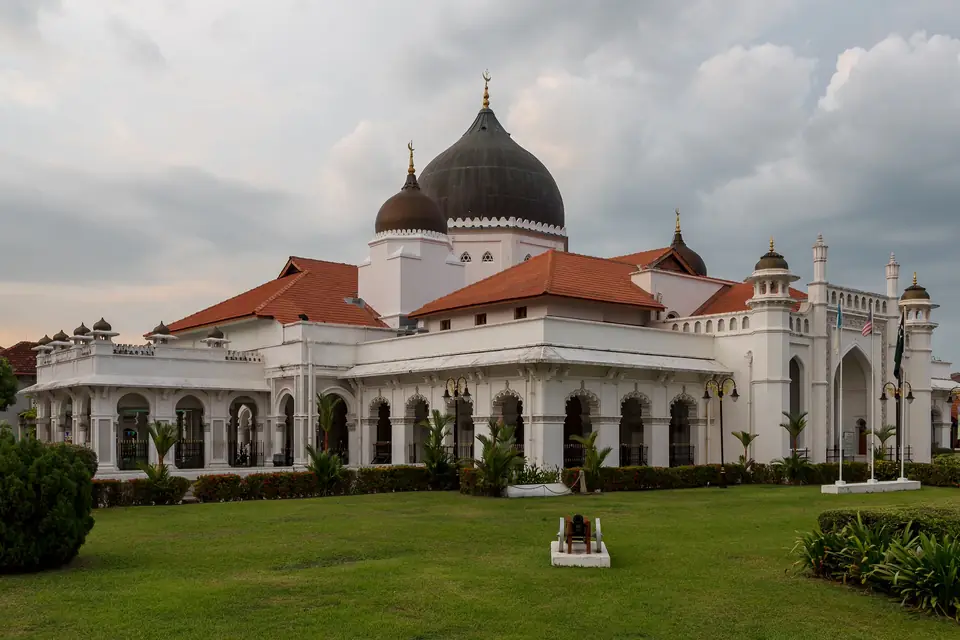
The Kapitan Keling Mosque is the great house of worship of Penang’s Tamil Muslims. In 1801 Lieutenant Governor Sir George Leith granted 18 acres beside today’s Lebuh Chulia to Cauder Mohudeen, a naval foreman from Porto Novo appointed head of the South Indian community, who brought builders, stone and brick from India and in 1803 opened a single-storey square hall. The silhouette of Mughal domes and turrets came much later, with the extension by the architect Henry Alfred Neubronner in 1916 and the 1930 renovation that gave it its present look.
What looks like a postcard of empire is really a building extended layer upon layer: according to the sources that have studied it closely, it was never demolished, and the minarets and the niche of the first mosque still stand at the back. Its history is not peaceful either: it lost more than half its land, lived through a cannon-fire quarrel over the end of Ramadan and a celebration interrupted during the Japanese occupation, and still keeps handing out food to the whole neighbourhood.
Highlights
- Great minaret of 1916 — a tablet with a double date and an Islamic Information Centre on its ground floor
- Ochre façade and Mughal domes — the Indo-Saracenic silhouette of Neubronner’s extension
- Old Lebuh Chulia gate — the first entrance, beside the mausoleum of the Noordin family
- Minarets and niche of the original mosque — the remains of 1801-1803 at the back
- Double-height prayer hall — horseshoe arches of 1930 and a dome with calligraphy since 2003
In 1791 a plan of George Town already showed a mosque on this plot, south of what was then Chulier Street. It served mainly the Muslim troops of the British East India Company. The date of its founding keeps wavering between the sources: some give the building as finished in 1801, others place it around 1800, and others put the first prayer in the brick hall in 1803. What nobody disputes is the name that stuck: Kapitan Keling, the office of head of the South Indian community. The word “keling”, which is considered offensive in Malaysia today, was not so when the mosque was founded, and the mosque and its street still carry it.
The history of the Kapitan Keling Mosque is that of a Tamil community that put down roots in the heart of George Town and never moved away. The mosque was extended in 1916 with domes, turrets and a great minaret, raised in 1930, restored in 2003 and in the meantime saw riots, trimmed land and a foreign occupation go by. What to see at the Kapitan Keling Mosque, how to read its architecture in layers and what the history of each one tells is what the audio guide unfolds over half an hour: from the ochre façade to the old Lebuh Chulia gate, the courtyard and the prayer hall.
Next to the mosque begins Little India, the Tamil quarter where merchants of both faiths built temple and shrine, and a few minutes’ walk away the Khoo Kongsi keeps behind its alley the golden hall of a Hokkien clan.
A minaret the mosque paid for itself
Masjid Kapitan Keling
Summary of this stop
The tour starts in front of the ochre façade facing Jalan Masjid Kapitan Keling, the former Pitt Street, renamed after the mosque in the early 1990s. From here you take in the silhouette that has made it famous: bulbous domes, turrets and a slender minaret, with geometric decoration and no human or animal figures. All that Indo-Mughal dress is a commission of 1916. By then the mosque had passed to the Board of Mohammedan and Hindu Endowments, and with funds from that Board the architect Henry Alfred Neubronner added domes, Mughal turrets, a great minaret for the muezzin and a madrasa.
The minaret keeps its own birth certificate: a tablet with a double date, 13 Rabi al-Akhir 1334 of the Hijra and 18 February 1916, naming who laid the first stone, the architect and the Board’s British officials. But its text says something more, which changes the reading of the whole façade: who really paid for the minaret, and what was demolished afterwards so that the mosque could show itself whole from the street, is what the narration reveals at the foot of the tower. In front of this same façade, moreover, in September 1944, a Hari Raya prepared on a grand scale went suddenly wrong with the arrival of the Japanese governor, in the episode Penang remembers as “Raya Banzai”.
The gate of a “forever” promise
Old Lebuh Chulia gate
Summary of this stop
The mosque did not always face Pitt Street. Its original gate opens onto Lebuh Chulia, the former Malabar Street, and beside it stands the mausoleum of the Noordin family, relatives of the Merican line, now turned into an art gallery. Through here came the congregation of Cauder Mohudeen, a naval foreman (mandoor) born around 1759 in Porto Novo, the Tamils’ Parangipettai, some 50 km south of Pondicherry. In 1801 Sir George Leith appointed him Kapitan Keling, and on 21 November of that year he signed land grant no. 367: 18 acres (7.2 ha) for a mosque, which could be neither sold nor transferred and which would revert to the Company if they ceased to have religious use.
The promise proved less eternal than the paper said. In the 1890s the Municipal Commission bought a parcel where the Carnarvon Street police station, a vernacular school and the Campbell Street market were built, on top of an old Muslim cemetery; by 1903 only 8 of the 18 acres were left. Cauder Mohudeen did not see it: he died in 1834 with a fortune of 50,000 Spanish dollars and a will that included a “declaration of humility”, in which he said he was leaving his family not enough estate, but “imperishable goods in the hands of God”.
The neighbourhood’s memory, moreover, disputes that he was the first. Penang’s oral tradition attributes an earlier, humble mosque, of wood and attap roof, to a Company sepoy, Major Nador Khan, known by a nickname straight out of a fairy tale. It is a story without documentary confirmation, and how it fits with the 1791 plan is better understood in front of this gate.
The minarets nobody pulled down
Minarets of the original mosque
Summary of this stop
From the tree-lined courtyard, under the covered walkway extended in 2003, the back of the building shows its secret. There the minarets and the niche of the first mosque are still visible, in the vernacular South Indian style: the remains of the single-storey square hall that received its congregation in 1803, with a circular well on the south side. For the sources that have studied the building closely, they are the proof that the mosque was never demolished but grew in layers around that core; some reference works, however, give the present building as raised in 1916 to replace the earlier one, and the debate is still open.
These walls also keep a wound between neighbours. In the early nineteenth century, Sheikh Omar Basheer, of the Masjid Melayu on Lebuh Acheh, took his mosque’s cannon to the Kapitan Keling and fired it to declare Ramadan over. One neighbourhood celebrated Hari Raya while the other was still fasting, and the quarrel left a young man from Armenian Street badly hurt in a ditch. The British response was as curious as it was lasting, and it reappeared more than a century later, during the Konfrontasi with Indonesia in the 1960s; what it consisted of is the story the audio guide tells in front of the old minarets.
Double height for a shared table
Double-height prayer hall
Summary of this stop
Inside, the aisles follow one another in rows of horseshoe arches topped with plaques dedicated to Edward VII, above a white marble floor. At the back opens the central prayer hall, whose height was doubled in the 1930 renovation to ventilate it and let in more light, with a great lamp in the centre. In 2003 the mosque closed for a year for a restoration costing 5 million ringgit against leaks and poor drainage: calligraphy then replaced the floral motifs inside the main dome, and on the ground floor of the minaret an Islamic Information Centre opened.
This is also a house of open doors. Since 1992 it has organised open days for non-Muslims and receives some 50 tourists a day, about 10,000 people a year, and up to 3,000 on George Town’s World Heritage Day. Every night of the 27th of Ramadan, after tarawih, it serves rice on large shared trays (nasi talam): in April 2023 more than 1,000 worshippers and visitors ate that way, and part of the food went to the nearby firefighters and police station. And there is a South Indian recipe that the mosque has been serving since the nineteenth century to anyone who comes, Muslim or not; its ingredients and its history close the narration in this hall.