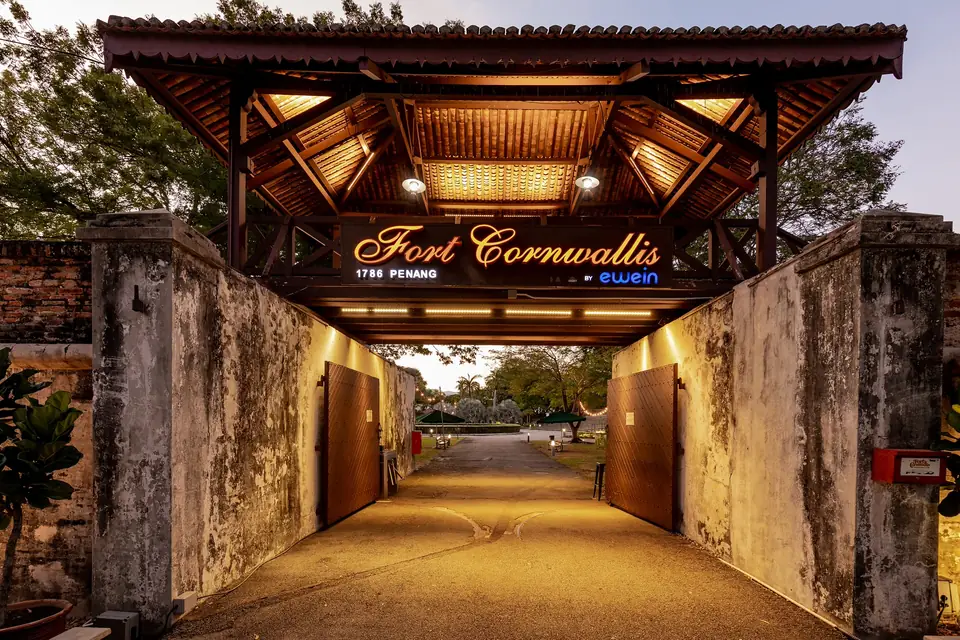
British colonial fort
Fort Cornwallis Audio Guide
The star-shaped fort that marks the exact spot where George Town was born: in two centuries it only fired salutes, it was nearly torn down and in 2026 it has seen water in its moat again.
- 40 min of audio
- Eighteenth-century fortification
Fort Cornwallis, Kota Cornwallis in Malay, occupies Point Penaga, the tip of the island where Francis Light landed on 17 July 1786 with 135 men of the Bengal forces of the British East India Company and only six cannon. Within two weeks a stockade of nibong palm trunks was rising, which in 1787 took the name of the Governor-General of India, Charles Cornwallis. The brick star that can be walked today is the largest standing fort in Malaysia and the founding stone of the whole city.
It never fought a battle: its cannon only fired blank salutes to greet authorities, announce the mail or warn of a fire, and even so the vibrations cracked a stretch of wall. In George Town it was joked that the fort’s cannon were its worst enemy. It was in greater danger in the 1920s, when its moat was filled in and the west wall and almost the whole interior were demolished.
Highlights
- South and west moat with water — reopened in July 2026 where a car park stood, for the first time in over a century
- Seri Rambai cannon — Dutch bronze of 1603, the largest in Malaysia, with a Jawi inscription inlaid in silver
- Powder magazine of the southwest bastion — a vaulted building of 1814 for 650 barrels that many present as a chapel
- Vaulted storerooms — three of them rebuilt in concrete after an Allied bomb in 1945
- Lighthouse of the northeast bastion — a metal tower of 1914 shaped like a ship’s mast
The history of Fort Cornwallis is the history of George Town told from its first square metre. Here Francis Light landed in 1786, here the first stockade of logs was driven in and here was raised, in two phases, the brick star that the British East India Company designed for 110 cannon and 12 mortars. Light began the walls in 1793, when war with France broke out, and did not live to see them finished: he died of malaria in October 1794. Between 1804 and 1810, with the Napoleonic wars as backdrop, Indian convicts rebuilt the fort in brick and stone and a moat some 9 metres wide was dug.
The curious thing is that this whole defensive apparatus waited for enemies who never came. In two centuries the fort served as the city’s clock, loudspeaker and lighthouse, as a refuge for civilians, as a store for an occupying army and as a temple; it nearly vanished between 1920 and 1930 and, after a decade of works, reopened on 25 July 2026 with its moat restored to water. What to see at Fort Cornwallis and how to read each scar of its walls is what the audio guide unfolds in 40 minutes, from the west moat to the rebuilt gate, the powder magazine, the storerooms, the lighthouse and the great bronze cannon.
The city that grew up behind the fort can be read in Little India, the Tamil quarter of Light’s grid, in the stilt village of Chew Jetty, facing Weld Quay, and in the Cheong Fatt Tze Mansion, the indigo palace of a Straits tycoon.
Point Penaga, where the water has returned
Fort Cornwallis
Summary of this stop
The tour starts beside the west moat, facing the gate. Underfoot is Point Penaga, the corner of the island where on 17 July 1786 Francis Light stepped ashore with a few Europeans, 135 men of the Bengal forces and only six cannon. Within two weeks there was a fort: a square enclosure of 500 by 500 feet made of nibong palm trunks driven in vertically, two parallel walls filled with logs and sand. The name came in 1787, when Light asked the Governor-General of India, Charles Cornwallis, for permission to use his.
The water that now surrounds the walls is the great novelty. On 25 July 2026 Prime Minister Anwar Ibrahim reopened the fort after a decade of works under the North Seafront Programme, and the south and west moats, rebuilt with stone, brick and hydraulic lime mortar, fill with water again for the first time in over a century: more than 4,000 square metres where cars used to park.
In Penang it is told, from generation to generation, how this clearing was opened in the middle of jungle and mangrove. The legend speaks of cannon that fired no balls; Light’s own diary notes something very different. That distance between myth and paper is the first tale the narration unpicks beside the moat.
A demolished gate that was a Sikh temple
Rebuilt west gate
Summary of this stop
Under the west gate you can grasp how close the fort came to not existing. Between 1921 and 1922 the moat was filled in, officially because of malaria, although other sources hold that the real reason was to make way for demolition machinery. By around 1930 almost all the interior buildings and this whole landward side had fallen, and the fort was left as a U-shaped shell open to the Esplanade, with a car park where there had been water. In January 1935 Governor Sir Shenton Thomas ordered it preserved; in 1952 it was declared an ancient monument, in 1977 a national monument and between 2000 and 2001 Universiti Sains Malaysia rebuilt the wall and the gate that now serve as the entrance from the Padang.
This gate also had a life that few would imagine in a military compound. According to a documented tradition, in the 1820s it served as a post office and afterwards became Penang’s first gurdwara, when the Sikh policemen stationed at the fort were given a room to pray in. How that temple ended and why the Vaisakhi festival has filled these walls with music is the story heard beneath the arch.
The chapel that stored gunpowder
Powder magazine of the southwest bastion
Summary of this stop
On the southwest bastion shelters a square building with a vaulted ceiling, a very steep roof and buttresses. Many present it as the fort’s chapel, the setting of a 1799 wedding that is indeed documented; but a 1805 report mentions no chapel at all, and the building matches the bombproof powder magazine for 650 barrels of gunpowder built in 1814, for fear of an American attack. That same July a report counted 76 cannon and one mortar mounted.
The walls around it hold two distinct works, often told as one. Light began the brick star in 1793 without waiting for authorisation from Bengal, and the walls reached rampart level in 1794, weeks before his death, at a cost of some 67,000 Spanish dollars that Cornwallis approved grudgingly. The brick and stone version was completed in 1810 for 80,000 dollars, with a contractor, Lam To’Kai, whose grandson would become a famous doctor. Reading in the brick where one phase ends and the other begins is part of the game of this stop.
The concrete scar of 1945
Vaulted storerooms
Summary of this stop
The row of vaulted storerooms, with their restored arches turned into galleries, bears in the middle a seam that betrays the war. During the Japanese occupation, from 1941 to 1945, the fort and the Esplanade were military workshops and warehouses served by a light railway from Swettenham Pier. In early 1945 an Allied bomb fell in the middle of the row and destroyed three storerooms, which the Japanese rebuilt in concrete; the join between old and new work can still be made out.
It was not the first time the fort had lived through other people’s wars. In 1867, during the Penang Riots between the Red Flag and White Flag factions, women and children took refuge inside its walls, perhaps the first civilian use of an enclosure until then strictly military. What those two episodes say about a fort that never fought is left for the narration in front of the arches.
Three shots: fire in the city
Lighthouse of the northeast bastion
Summary of this stop
On the northeast bastion rises a white metal tower some 21 metres tall shaped like a ship’s mast: the Penang Harbour Lighthouse, finished in January 1914. This corner has marked the bay since 1 January 1882, first with a fixed red light and then with an iron mast with a rotating light, and for more than a century it was also a weather station. The date of the present tower is a matter of debate, because it is often given as 1882.
Before it was a lighthouse, the fort was already George Town’s voice. Its cannon fired salutes regulated in number to greet those arriving or leaving, open and close the military day, announce the mail, celebrate royal birthdays or bid farewell to notable figures; three shots meant a fire had been sighted in the city. When Penang became a Presidency in 1805, the coming and going of admirals and senior officials meant firing almost without rest for two years, and the din ended up damaging its own walls. What had to be done about that stretch of wall is the finale of this stop.
Seri Rambai, a four-century spoil of war
Seri Rambai cannon
Summary of this stop
The tour ends on the northwest bastion, before the Seri Rambai, the largest bronze cannon in Malaysia: 3.25 metres cast in 1603 by Jan Burgerhuis in Middelburg, with dolphin-shaped handles, a band of heraldic lions, the VOC seal and a Jawi inscription inlaid in silver. Its history is a chain of gifts and spoils: the Dutch East India Company gave it to the Sultan of Johor, Aceh captured it in 1613, it travelled to Selangor in 1795 and the British confiscated it in 1871 after razing Kuala Selangor. It stood on the Esplanade until the 1950s and by 1970 it already rested on this rampart.
Several legends have been woven around it, and one reaches the present: some people leave flowers on the bronze. How the cannon is said to have reached the shore and what prophecy keeps alive its loss on the other side of the strait is the closing the narration keeps for this bastion.