Hokkien clan house
Khoo Kongsi Audio Guide (Leong San Tong Khoo Kongsi)
A gold-covered clan temple that cannot be seen from the street: it hides behind an alley and a ring of the clan’s own houses, and it is the modest version of another that burned on Chinese New Year’s Eve in 1901.
- 60 min of audio
- Chinese clan temple of 1906
The Khoo Kongsi is the house of the Khoos of Sin Kang, a village in the Xinglin district of Xiamen (Fujian), whose emigrants founded in Penang in 1835 the association that would build this complex. The Leong San Tong hall, the “Dragon Mountain Hall”, was finished in 1906 with materials and craftsmen brought from China, and it shares its compound with an opera stage, an administrative building and 62 terraced houses and shops, closed in on themselves like a clan village.
So much gold is, paradoxically, a gesture of restraint. The earlier temple, the result of eight years of work with master builders from southern Fujian, burned just 29 days after it was finished, and the Khoos blamed the fire on the gods’ anger at a building that was too lavish. Its replacement was built on a reduced scale, although it cost, like the first, more than 100,000 dollars.
Highlights
- Cannon Square — a granite plaza ringed by the clan’s houses, with a Sin Kang plaque above one doorway
- Opera stage of around 1906 — three bays and a screen of nine carved, gilded panels
- Stairway to the hall — two stone Sikh sentries and roofs covered in broken porcelain
- Cheng Soon Keong Hall — an altar to two Jin dynasty generals and a mural of the 36 heavenly guardians
- Hock Teik Soo Hall — the bamboo couplets of 1851, the only thing the 1901 fire spared
The story of the Khoo Kongsi begins in a village in Fujian and with a collection. According to the clan’s documented tradition, around 1816, when barely a hundred Khoos lived in Penang, the emigrants sent 120 dollars to their native temple in the name of a “Tua Sai Yah Public Fund of Penang”. In 1835, on the eighth day of the fifth moon, 102 members of the clan pooled 528 dollars to found the Ee Kok Tong, the seed of the association; in 1850 they bought a plot of 97,035 square feet in the name of their patron saint, and in 1851 they turned the bungalow standing on it into their first hall. Which date marks the founding, 1835 or 1850-1851, depends on the source consulted.
What can be visited today is the third chapter of that story: a hall raised between 1902 and 1906, after the previous one burned just as it was finished. The architecture of the Khoo Kongsi brings together gilded carvings, murals, ancestral tablets and ridges of broken porcelain, all enclosed in a compound that protected itself from an unsafe city. What to see at the Khoo Kongsi and how each piece fits together, from the entrance alley to the last side hall, is what the audio guide unfolds over an hour of walking.
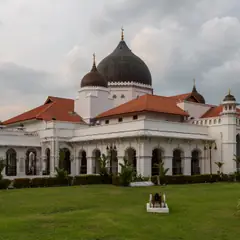
Another Hokkien clan built its village on stilts at Chew Jetty, facing Weld Quay; the house that the Hai San secret society boss built over the old headquarters of the Ghee Hin, the Khoos’ enemy in 1867, is today the Pinang Peranakan Mansion, and a few steps away stands the Kapitan Keling Mosque.
An alley that hides a clan village
Leong San Tong Khoo Kongsi
Summary of this stop
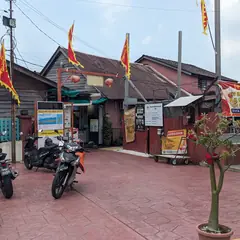
From Lebuh Cannon no temple is visible. You enter through a narrow passage, the only one of the three entrances still open and the only one without a raised threshold, which is why carriages used to pass through here. On the other side, the alley opens onto Cannon Square, a granite-paved plaza ringed by the so-called Sixteen Houses and Eight Houses, two-storey terraced houses from the late nineteenth century.
That surprise is deliberate. The complex brings together the Leong San Tong hall, an administrative building, an opera stage and 62 terraced houses and shops, with access from Cannon Street, Beach Street and Armenian Street, and its closed layout, like a clan village, answered the public insecurity of nineteenth-century British Penang. Nor is it the home of every Chinese person surnamed Khoo: only of the descendants of Sin Kang, today Sin Aun, in the Xinglin district of Xiamen. Above one of the doors onto the plaza, a small plaque gives away that origin, and the narration points out which one.
Cannon Square: the plaza that armed itself in 1867
Sealed gate on Beach Street
Summary of this stop
In the middle of the plaza, the most telling thing is what is missing. The passages from Beach Street, with its carved and gilded arch, and from Armenian Street were closed in times of danger and are sealed today. The name of the plaza already appears in 1867, the year of the Penang riots: for ten days from 3 August, the Tua Pek Kong Hoey (Kean Teik Tong), a Hokkien society led by Khoo Thean Teik, allied with the Red Flag against the Cantonese Ghee Hin and the White Flag. The society owned firearms and artillery, and Cannon Street may have taken its name from the plaza.
Where that name comes from is disputed: some versions speak of colonial government cannon that blasted a great hole in the neighbourhood, others of cannon placed by the society itself or fired from the plaza. There is no agreement either on the fate of Khoo Thean Teik, arrested in 1868: the clan’s chronology says he was sentenced to death and walked free seven years later, while other sources speak of a commuted sentence. The outcome came in 1920, when the Khoo Kongsi bought the 379-acre Thean Teik Estate from his descendant, the largest property investment in Penang in the 1920s; what part the clan kept for itself is one of the details told in the plaza.
A temple scaled down after a New Year’s Eve fire
Stairway and Sikh guardians
Summary of this stop
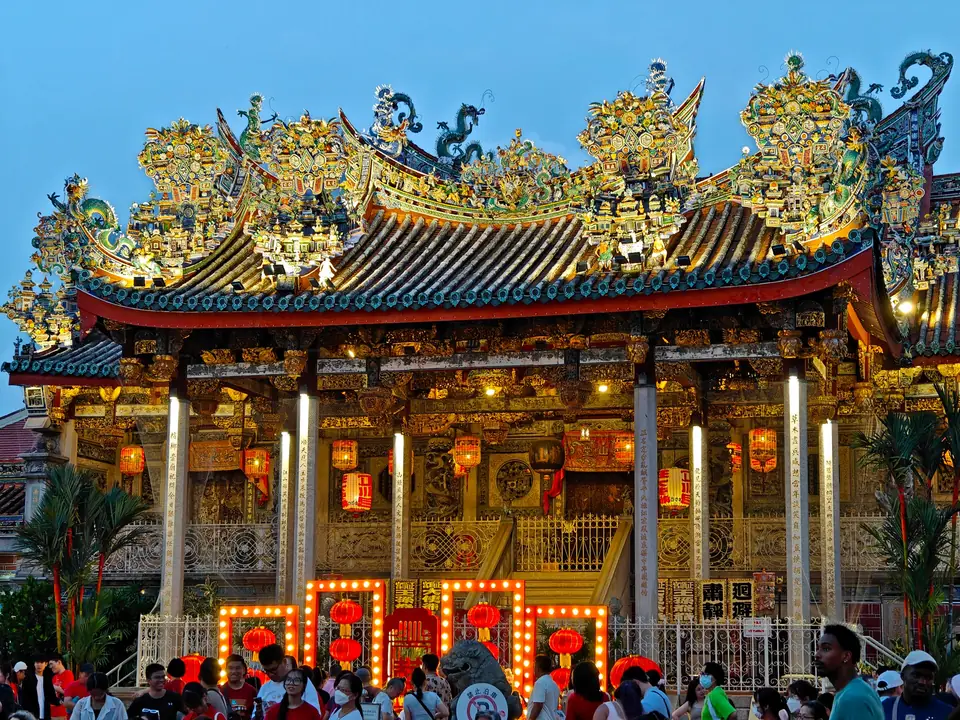
At the foot of the stairway, the hall presents itself whole: curved ridges covered in dragons, figures and mythical creatures made of broken porcelain, and opposite, the three-bay opera stage, with its screen of nine carved and gilded panels. That stage is not the original, which was simpler and had a single bay: the present one went up around 1906, with the rebuilding of the hall, and Chinese operas are still performed on it during the seventh lunar month.
Behind all that shine there is a failure. In 1894 the administrators decided to pull down the old hall and build another with master craftsmen from southern Fujian; the work lasted eight years and the temple burned on Chinese New Year’s Eve of 1901, 29 days after it was finished. The cause of the fire is disputed: some sources speak of lightning and others say nobody ever knew how it started; the Khoos blamed the anger of the gods at a temple that was too lavish, and popular belief adds that it looked too much like the emperor’s palace. The building that replaced it was made on a reduced scale.
On the stairway two stone watchmen stand guard in turbans, uniforms and rifles: Sikh sentries in a Hokkien temple. The explanation given is a practical one, because in old Penang the Sikhs were the trusted guards of merchants, sultans and the government itself, and the Khoos commissioned two life-size statues to guard the pavilion forever. The narration reveals what other details this staircase hides.
Two Chinese generals and a debt to the village
Cheng Soon Keong Hall
Summary of this stop
The central hall, Cheng Soon Keong, venerates the patrons of the clan, Ong Soon Yah and Tua Sai Yah: the generals Cheah Aun and his nephew Cheah Hean, of the Jin dynasty, victors in the fourth century at the battle of the Fei River. Around the altar come the murals of the 36 heavenly guardians, the lamps hanging from the ceiling and the Sam Kai Kong incense burner, suspended between ceiling and floor.
The name of the hall is that of the temple in the home village, and with it travels a debt of almost two centuries. According to the clan’s tradition, that temple in Sin Kang received the 120 dollars from the first emigrants; when it fell into ruin through lack of maintenance during the Cultural Revolution (1966-1976), the Khoo Kongsi of Penang donated 2.5 million ringgit to rebuild it, and the new one was finished in 1997. The gold of this hall did not come out of the twentieth century unscathed either: it was partly damaged when the Japanese bombed George Town in the Second World War, was repaired completely in 1958 and restored again between 1999 and 2001, for more than 4.2 million ringgit. Among the murals there is also the signature of a painter who called himself “the Hermit”, and the audio guide tells where to look for it.
The bamboo couplets that outlasted the fire
Hock Teik Soo Hall
Summary of this stop
In the side hall Hock Teik Soo, dedicated to Tua Pek Kong, god of prosperity, two bamboo boards with inscriptions hang. They are a pair of couplets from 1851, from the first Cheng Soon Keong hall, and the only thing that survived the 1901 fire. Nearby, two green marble plaques record the names of the 102 members who founded the association in 1835.
This is not only a monument: the clan still holds its rites here on fixed dates of the lunar calendar. Tua Sai Yah’s birthday coincides with the Dragon Boat Festival, on the fifth day of the fifth moon; three days later the founding of 1835 is commemorated, and at the winter solstice the trustees attend the worship in ceremonial dress. How those dates connect with the temple that burned and the one that replaced it is the closing the narration keeps for this hall.