Historic park
Esplanadi Audio Guide
A former firing range raised over a wetland became Helsinki's open-air drawing room: 19th-century lime trees, the poet of the anthem in the centre and a café from 1867 that one morning in 1918 served as a shelter under fire.
- 30 min of audio
- 19th-century tree-lined promenade
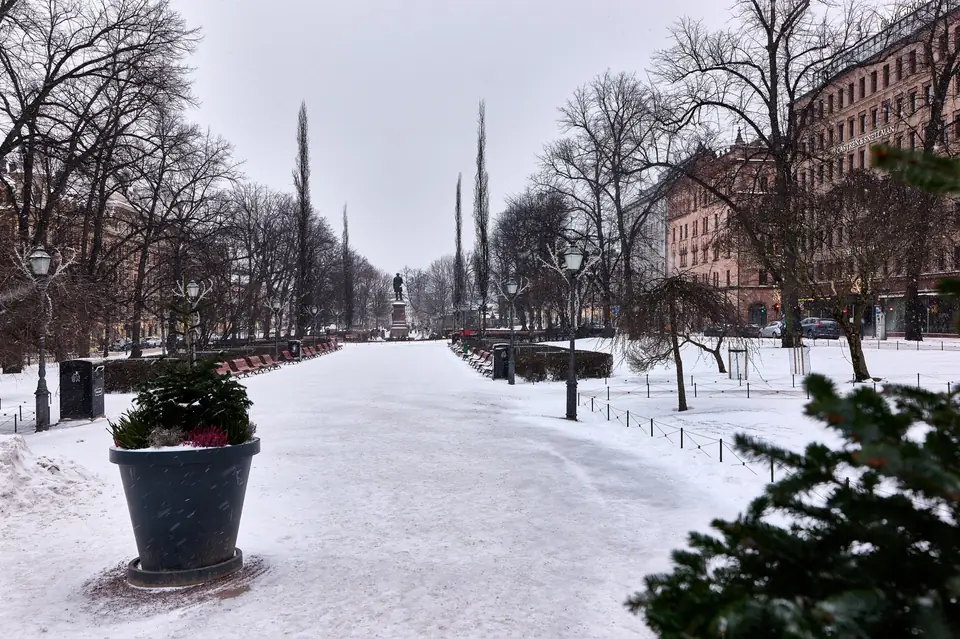
Esplanadi runs through the centre of Helsinki between the Swedish Theatre and Market Square. It already appears on Johan Albrecht Ehrenström's 1812 plan, the one that redrew the city when it became a capital, and it was completed in 1827. Carl Ludvig Engel conceived it as a continental promenade of double rows of lime trees that, in a city still made of wood, also served as a firebreak.
The park's most visited monument does not bear the name of the man it depicts. The statue of Johan Ludvig Runeberg, unveiled in 1885 before some 20,000 people, says on its pedestal only “The people of Finland to the singer of our land”: at the time it was taken for granted that nobody would need to ask who it was.
Highlights
- Runeberg statue — 8 metres of bronze and granite, without the poet's name
- Kappeli — café-restaurant from 1867 with walls decorated by painters
- Espan lava — free concerts from May to August, some 200 artists per season
- Svenska Teatern — the stage where Sibelius's Finlandia premiered in 1899
- Water Nymphs by Viktor Jansson — Tove Jansson, creator of the Moomins, posed for the largest
The history of Esplanadi begins with a piece of land that nobody wanted. Where Helsinki residents now stroll under the lime trees there was a low wetland, the “calves’ enclosure”, and a foul-smelling bay, Kluuvinlahti, that reached almost this far. The name, fixed in 1820, comes from its first military use: the strip was the cleared esplanade that stretched in front of the Ulrikasborg fortress. From that firing range came, plan after plan, the showcase in which Helsinki learned to display itself.
In a single walk two centuries of Finnish life pile up: the theatre where Jean Sibelius’s Finlandia was first heard, a quarrel over a monument with a linguistic backdrop between Finnish and Swedish, the national poet honoured without his name and a café to which artists went as to a headquarters. Legend has it that Sibelius came back from a few days in Stockholm and found his friends still sitting at the same table in the Kappeli; nobody can swear to it, but it says a lot about the place. The history of Esplanadi, its architecture and its monuments are best understood by walking them from one end to the other with the audio guide, documented stop by stop.
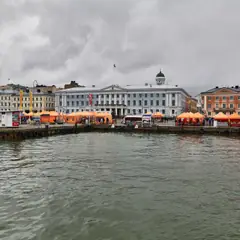
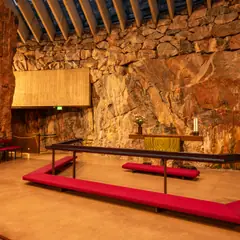
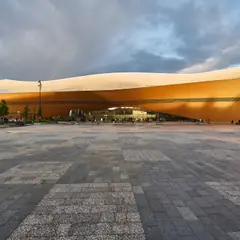
At its eastern end, Market Square opens the promenade to the harbour; to the north-west, Oodi Library and Temppeliaukio Church show Helsinki’s other face, that of 20th- and 21st-century architecture.
The theatre that burned and premiered Finlandia
Svenska Teatern
Summary of this stop
The western end of the promenade is closed by Svenska Teatern, and its sober façade hides a pile of superimposed theatres. In 1827 a small wooden house designed by Carl Ludvig Engel was built on this corner, Helsinki’s first theatre, through which travelling Swedish and German companies passed on their way to St Petersburg. With it the park was completed, whose first landscaped stretch had been the eastern one.
Its successor, by Georg Theodor von Chiewitz, opened in November 1860 and burned barely three years later. Nicholas Benois, an architect who came from Russia, rebuilt it in neoclassical style in 1866, and in 1935 Eero Saarinen and Jarl Eklund replaced the decorated façade with the functionalist one seen today.
On this stage the initial version of Sibelius’s Finlandia premiered in November 1899, together with other incidental music by the composer. How that premiere fits into the Finland that was beginning to recognise itself is something the narration reveals in front of the building.
Two rival statues and a hidden coin
Eino Leino statue
Summary of this stop
On Teatteriesplanadi, the stretch nearest the theatre, the bronze holds rivalry and joking in equal parts. The monument to Zacharias Topelius, “Fable and Truth” by Gunnar Finne, shows two female figures looking in opposite directions: one holds the flame of truth and the other the crowned bird of fable. It won the 1928 competition, but the result set off a debate with a linguistic backdrop between Finnish and Swedish. The writer Maila Talvio responded by promoting a rival statue by Ville Vallgren, paid for by popular subscription with schoolchildren selling postcards, which was unveiled in 1932, six months before Finne’s.
Very close stands Eino Leino, the bohemian poet who was a regular at the Kappeli, in the statue Lauri Leppänen dedicated to him in 1953. According to a documented tradition, his left palm keeps an almost invisible secret in the bronze, a workshop prank that the sculptor himself, a friend of the poet, decided not to correct. The audio guide tells what is in that hand and why it is still there.
A firing range over a wetland
Double row of lime trees
Summary of this stop
The central walk, between the double rows of lime trees, explains by itself why this strip exists. Here was the cleared zone before the Ulrikasborg bastion, on the Tähtitorninvuori hill, and below it a waterlogged terrain known as the small and large calves’ enclosure. Turning it into a park required major landfill in the 1850s.
The lime trees form a green nave on both sides, and many of those planted in the 19th century are still standing. Engel arranged them in the manner of continental promenades, but with an added practical function: to slow fire in a city where wooden houses still predominated.
Few places in Helsinki are governed by a plan as old: that of Esplanadi dates from 1836, earlier than all the buildings that surround it. The new plan presented by the City Council in September 2026 protects the rows of trees, the sand paths, the lawns, the monuments, the kiosks, the stage and the Kappeli.
The poet who needs no name
Runeberg statue
Summary of this stop
In the centre of the promenade, Johan Ludvig Runeberg looks towards Market Square from a red granite pedestal. The statue, the work of his son Walter Runeberg, was unveiled on 6 May 1885, the eighth anniversary of the poet’s death, before some 20,000 people: the city filled with flags, the shops closed and Fredrik Pacius conducted the anthem “Maamme”. It is held to be the first commemorative public monument in Helsinki. The City links the origin of the patriotic candles in windows to that day, although an archivist of the Finnish Literature Society maintains that there is no single explanation and points to Runeberg’s Day and the years of Russification.
The ensemble measures eight metres and the poet’s name appears nowhere: only the dedication of the people of Finland “to the singer of our land”. At its feet, the Maiden of Finland, wrapped in a bearskin, holds a laurel wreath and a tablet with stanzas of the anthem in Swedish, Runeberg’s mother tongue. Around it, the flower bed is replanted three times a year.
That question of language flared up again in 2014, when the statue “began to speak” thanks to a QR code, in an episode that reopened in the middle of Esplanadi the old debate between Finnish and Swedish. The narration, in front of the monument, explains what happened and what irony it held.
The painters’ café that became a trench
Kappeli
Summary of this stop
At the eastern end, with its glass and iron wings, the Kappeli inherits the nickname “the chapel” from a church-like pastry and lemonade kiosk that the confectioner Johan Daniel Jerngren put up in 1840; there are other theories about the name, and none prevails completely. The present building, by Hampus Dalström, opened on 4 June 1867. In the time of the restaurateur Onni Wetterhoff, between 1877 and 1879, painters began to pay for Sunday breakfasts by decorating the walls, as Albert Edelfelt did with his Gambrinus.
In front of the café, the Espan lava stage, by Valter Jung from 1939, succeeds the shell-shaped music pavilion of 1887, where Alexey Apostol’s military band played for more than twenty years. Today it hosts every year, from May to August, Finland’s longest-running music festival, with some 200 artists per season. On either side are Viktor Jansson’s fountains: in “Water Nymphs”, unveiled in 1942, the largest nymph is modelled on his daughter Tove Jansson, the creator of the Moomins.
This pavilion of cafés and terraces also keeps a dark page from the spring of 1918, when for a few minutes it was a refuge under fire. What a ten-year-old boy saw there, and the opera diva who accompanied him, is heard at the same place where a coffee is ordered today.