Neoclassical heart
Senate Square Audio Guide (Senaatintori)
A perfect square laid out for the glory of the tsars, built over a cemetery nobody emptied and presided over by a bronze emperor whom the Finns ended up turning into a symbol of their own cause.
- 30 min of audio
- Neoclassical architecture
When Alexander I made Helsinki the capital of the Grand Duchy of Finland in 1812, the town had barely 4,000 inhabitants. Johan Albrecht Ehrenström's plan turned the old Swedish-era Great Square into a purely representative stage, and Carl Ludvig Engel closed it with the Senate, the University and the white cathedral: the neoclassical ensemble that is today the capital's postcard.
Beneath that impeccable order lie the graves of Helsinki's residents from the 17th and 18th centuries, levelled in 1827 without moving the dead. And in the centre, Tsar Alexander II wears the uniform of the Finnish Guard: the pedestal that was covered in flowers against Russification survived every campaign to remove it.
Highlights
- Statue of Alexander II — 10.67 metres tall, with a 3.23-metre tsar in Finnish uniform
- Cathedral steps — some 60 metres wide, imposed by Nicholas I
- Old Senate — Engel's masterpiece and the setting of the 1904 assassination
- Ulrika Eleonora relief — the wooden church pulled down in 1827
- Sound of Senaatintori — a digital chime that plays every day at 17:49
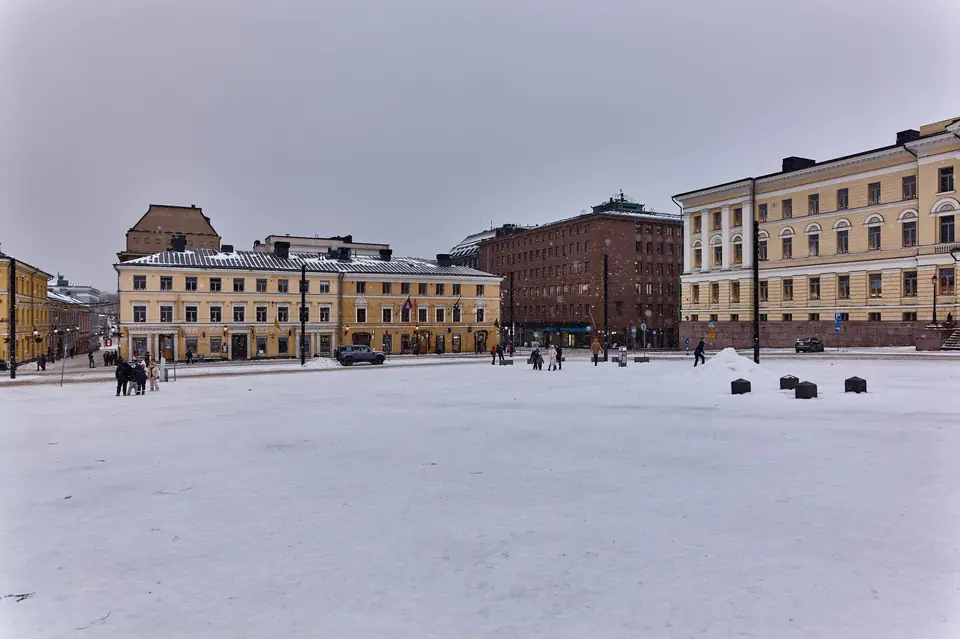
Senate Square, Senaatintori in Finnish, looks like the most orderly place in Helsinki: three neoclassical façades, a monumental flight of steps and the green dome of the cathedral cut against the sky. Its history, however, is anything but calm. In 1812 Tsar Alexander I declared a small town of some 4,000 inhabitants his capital and put Johan Albrecht Ehrenström in charge of rebuilding it; Ehrenström took the market out of the old Suurtori and moved it to Kauppatori, leaving this space for power alone. Carl Ludvig Engel built the Senate between 1818 and 1822 and the University in 1832, and he designed the cathedral, consecrated in 1852, twelve years after his death.
What to see at Senaatintori goes well beyond the photo of the steps. Under the paving lie the graves of Swedish-era Helsinki; flowers of protest were left on the tsar’s pedestal; on the Senate staircase in 1904 the shots rang out that killed the Russian governor-general; and even Hollywood used the square to pass for Russia. The audio guide walks its perimeter in five stops, from the central monument to the corner where the old wooden church stood, and lets the history of Senaatintori be read layer by layer on the ground itself.
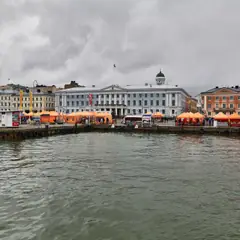
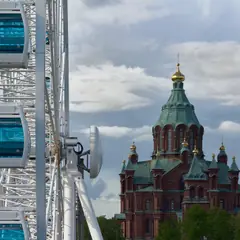
The same Ehrenström plan moved trade to Market Square, some 250 metres towards the harbour, and on the Katajanokka hill, some 450 metres away, stands Uspenski Cathedral, the Orthodox cathedral of Grand Duchy Helsinki.
A bronze emperor dressed as a Finn
Statue of Alexander II
Summary of this stop
In the centre of the square stands the statue of Alexander II, 10.67 metres in all, with a 3.23-metre figure of the tsar on a pedestal of red granite. After his assassination in 1881, the Diet called in 1884 the first sculpture competition in Finland. It was won by Johannes Takanen, who died the following year, and Walter Runeberg finished the work by combining his colleague’s sketch with his own pedestal figures. Takanen had dressed the tsar in civilian clothes; the uniform of an officer of the Finnish Guard was Runeberg’s idea.
The unveiling, on 29 April 1894, the emperor’s birthday, gathered 30,000 people, half of Helsinki’s population at the time, with representatives from 300 towns and municipalities. At the foot of the monument also begins the reading of the square as what Ehrenström meant it to be: a representative stage for a newly created capital.
This is, besides, the best spot to hear a little-known daily ritual: at 17:49 the “Sound of Senaatintori” plays, a digital composition of 5 minutes and 18 seconds by Harri Viitanen, the cathedral organist, and Jyrki Alakuijala, which travels from one building to another. What lies behind the choice of that uniform is better understood by listening to the narration right there.
The pedestal that became an altar of protest
Lex group on the pedestal
Summary of this stop
The south face of the pedestal looks south with the “Lex” group: a female figure with a bearskin, a sword, a shield and a lion, later read as the Maiden of Finland. Labor, Pax and Lux complete the other sides, alongside the date 1863 and ten shields of the historic provinces, among them the burning castle of Kexholm, now in Russia.
On 13 March 1899, the anniversary of Alexander II’s death, Helsinki residents covered this pedestal in flowers in protest against the Russification pushed by his grandson Nicholas II, and during the years of oppression the statue remained a fixed point of anti-Russian demonstrations. After independence it survived a 1918 column in Uusi Suomi that asked for it to be taken to a museum, the threat of the Lapua Movement in 1931, a 1935 proposal to replace it with Aleksis Kivi and Mannerheim, and a 1942 student demand to swap it for a national statue of liberty.
Among those indignant at its staying was a young Urho Kekkonen, who in 1924 mocked in an article the “immense piety” of the Finns towards the relics of the old power, though he admitted that whoever called for its removal would bring the whole capital’s press down on him. That young man later presided over Finland from 1956 to 1982, and the tsar is still in his place.
Cossacks in the square, shots in the Senate
Valtioneuvoston linna
Summary of this stop
The eastern side is occupied by the old Senate, now the Government Palace, which Engel considered his masterpiece. It was the seat of the Senate of Finland until 1918 and today houses the prime minister’s offices. Opposite, the University, moved from Turku by an order of 1828, took the plot reserved for the governor-general’s palace and repeats the same façade by Ehrenström’s rules of symmetry: a stone mirror that defines the architecture of Senaatintori.
That serenity contrasts with what happened here on 17 and 18 April 1902, during the resistance to the Russian conscription law. According to accounts from those days, Governor Mikhail Kaigorodov sent a hundred Cossacks against an already almost empty square, and they chased strollers with sabres and nagaika whips, wounding women and children. Among those who stood up to them, an official named Eugen Schauman earned a reputation for courage.
Two years later, on 16 June 1904, Schauman shot dead Governor-General Nikolai Bobrikov on the staircase of this building and then killed himself. A small plaque on that staircase bears the Latin inscription “Se pro patria dedit”. The thread joining the two episodes is untangled in the narration, in front of the façade.
A tsar’s steps and the Hollywood backdrop
Helsinki Cathedral
Summary of this stop
The grand flight of steps some 60 metres wide that climbs to the cathedral was not in Engel’s plans. In June 1833 Tsar Nicholas I inspected the church works in person and ordered it built, to the architect’s displeasure; to make room for it the main guardhouse was demolished and the square lost the closure on all four sides that the original project foresaw.
Engel died in 1840 without seeing the church finished; it was consecrated in 1852 as St Nicholas’s Church in honour of the tsar. His successor, Ernst Bernhard Lohrmann, added the four smaller domes, the pavilions on either side of the steps, with the bell tower and the chapel, and the twelve zinc statues of the apostles, cast in Berlin, that stand out against the roof.
That highly recognisable image ended up being used to fake another country: in 1970 John Huston filmed the opening credits of The Kremlin Letter here at night, and in 1981 Warren Beatty shot scenes of Reds with Helsinki standing in for St Petersburg.
The church and the graves under the paving
Relief of the Ulrika Eleonora church
Summary of this stop
In the ground of the north-west corner, a red granite relief by Gunnar Finne, placed in 1937, recalls the wooden church of Ulrika Eleonora, the third church of Helsinki built on this site, between 1724 and 1727. Its beams were auctioned on 27 February 1827 and the church was demolished that same year; its bell hangs today in the central tower of the cathedral.
That year, with the new church finished, the public buildings of the Suurtori were pulled down and the square and the cemetery were levelled without moving the dead. Excavations in 2012, 2020 and 2021 brought out from beneath Senaatintori the remains of more than 300 people, 53 of them in the autumn of 2012 alone, studied by the archaeologist Kati Salo, which in 2023 were reburied in the Malmi cemetery.
The visit thus ends looking down, with the whole square turned into a superposition of cemetery, imperial power and resistance. What the subsoil still keeps is told in the last stop of the audio guide.