Church cut into the rock
Temppeliaukio Church Audio Guide (Temppeliaukion kirkko)
A Lutheran church sunk into a granite dome in Töölö, where the living rock serves as wall and altarpiece beneath a copper disc that seems to float on the light.
- 30 min of audio
- Modern architecture
The square had a temple's name sixty years before it had a temple: the 1906 town plan reserved this rocky outcrop for a church, a war stopped the first excavation after three days and only in 1961 did a competition of 67 entries reward the brothers Timo and Tuomo Suomalainen, who decided to put the hall inside the stone instead of raising it on top. Consecrated in 1969, it is today an active parish and one of Helsinki's most singular concert halls.
The press of the sixties called it the “anti-devil bunker” and the “million church”, and some students painted “Biafra” on its rock to denounce the spending in the face of famine. With its furnishings it cost roughly the same as a school of equal volume. In 2019 it received 938,000 visitors, and down its walls rain and snow water still runs in small cascades.
Highlights
- Living rock walls — granite some 2 billion years old, with rainwater seeping through
- Copper dome — up to 22 km of copper strip over a ring of skylights
- Natural altarpiece — an Ice Age crack and the crucifix forged by Kauko Moisio
- “Biafra” graffiti — the student protest against an expensive church
- Church of music — up to 400 concerts a year in its busiest years
At the end of Fredrikinkatu, where anyone would expect a tower, a copper disc appears barely raised over a knoll of granite. It is Temppeliaukio Church, Temppeliaukion kirkko in Finnish, also known as the Rock Church: a Lutheran church that was not built on the stone but inside it. Its story begins in 1906, when the first town plan of Etu-Töölö reserved the outcrop for a church and gave the square its name, and it does not close until 1969, after two failed projects, a war, a press scandal and a protest graffito.
What to see at Temppeliaukio is almost as much a matter of hearing as of sight: living rock walls with water running down them, a dome lined with kilometres of copper strip, an altarpiece opened by the ice and acoustics designed for music. The architecture of Temppeliaukio is best understood by walking through it from the inside, stop by stop, with the audio guide, which links each detail of the hall to the history that explains it.
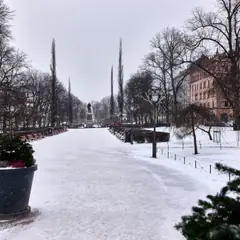
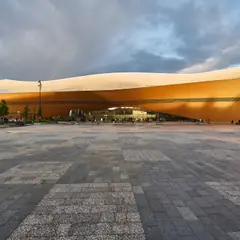
Some 700 metres away, Oodi Library carries on the story of contemporary Finnish architecture, and towards the centre Esplanadi offers the 19th-century counterpoint of lime trees and cafés.
A square that waited sixty years
Temppeliaukio Church
Summary of this stop
The route starts outside, at the end of Fredrikinkatu, in front of a low dome that closes the street’s perspective instead of a bell tower. The name of the square, Temppeliaukio (“Temple Square”), comes from the 1906 plan: the district had a church’s name sixty years before it had the church.
Before that there was a very different project. J. S. Sirén’s cathedral-style church with a tower, approved after the 1936 competition, began to be excavated in November 1939, and the Winter War stopped it after three days. In 1959 the parish council abandoned it as expensive and old-fashioned. When it was finally consecrated, on 28 September 1969, it did not even carry the name of the square: it was called Taivallahti Church until 1971.
There are no bells either. The chimes, composed by Professor Taneli Kuusisto, play recorded through loudspeakers set into the outer stone wall. What that absence of a tower says about the architects’ idea is told right there, in the narration of this first stop.
“Biafra” painted on the site
Entrance between concrete walls
Summary of this stop
The entrance, at street level and with no steps, runs between walls of exposed concrete to a low, dark vestibule. This threshold was contested ground. In the sixties the Finnish press christened the project the “anti-devil bunker”, the “million church” and a “giant investment”; the parish council was split almost evenly and a good part of the planned parish rooms was cut.
The best-remembered protest came at night. According to most sources, between 16 and 17 July 1968, though others place it in 1969, ten members of the Student Christian Association led by Seppo Kjellberg painted “Biafra” in eleven places on the rock and concrete of the site, to set the famine in Biafra against the spending on an expensive church. The municipal court fined them between 10 and 100 marks plus costs, and a support group with bishops among its members raised the money. One of those paintings is preserved in the cellar, closed to the public.
The large concrete blocks in front of the door have their own story too, much more recent: they were left there after a police operation in June 2017, tied to an alleged terrorist threat against the church that was eventually judged unfounded. The audio guide reconstructs that episode and what has changed in the visit since.
The walls that almost were concrete
Living rock walls
Summary of this stop
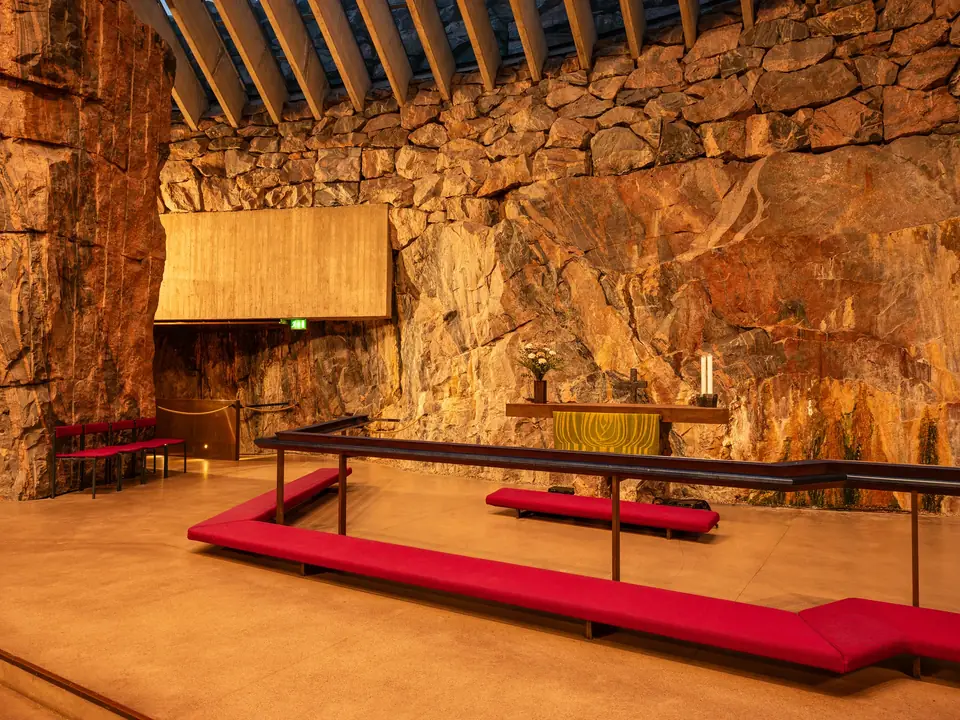
Inside, the oval hall is surrounded almost entirely by excavated living rock and quarry-stone masonry, rough and irregular. It is a granite some 2 billion years old that extends under the whole square. The winning design of the 1961 competition, with the motto Kivikirkko (“Stone Church”), chosen unanimously among 67 entries, sank the hall into the centre of the outcrop to keep as much of the rock as possible.
And yet those bare stone walls were not in the awarded proposal. The Suomalainens had replaced them with smooth concrete for fear of the jury’s reaction. It was the conductor Paavo Berglund and the acoustic engineer Mauri Parjo who, during the development of the project, defended the irregular surfaces and gave the rock back to the hall.
The stone is alive in another sense too: part of the rain and melted snow runs slowly down the interior walls in small cascades, and a slot by the floor collects the water towards hidden channels. Why that roughness matters so much for the sound of the hall is one of the threads the narration reveals beside the wall.
Twenty-two kilometres of floating copper
Copper dome
Summary of this stop
In the centre of the hall, the gaze rises towards the building’s only mathematical form: a dome lined with up to 22 kilometres of unpatinated copper strip. It is ringed by a glazed band, of some 180 skylights according to the most cited sources, held by radial reinforced-concrete beams resting on the stone wall, so that the disc seems suspended over the light.
That copper was not born as decoration. Mauri Parjo demanded box-shaped acoustic structures under the dome, and the architects hid them with the metal strip, the same copper that covers the parapet of the rear gallery, where Veikko Virtanen’s organ stands.
Under this dome a childhood story also surfaces. Timo and Tuomo Suomalainen were born on Suursaari, a granite island in the middle of the Gulf of Finland that the war devastated and that the country ended up ceding to the Soviet Union. According to Timo, the brothers only recognised that lost island in the church when the work was already finished. Which concrete image of their native village reappears here is left for the narration, heard under the copper.
An altarpiece opened by the ice
Glacial crack of the altar
Summary of this stop
The brightest point of the hall is the altar wall, the one that receives the most light from the ring of skylights. There is no painted altarpiece: a crack in the rock opened in the Ice Age serves as one, and in front hangs the crucifix forged by Kauko Moisio, beside a reinforced-concrete pulpit.
The “million church” cost, with its furnishings, some four million marks, more or less the same as a primary school of equal volume in Helsinki in 1969. Conceived from the start as a church of music, with a stepped platform for a choir and room for an orchestra, it came to host up to 400 concerts a year in its busiest seasons, and in 2019 it set its record with 938,000 visitors.
It remains, above all, the parish of Töölö. On Sundays and almost all holidays at ten in the morning the Lutheran Mass is held in Finnish, open to all, and during that time there are no tourist visits or photos; the same applies at weddings, baptisms and funerals. The close of the route, facing the glacial crack, tells how the church that scandalised for its cost ended up being the place in Helsinki where stone sounds, drips and prays.