UNESCO heritage
Suomenlinna Audio Guide
A Swedish fortress on granite islands off Helsinki that surrendered without a battle, changed flags three times and is today a neighbourhood with residents, ferries between bastions and a church that doubles as a lighthouse.
- 120 min of audio
- 18th-century sea fortress
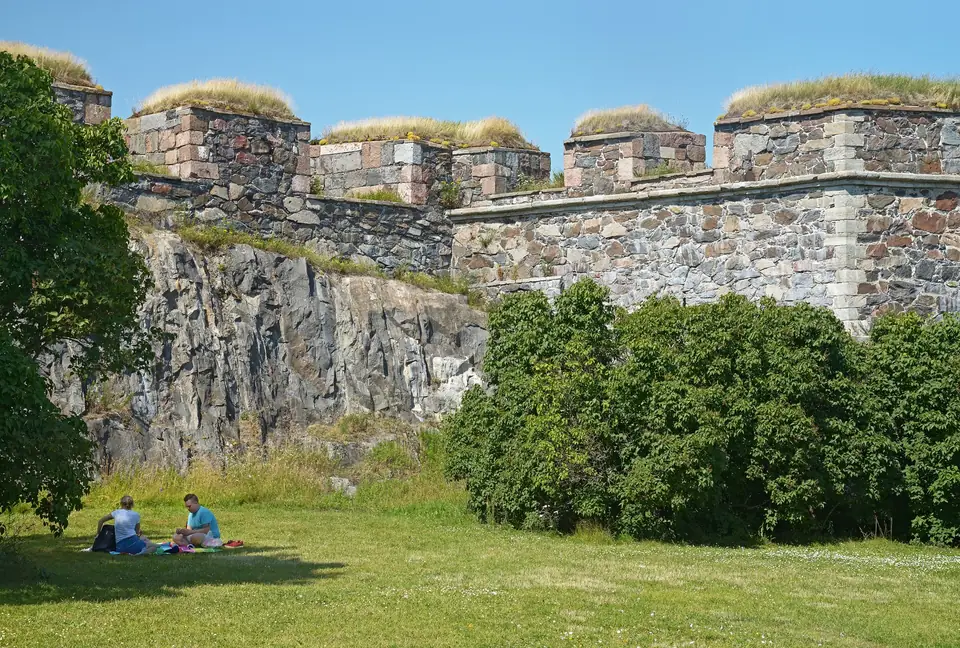
Suomenlinna was born in 1748 as Sweden's answer to Russia: a central fortress with a naval base raised on the Susiluodot islets under the direction of Augustin Ehrensvärd, paid for largely with French money and built with the rock of the islands themselves. A UNESCO World Heritage Site since 1991, it preserves bastions, a great Baroque courtyard, the oldest dry dock in Finland and the King's Gate, its ceremonial entrance.
The paradox runs along every wall: the fortress that the tsar's entourage called “this new Gibraltar” surrendered in 1808 after a few weeks of blockade, and its founder's tomb was cast with bronze from captured Russian cannon by Carl Olof Cronstedt, the very commander who years later signed the surrender.
Highlights
- King's Gate — 1753-1754 entrance with a drawbridge and a plaque whose year was left blank
- Suomenlinna Church — an 1854 Orthodox church turned Lutheran and a lighthouse that flashes the H of Helsinki in Morse
- 1750 dry dock — the oldest in Finland, still in service
- Ehrensvärd's tomb — Sergel's monument cast with bronze from Russian cannon
- Kustaanmiekka strait — the big ferries pass a few metres from bastions and cannon
In 1747 the Swedish parliament decided to shield its eastern border with two works: a border fortress at Degerby, near Loviisa, and a great fortress with a naval base off Helsinki. Work on the latter began in 1748 on a cluster of granite islets, with Lieutenant Colonel Augustin Ehrensvärd in charge of design and direction. In 1755 7,000 labourers worked on it, when neighbouring Helsingfors had some 2,000 inhabitants. The history of Suomenlinna is that of this disproportion: a stronghold meant to resist Russia that ended up in Russian hands without an assault, that was bombarded from where its cannon could not reach, and that is today kept up by its own residents.
The architecture of Suomenlinna is spread over several islands: bastions, barracks, a Baroque courtyard, a former Orthodox church, a dry dock and the King’s Gate facing the strait through which the ferries enter Helsinki. Since 1991 it has been a UNESCO World Heritage Site, and since the army left in 1972-1973 it has been a neighbourhood with some 800 residents and 400 workers. EarGuide’s documented audio guide walks it in five stops, from the ferry quay to the King’s Gate, so that each episode can be heard where it happened.
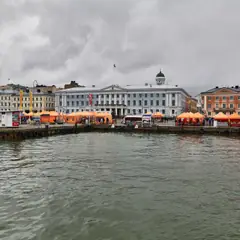
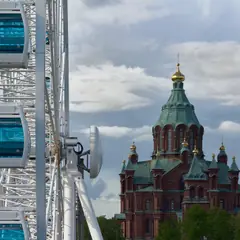
The ferry that takes visitors to the fortress leaves from Market Square, and back on the mainland Uspenski Cathedral, in Katajanokka, recalls the period when Helsinki and its islands formed part of the Russian Empire.
Sveaborg, Viapori, Suomenlinna: a quay with three names
Rantakasarmi
Summary of this stop
The route begins beside the main ferry quay, in front of the Quay Barracks (Rantakasarmi), a Russian-era building plastered pink that was the fortress’s main gate under the tsar. From here it is clear that the name of the place is itself a story of flags. Ehrensvärd christened it Sveaborg, “fortress of Sweden”, as a deliberate answer to Göteborg, and King Adolf Frederick fixed the name on 17 July 1750. Viapori, the Finnish form used until 1918, is only a phonetic adaptation of Sveaborg, documented since the mid-19th century.
The third name came on 12 May 1918, when the red and yellow flag of the lion was hoisted on the Kustaanmiekka mast with eight salvos from two Russian field guns. On the proposal of Senator Kyösti Kallio, the fortress was renamed Suomenlinna, “castle of Finland”, and a decree the following day allowed Sveaborg to go on being used in Swedish.
That spring had another face on these same islands. Between April 1918 and March 1919, the Whites kept a camp of Red prisoners here; figures vary according to the sources, but there is talk of some 8,000 inmates at the peak and of around 1,100 dead from hunger, disease or shooting. A memorial by Marja Kanervo, unveiled in 2004 on the north shore of Iso Mustasaari, recalls those months, and at this point the narration tells how the two memories of 1918 coexist.
The tsar’s church that now serves as a lighthouse
Suomenlinnan kirkko
Summary of this stop
On the highest point of Iso Mustasaari stands Suomenlinna Church, built under Russian rule as an Orthodox garrison church to a design by Konstantin Thon. It was consecrated in 1854 to Alexander Nevsky, the prince who defeated the Swedes on the Neva in 1240: quite a statement in a fortress built by Sweden. In the 1870s it was surrounded with a fence made of cannon and chains, and in 1885 its 6,683 kg bell, the largest in Finland, was cast in Moscow and is now displayed beside the church.
After independence, the church lost its five onion domes, and its icons were put in storage, with no one today knowing where they are. The exact date of the change of worship is disputed, but there is agreement that, remodelled by Einar Sjöström, it was reconsecrated as Lutheran on 28 April 1929. Since that year its central dome has also been a lighthouse, whose four-pulse flash draws the H of Helsinki in Morse.
The building also holds a dark episode: the mutiny of the Russian gunners in 1906, some sixty hours of revolt that began with three cannon shots and ended with hundreds of arrests. It is said that, while shells fell on Iso Mustasaari, the commander took refuge in this church’s cellar. What happened next, with a decisive shell and two ships the rebels believed to be on their side, is revealed in the audio guide in front of the church.
The 1750 dock that still repairs ships
Suomenlinnan telakka
Summary of this stop
Suomenlinna’s reason for being lies in its dry dock. The fortress was above all a naval base, and in 1750 construction began on Susisaari of a dock for the ships of the Archipelago Fleet, which in 1764 launched its first three archipelago frigates here. It is the oldest dry dock in Finland, with an inner basin of 140 by 50 metres, and it is still in service: ships are still repaired and kept in its basins, many of them wooden sailing boats.
Here the scale of the enterprise can be felt. France financed the work with 450,000 thalers a year for four years, and most of the stone of the walls came from the rock of the islands themselves. The result was a military city of granite raised by thousands of labourers before a Helsinki that was still small.
The water around the fortress fills with sails once a year. Since 1985, on a Saturday in mid-August, the island’s sailing club has organised the Viaporin Tuoppi, a regatta reserved for wooden sailing boats in which some 200 boats and a thousand sailors take part, also from other Baltic ports. The narration explains how that tradition links with the old fleet that was born in this very dock.
The founder’s tomb and Cronstedt’s shadow
Ehrensvärdin hauta
Summary of this stop
In the centre of Susisaari’s great courtyard, the Linnanpiha, rests Augustin Ehrensvärd. He died in 1772 and, by order of Gustav III, his coffin was moved here on 5 July 1783 with the king present. The monument, a granite slab with bronze ship prows and, above, a shield, a sword and a helmet, was made from a sketch by the king himself and is the work of Johan Tobias Sergel. It was finished in 1805 with bronze cast from Russian cannon captured at the battle of Svensksund in 1790, a victory of Carl Olof Cronstedt. Beside the courtyard stand the Commander’s House, now the Ehrensvärd Museum, and the Town Major’s House, from 1756, the oldest block of dwellings in Helsinki inhabited from the start.
The paradox came three years later. After a siege begun in March 1808, Cronstedt, by then commander of the fortress, agreed with the Russian Jan Pieter van Suchtelen to hand it over on 3 May if no Swedish relief arrived first. The sea was still frozen in early May and Sveaborg surrendered that day with almost 7,000 men and more than 100 ships. A court in Stockholm sentenced him to death as a traitor, a sentence annulled at the Russian emperor’s request, and Johan Ludvig Runeberg covered him with opprobrium in his poem “Sveaborg”.
The reasons for the surrender remain disputed: the traditional version speaks of treason or bribery; others point to a desperate situation, to Russian psychological warfare, to a lack of gunpowder or to fear for the civilian refugees, and see Cronstedt as a scapegoat. The fortress’s official website considers it an unresolved mystery. In the 1990s Helsinki dedicated a quay to him; the rest of the story is heard at the tomb cast from his own trophies.
The King’s Gate and its plaque with a blank year
Kuninkaanportti
Summary of this stop
The route ends at the southern tip, on the island of Kustaanmiekka, in front of the King’s Gate (Kuninkaanportti). It was built in 1753-1754 at the point where Adolf Frederick’s ship anchored when he came to inspect the works, and it keeps its steps, gun embrasures and a drawbridge over a moat; in 1986 it appeared on the 1,000-mark banknote. A few metres away, through the Kustaanmiekka strait, the big passenger ferries come and go from Helsinki.
The gate’s four plaques, with Ehrensvärd’s text in Swedish, record that King Frederick laid the first stone in 1748 and that King Gustav laid the last in a year that was left blank: Gustav III never came to place it. Another plaque asks posterity to stand on its own ground and not trust foreign help. That same Gustav III, according to a documented tradition, counted in 1772 on the Sveaborg garrison for his coup against the Parliament, but contrary winds held his troops back and the king won in Stockholm before they arrived.
Today the fortress is still alive: besides its residents, only the Naval Academy remains there as a military presence, and the inmates of an open prison founded in 1971 do a good part of the restoration of walls and buildings. How that 1772 adventure ended for the colonel who was to bring the garrison to Stockholm is the close the audio guide reserves for this last point.