Orthodox cathedral
Uspenski Cathedral Audio Guide (Uspenskin katedraali)
Red brick from a fortress blown up in the Crimean War, thirteen golden domes on the highest rock of Katajanokka and a nave where the icons are kept as if they were people.
- 30 min of audio
- Neo-Russian architecture
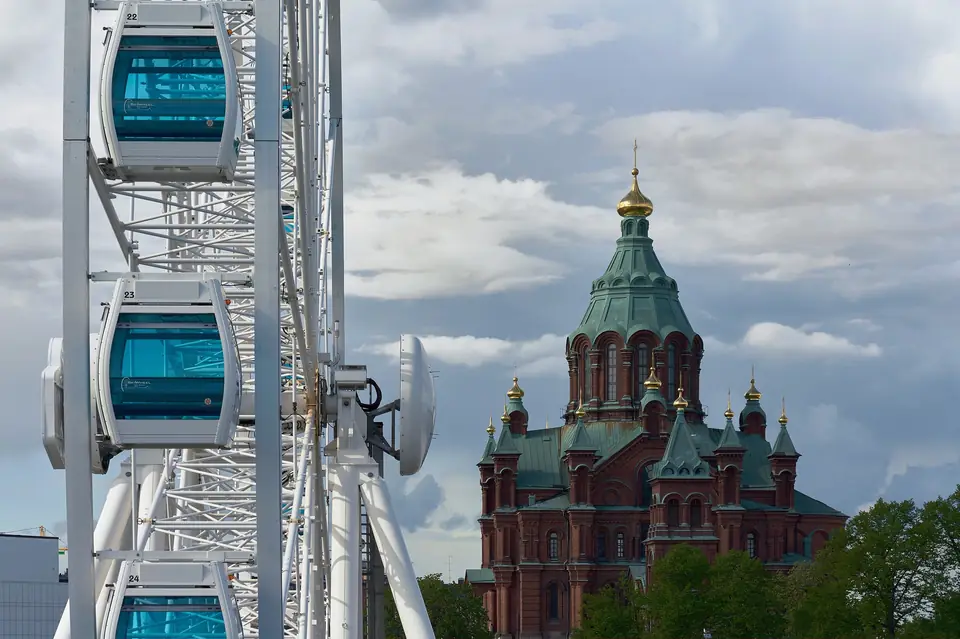
Uspenski Cathedral has crowned the rock of Katajanokka, above Helsinki's South Harbour, since 1868. It was designed by the Russian architect Aleksey Gornostayev, who died in 1862 without seeing it finished, and completed by Ivan Varek. Its exterior takes as a model a 16th-century stone church at Kolomenskoye, near Moscow: thirteen onion domes, one large and twelve smaller for Christ and the twelve apostles, plus another over the bell tower, with the central one 33 metres high. It was born as a temple of the Russian Empire in the capital of the Grand Duchy and is today the cathedral of the Orthodox Church of Finland.
Some 700,000 of its bricks arrived by barge from Bomarsund, the Russian fortress on the Åland islands that the Anglo-French fleet took in 1854 and that ended up blown up into ruins. The tsar's temple was raised, literally, from the remains of a defeat. And beneath its foundations, some 30 metres deep, a data centre operated between 2010 and 2019 whose heat went into the city's district heating.
Highlights
- Thirteen onion domes — 24-carat gold and 33 metres on the central one
- Red brick walls — some 700,000 bricks from the Bomarsund fortress
- Shiltsov's iconostasis — 22 oil paintings, the only one of his preserved complete
- Nave without pews — four single-piece granite columns
- Kozelshchan icon — stolen in 2010 and recovered from underground in 2011
The history of Uspenski Cathedral begins, according to several sources, with salt: in 1814, two years after making Helsinki the capital of the Grand Duchy of Finland, Tsar Alexander I set aside 15% of the tax on imported salt for a fund for two churches, one Lutheran and one Orthodox. The parish, by contrast, stresses that the church was paid for mostly with donations from the faithful and benefactors, and the debate remains open. Work began in the 1860s and the cathedral was consecrated on 25 October 1868, dedicated at Alexander II’s wish to the Dormition of the Mother of God, the uspenie of Church Slavonic that gives it its name.
Its architecture tells a story of empire and defeat; its later life, that of a country that made it its own. Since 1923 it has belonged to the Orthodox Church of Finland, autonomous under the Ecumenical Patriarchate of Constantinople, and since 1990 it has celebrated in Finnish. The domes, which now shine over the harbour, were not gilded until the restoration finished for the centenary in 1968, and between 2004 and 2007 they were covered again with 24-carat gold. It is usually described as the largest Orthodox church in western or northern Europe, depending on who says it, although no source offers a comparative measurement. The whole route, from the park rock to the icon in the nave, is best understood by listening to it on the ground, with the audio guide.
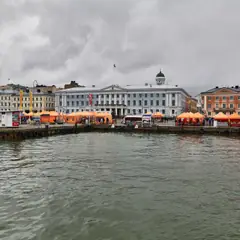
Some 450 metres away, by the harbour, lies Market Square, from whose quay the ferry to Suomenlinna departs, and a little further on Senate Square brings together the Lutheran cathedral and the buildings of Grand Duchy power.
A rock meant for a palace
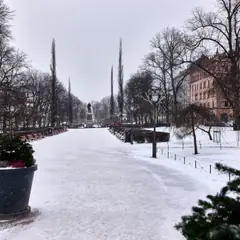
Tove Janssonin puisto
Summary of this stop
The route starts below, in Tove Jansson Park, in front of the bare granite rock that holds up the cathedral. It was the highest on Katajanokka and was at first reserved for the Imperial Palace, today the Presidential Palace. In the late 1850s, on the initiative of Governor-General Friedrich Wilhelm Rembert von Berg, it was decided to build the Orthodox church there. Why there is a matter of dispute: popular memory speaks of cleaning up a harbour district of barracks and brothels, while the local press maintains that height was the aim, so that the church could be seen from land and sea.
From this point one can appreciate the profile that inspired the Kolomenskoye church: the great central dome, the twelve smaller ones and that of the bell tower cut against the sky. But these rocks also hold an intimate story. Tove Jansson, the creator of the Moomins, spent her childhood a few steps from here, and tradition recalls that the cathedral’s rocks and the neighbouring park were her playground, a landscape that reappears in many of her works.
Since 2014 the park has carried her name, and after its restoration it premiered in 2026 a small bronze Moomin made to be hugged. What the girl did in this very park, hidden from the guard, is left for the narration on the spot.
Walls made from the ruins of a war
Bomarsund red brick walls
Summary of this stop
On the esplanade in front of the façade, exposed red brick dominates the scene. A good part comes from Bomarsund, in the Åland islands: the Russian fortress that the Anglo-French fleet took in August 1854, during the Crimean War, and that ended up blown up into a heap of ruins. Some 700,000 bricks travelled by barge to Helsinki to raise this neo-Russian church.
The empty ground of the esplanade has a memory too. In 1913 the Rauhankappeli, the Chapel of Peace, rose here, for the centenary of the Treaty of Fredrikshamn that annexed Finland to the Russian Empire. It was built without permission from the Finnish authorities; in 1919 nationalist students smeared it with tar and in 1920 it was demolished by order of the Ministry of the Interior. No trace of it remains outside, but its icon of the Nativity is kept inside the cathedral.
Through this door Tsar Nicholas II came out on his only visit to Helsinki, on 10 March 1915, before a city that received him with protocol coldness in the midst of Russification. A Finnish cameraman filmed that day, and what he had to do to save his film is one of the episodes the audio guide tells in front of the façade.
Standing before a wall of gold
Shiltsov's iconostasis
Summary of this stop
Inside, the 967-square-metre nave has no pews: following Orthodox custom, the service is followed standing. The central dome, with its starry sky, rests on four great columns, each carved from a single block of granite. The space invites looking up before sitting down.
At the back, on the east side, extends the gilded iconostasis, the wall of icons behind which the altar stands. Its 22 oil paintings were done by the Russian academician Pavel Shiltsov in a Renaissance-inspired manner, closer to portraiture than to the Byzantine icon. It is the only iconostasis of his that is preserved complete: the others were lost or dismantled into separate icons.
Here the name of the church makes sense, dedicated to the Dormition of the Mother of God, whose patronal feast, the praasniekka, is celebrated every 15 August. How this gallery of faces is read, and what makes it different from any other wall of icons, is revealed by the narration among the columns.
The icon that came out of the ground
Kozelshchan icon of the Mother of God
Summary of this stop
The last stop is before the miraculous icon of the Mother of God of Kozelshchan, surrounded by votive jewels donated by the faithful. It came from Vyborg during the Second World War and in the early hours of 9 June 2010 it was stolen along with the jewels around it. In February 2011, the convicted thief told the police that he had buried it near Turku. Restored at Valamo Monastery, it returned to the cathedral in procession in August 2011, though without most of its jewels.
According to accounts of the case, the backstory has something of a crime novel: the thieves entered through a window, tried again in August and a bloodstain from the first break-in ended up giving them away. The sources do not agree on how long the icon spent underground, between six and eight months depending on which is consulted.
This icon sums up what the cathedral has come to be: a church born as a seal of the Russian empire that today prays in Finnish for a parish of some 20,000 faithful who speak 50 different languages. What happened the first night after it was dug up, and how its restorer said farewell to it, are details heard right there, in front of it.