Harbour and market
Market Square Audio Guide (Kauppatori)
A reclaimed fishermen's bay that became Helsinki's gateway from the sea: tsars and kings landed here, the city was scandalised here by a naked mermaid, and people still come down here to buy fish under orange awnings.
- 40 min of audio
- Maritime history
Market Square grew out of Johan Albrecht Ehrenström's 1812 urban plan, which placed the new market over the old fishing quays of the Kaupunginlahti bay. Since then it has been the city's ceremonial entrance by sea: Carl Ludvig Engel's red granite obelisk marks the exact spot where Tsar Nicholas I and Empress Alexandra stepped ashore in 1833, and in 1925 King Gustav V of Sweden arrived at this same quay on the first official state visit to Finland.
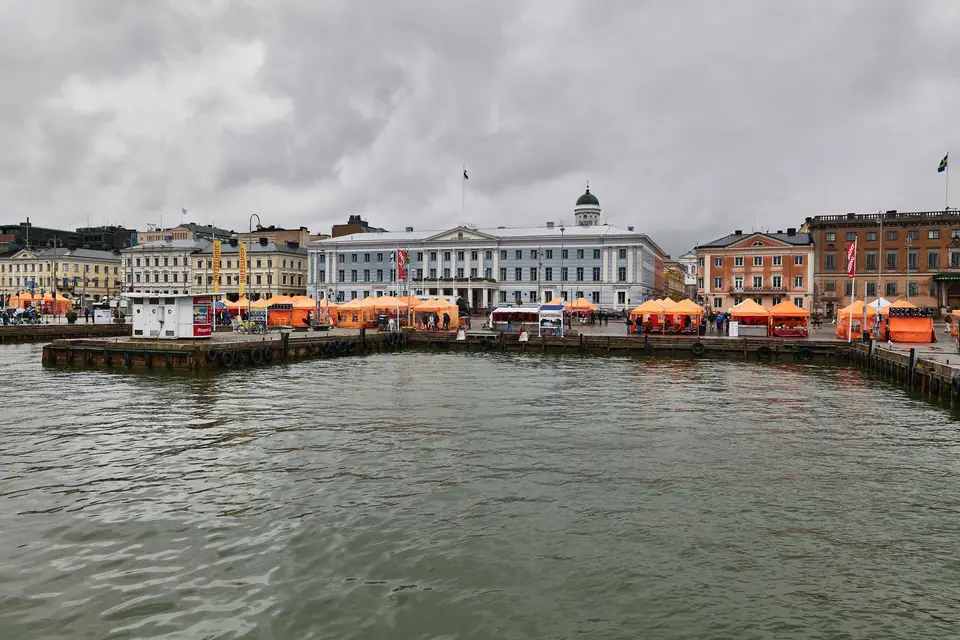
Beneath the postcard of orange awnings and boats selling straight from the water hides a working harbour with a rough memory: a basin that still bears the name of cholera, rails of a harbour railway embedded in the paving and a fountain that in 1908 set off Finland's first great public art debate and that today, on nights of sporting glory, is shut inside a steel cylinder.
Highlights
- Keisarinnankivi — 1835 obelisk, the oldest public monument in Helsinki
- Havis Amanda — 2.1-metre bronze mermaid by Ville Vallgren, controversial in 1908
- Kolera-allas — the fishermen's basin named after the 1893 cholera
- Orange awnings — the regulation colour for the stalls since 1957
- Old Market Hall — red-brick hall by Gustaf Nyström, opened in 1889
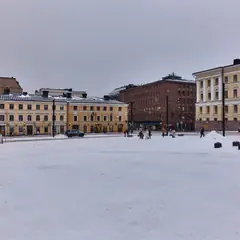
Until the early 19th century, the ground that Kauppatori now occupies was the muddy floor of a bay where fishermen moored and sold their catch. In 1812, Johan Albrecht Ehrenström’s plan turned the old Suurtori into the monumental Senate Square and moved the market to this shore, over the former fishing quays. What came out of it is the great square open to the South Harbour: the place where Helsinki buys fruit and fish, drinks coffee under orange awnings and boards the boat for the Suomenlinna fortress.
The history of Kauppatori is also the history of the country seen from the water. Nicholas I arrived at its quay in 1833 and Gustav V of Sweden in 1925; beside it Elizabeth II’s royal yacht Britannia anchored in 1976 and 1994. Here the fear of cholera was lived through in 1893, the scandal of a naked mermaid in 1908 and, on 26 May 2006, the largest gathering held in Finland until then: some 90,000 people celebrating Lordi’s Eurovision victory, with a world record in collective karaoke included. What to see at Kauppatori goes well beyond the stalls, and the audio guide arranges it in four stops on foot, from the imperial obelisk to the Old Market Hall.
The square is also the starting point of three other visits: from its quay the ferry to Suomenlinna leaves all year round, to the west Esplanadi begins, and some 250 metres to the north lies Senate Square, the old main square that gave up the market to it.
A red granite obelisk and the tsar who stepped off the steamer
Keisarinnankivi
Summary of this stop
In the centre of the square, opposite the Swedish embassy, stands the Keisarinnankivi, the Empress’s Stone. It is a red granite obelisk designed by Carl Ludvig Engel and the oldest public monument in Helsinki. It was unveiled on 18 December 1835, Nicholas I’s name day, at the exact spot where the tsar and Empress Alexandra had landed from the steamer Ischora on 10 June 1833. Twelve granite pillars with chains held by lion heads surround it, and it bears a Latin inscription on the south face and a Finnish one on the north face.
The most telling part is at the top: a gilded sphere and the imperial double-headed eagle, with the lion of Finland on its breast. On 17 April 1917, after the February Revolution, Russian sailors tore off the bronze sphere and the eagle and erased the inscriptions. The eagle broke, but both pieces were kept, and they did not return restored to the top of the obelisk until 1971, after consulting the Soviet Union. How a bay bed ended up turned into the stage for that history of power is what is revealed by listening to the narration beside the stone.
Havis Amanda, the mermaid who divided the city
Havis Amanda
Summary of this stop
At the western end, beside Esplanadi, a naked mermaid in blue-green bronze rises on a rock, surrounded by four sea lions and four fish spouting water, in a basin of polished red granite. The fountain measures five metres and the mermaid 2.1. Ville Vallgren, who had lived in Paris since 1877, modelled her in his studio on the rue du Faubourg Saint-Honoré from two 19-year-old Parisians, Léonie Tavier and Marcelle Delquini, on a commissioned theme: Helsinki rising from the sea. It was unveiled early on Sunday 20 September 1908, with no publicity or ceremony, and it set off Finland’s first great public art debate: women’s associations led by Lucina Hagman protested against the nudity, the newspaper Työmies denounced its cost of 80,000 marks, and twelve cultural figures, among them Akseli Gallen-Kallela and Eliel Saarinen, came to its defence.
The scandal ended in affection. At least since 1921, when Vallgren celebrated that his “daughter” had graduated, students place a large white cap on her on the eve of May Day; the rite has been official since 1951 and, since climbing the statue was banned in 1990, the washing and the capping are done from a crane. The name, by the way, comes from no soap: everything points to the Swedish “Havets Amanda”, the Amanda of the sea.
And beneath her feet lies another story. When the fountain was removed in 2023, an archaeological dig found an old dump where residents had perhaps thrown rubbish since the late 17th century: animal bones, pottery, clay pipes, leather shoes with pointed toes and a wooden jetty probably built around 1700, something never seen before in Helsinki. What it means that this mermaid rising from the sea rests on the city’s lost shoreline is left for the stop.
The cholera basin and the fair that survived
Kolera-allas bridge-keeper's hut
Summary of this stop
Opposite the square, the Kolera-allas still welcomes fishermen’s boats that sell directly and small excursion boats. Its popular name, “cholera basin”, comes from the autumn of 1893: skipper Johannes Michelsson, of Nauvo, who had come for the herring fair, died of cholera on board after his vomit and excrement had been dumped into the water. The herring boats were towed out of the harbour and guards were posted on the shore.
In the 1890s a harbour railway was also laid towards Katajanokka, which made it necessary to widen the square towards the sea and to build two swing bridges. The trains stopped running in the 1980s, but some twenty metres of rails remain embedded in the paving and, beside the basin, the ornate bridge-keeper’s hut is preserved.
The herring fair, held in Helsinki every year since 1743 and settled in the South Harbour since 1820, was the only one to survive when in 1891 the governor abolished the city’s other annual markets. It keeps returning in the first week of October, with traditional sailing boats at the quay and a jury that awards the best spiced herring of the year as if it were a great wine. That smell of herring, tar and archipelago is what the narration brings back to the shore.
Brick, regulations and the seagull war
Vanha kauppahalli
Summary of this stop
On the south side of the basin, on Eteläranta, stretches the long red-brick hall of the Old Market Hall, by Gustaf Nyström. At its southern end it bears the year 1888, when work began, although it did not open until 1889 because of problems with the cement supply. It was born to move food sales off the square into a covered building for reasons of hygiene.
A good part of what is seen today at Kauppatori is the result of rules like that: the sale of meat on the square was banned in 1927 with the tightening of food legislation, and since 1957 a rule requires the stall awnings to be orange. But there are those who respect no rule: the seagulls, which steal buns, vegetables and ice creams. In 2010 the municipal director Jussi Pajunen even called for a “seagull war”, with criticism from BirdLife Suomi, and in 2011 the city hired full-time seagull watchers for the square. Who won that war is the finale of the audio guide.