The Carp Castle
Hiroshima Castle Audio Guide (Hiroshima-jō)
The castle that gave Hiroshima its name never saw a battle, and yet it has been undone and rebuilt again and again: a shogun, a bomb, five months of works and, now, a pending decision about its keep.
- 60 min of audio
- Plains castle
Hiroshima Castle began to rise in 1589, when Mōri Terumoto chose a cluster of islets in the delta of the Ōta river called Gokamura, the “five villages”; around those years the place began to be called Hiroshima. Terumoto moved in in 1591 and the works ended in 1599. Its tenshu, raised around 1592, was a complex of a five-level main keep joined by corridors to two smaller towers, some 32.7 metres tall, and when built only the one at Osaka Castle surpassed it.
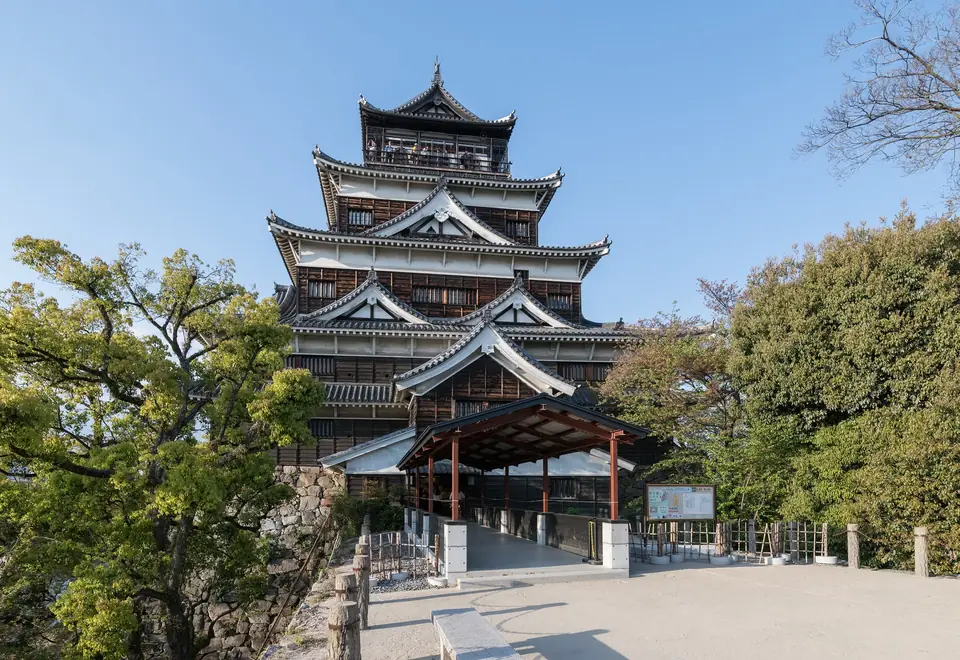
On 6 August 1945 the great keep, a National Treasure since 1931 and some 980 metres from the hypocentre, withstood the heat of the explosion and did not burn: the blast wave brought it down. The one seen today is an exterior reconstruction of 1958, in reinforced concrete with only the top floor in wood, closed inside since 22 March 2026. The city is studying rebuilding the whole complex in wood, with a decision not expected before about 2030.
Highlights
- 1958 tenshu — five levels on a 12.4 m stone base, with tiles recovered from the moat
- Omote-gomon gate — rebuilt in wood in 1994, with stones stained by the 1945 fire
- Chūgoku Military District bunker — the first known warning of the bombing went out from here
- Surviving trees — a eucalyptus, a willow and a holly that withstood the bomb
- Cut wall — the mark of the lord punished by the shogunate in 1619
The story of Hiroshima Castle is that of a fortress that never fought. During the Edo period the great keep served almost only as a storehouse, with no ceiling and the log beams in view; in 1894 it housed the Imperial Headquarters, and in the Second World War the army kept important documents in it and had the headquarters of the Chūgoku Military District on the grounds. Even its origin is wrapped in doubt: a much repeated account explains the name Hiroshima with the syllables of two figures tied to the Mōri, while the municipal sources translate it as “wide island”, for the islands of the delta.
The architecture of Hiroshima Castle is read today in layers. Of the original complex there remain stone walls and the inner moat, the only one of the three that survives, fed by a canal with water from the river. The main gate and three yagura towers of the ninomaru were rebuilt in wood in 1994 from old photos and plans of the 1930s, and the present keep is the concrete replica of 1958. The official tourist sheet presents it as faithful to the original, but it differs from the prewar appearance in its windows, and the two smaller towers were never rebuilt. The keep’s collections are moving to the new Sannomaru History Museum, which opens in phases from 1 June 2027.
The audio guide covers the grounds in five stops, from the main gate to the cut wall at the eastern end, with documented narration checked against historical sources.
Of feudal Hiroshima there remains also the Shukkeien Garden, which the Asano lords began to lay out in 1620 and which Emperor Meiji visited in 1894, when the Imperial Headquarters was in this castle. The same lineages that ruled from here left their mark on the Itsukushima Shrine: the Mōri donated the stone pillars of its great platform, and an Asano lord paid in 1680 for its Noh stage over the sea.
The castle gate that named a city
Omote-gomon Gate
Summary of this stop
The visit starts before the Omote-gomon gate, the main entrance, rebuilt in wood in 1994 together with its earth walls and the Hirayagura, Tamon-yagura and Taiko-yagura towers, which can be toured inside. The stones of the gate walls are not new: they keep dark stains from the fire that followed the bomb.
Behind lies the origin of the city. In 1589 Mōri Terumoto began to build the castle here, on the islets of Gokamura, and the city grew around it under the name of Hiroshima. The castle has, besides, another name, Rijō, the “carp castle”, which lives on in Rijō-dōri avenue and in the baseball team the Hiroshima Tōyō Carp. Where that nickname comes from is not clear: people speak of the old place name Koi, which sounds the same as “carp”, of the carp in the moat or of the black colour of the keep. Which version has more papers behind it is what the narration settles before the gate.
A military telephone under a mound
Former Chūgoku Military District bunker
Summary of this stop
Against the south wall of the inner moat, beside the Gokoku shrine, a low mound covered with earth and trees hides the semi-underground concrete bunker of the Chūgoku Military District, 790 metres from the hypocentre. Its entrance is behind a fence and the interior has been closed since 2017. On 6 August 1945 more than 700 employees died at the district headquarters, along with 64 students and teachers from the Hijiyama girls’ school and two American prisoners. The bunker held without collapsing.
From here, two mobilised 14-year-old students, Oka Yoshie and Araki Katsuko, warned over the military telephone, which still worked, that Hiroshima was almost completely destroyed. It is considered the first known warning of the bombing to go out from the city, although the sources do not agree on whether both gave it or only Oka. The neighbouring shrine, rebuilt in 1956 inside the honmaru, also keeps a ritual that the Carp team has repeated every season since 1958, and whose origin is told beside the mound.
Seven months as capital beside a brazier
Imperial Headquarters ruins
Summary of this stop
In the honmaru remain the foundations and base stones of the 1894-1895 wooden building that was the Imperial Headquarters, beside a monolith whose letters have been erased. In September 1894, during the Sino-Japanese War, the headquarters moved here and Emperor Meiji lived and worked in the castle for some seven months; in October the 7th Imperial Diet met in a temporary building in Hiroshima. It is the only case, since the Meiji Restoration, in which the functions of capital left Tokyo. When exactly the stay ended is something the sources do not agree on.
South of the ruins, where the entrance courtyard stood, a holly that survived the bomb about 910 metres from the hypocentre is still alive; a eucalyptus and a willow, at 740 metres, flank the earth bridge of the Nakagomon gate. The emperor’s life in a single room, and what the prewar school did with it, is the episode the narration tells about these stones.
A keep that did not burn and fell
Castle tenshu
Summary of this stop
At the foot of the 12.4-metre stone base rises the 1958 keep: five levels of dark boards and stacked roofs, concrete inside and wood only on the top floor. The esplanade before the entrance occupies the place of the smaller south tower and its corridor, and at the base of the east one foundation stones remain: it is the visible absence of the 1592 three-tower complex.
The original did not burn in 1945; it collapsed from the blast wave and much of its materials ended up on the base and in the northeast moat. How exactly it fell is still debated, from a 2010 hypothesis to a new photographic examination of 2024 that describes pressures in several directions. The replica was raised in five months for the 1958 Reconstruction Exposition, for about 36 million yen, and for its tiles pieces sunk in the moat were sought and neighbours were asked, with press ads, for tiles from the old castle. Beneath it all, a thousand stakes are said to be driven into the sand of the delta, an explanation that excavations have not confirmed, and the narration explains why.
The wall the shogun had cut
Fukushima Masanori's cut wall
Summary of this stop
At the east end of the upper honmaru, a stretch of the stone wall is interrupted by irregular stones. It is taken as the mark of a punishment: in 1619 the Tokugawa shogunate stripped Fukushima Masanori, lord of the castle since 1600, of his fief for repairing without permission the damage of a flood, and one of the preliminary conditions was to demolish the repaired walls.
It was not the last time others decided for the castle. After the bomb, the city council wanted to rebuild the keep, the heritage officials preferred to keep the ruins and some residents proposed filling in the moat; a pacifist movement led by Professor Osada Arata even proposed a replica of the Statue of Liberty in the honmaru. In 1951 a provisional wooden tower was raised for the National Games, lit at night and surrounded by a wooden roller coaster, which withstood Typhoon Ruth and stirred the reconstruction campaign. And in 2026 the concrete keep closed inside, awaiting word on whether it will return in wood. That chain of decisions made by others is what the narration closes the tour with.