Atomic bomb memorial
Hiroshima Peace Memorial Park Audio Guide
Beneath the lawn of this flat park Nakajima is still buried, a district of cinemas, cafés and landing stages erased on 6 August 1945. Kenzo Tange drew over it a single line joining museum, cenotaph, flame and Dome.
- 60 min of audio
- Kenzo Tange's axis
The Peace Memorial Park occupies the tip of the island between the Motoyasu and Honkawa rivers, where the Nakajima district stood. The Hiroshima Peace Memorial City Construction Law of 6 August 1949 devoted all of it to memory, and that same year Kenzo Tange's team won the competition, with a north-south axis chaining museum, plaza, cenotaph and Atomic Bomb Dome. The park, of about 122,100 square metres, was completed on 1 April 1954.
The smooth grass is a lid. To build the park, earth was spread over the 1945 ground and almost all the former residents were evicted, so the district was left buried under the lawn. Since 2022 a pavilion has shown, below the level of the grass, remains of houses and of a paved street damaged by the bomb, and each monument in the park is a different way of going on naming those who lived here.
Highlights
- Cenotaph — Tange's arch in the shape of a haniwa house, over 353,639 victims' names
- Flame of Peace — lit in 1964 to burn until no nuclear weapon remains
- Children's Peace Monument — Sadako's statue, which receives some 10 million cranes a year
- Rest House — the 1929 kimono shop, the only building in Nakajima left standing
- Memorial Mound — the ashes of about 70,000 unidentified or unclaimed victims
The story of the Peace Memorial Park begins before it was a park. In the Edo era Nakajima was where goods coming downriver by boat were unloaded; in the Meiji era it concentrated the city hall and the prefecture, and from the end of the Edo period to the Taishō era it was one of the liveliest commercial and entertainment districts of Hiroshima, with cinemas, cafés, banks and the old Saigoku Kaidō road crossing it from bridge to bridge. In August 1945 several thousand people lived there; the sources do not agree on the figure, which is given as about 6,500 in seven neighbourhoods or about 4,400 in some 1,300 households. After the bomb, some 400 shacks occupied its ruins.
The architecture of the Peace Memorial Park is, above all, a line. In the 1949 competition Kenzo Tange’s team won with Takashi Asada, Sachio Ōtani and Tokukuni Kimura, and its proposal drew a north-south axis, perpendicular to the future 100-metre boulevard. On 6 February 2007 that axis made the grounds the first postwar park designated a Place of Scenic Beauty of Japan, a protection extended to the whole park on 28 March 2008. Across the lawn are also scattered the Peace Bell of 1964, surrounded by a lotus pond, the aogiri trees burned by the bomb 1.3 kilometres from the hypocentre and transplanted here in 1973, and the stones raised by former residents of the vanished districts.
The audio guide covers the park in six stops, from the kimono shop that was left standing to the mound of ashes, with documented narration checked against historical sources.
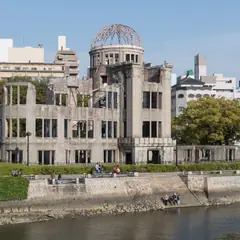
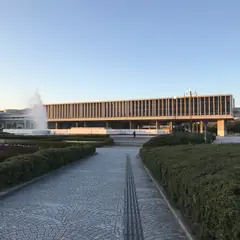
To the south, the pilotis of the Peace Memorial Museum open Tange’s axis, and to the north, across the Motoyasu River, the Atomic Bomb Dome closes it.
The kimono shop that was left standing
Peace Park Rest House
Summary of this stop
Beside the Motoyasu Bridge stands the Rest House, the only building of old Nakajima left standing. It was the Taishoya kimono shop, from 1929, a rare concrete building where one shopped without taking off one’s shoes, in a district of cinemas and cafés through which the Saigoku Kaidō road passed. During the war it became a fuel rationing office, and on 6 August 1945 it stood 170 metres from the hypocentre. Of its 37 workers only one man survived, who had gone down to the basement to look for some documents; that basement is preserved as it was left.
The river next door keeps a living custom. Every 6 August, from six in the evening, the Motoyasu fills with floating paper lanterns in front of the Dome. Nobody knows for certain who began it: it is believed to have been families who, shortly after the war, set afloat on the water lanterns made by hand for their dead. Where the flame of those lanterns comes from today, and what paper they are made of, is what the narration tells at the riverbank.
The Nakajima street under the lawn
Nakajima remains pavilion
Summary of this stop
North of the museum’s east wing, a pavilion opened on 26 March 2022 shows what the park covers: below the level of the lawn appear remains of houses and of a paved street of the Nakajima of 1945, damaged by the bomb.
The district was buried on purpose. The law of 6 August 1949 reserved all of Nakajima for memorial facilities; when the park was built, earth was spread over the 1945 ground and almost all the former residents were evicted. What can be seen at this stop is the level of the city that existed before, that of the landing stages, the city hall and the houses, a few centimetres below the feet of anyone strolling on the grass.
A Tange arch, an epitaph without a subject
Cenotaph for the victims
Summary of this stop
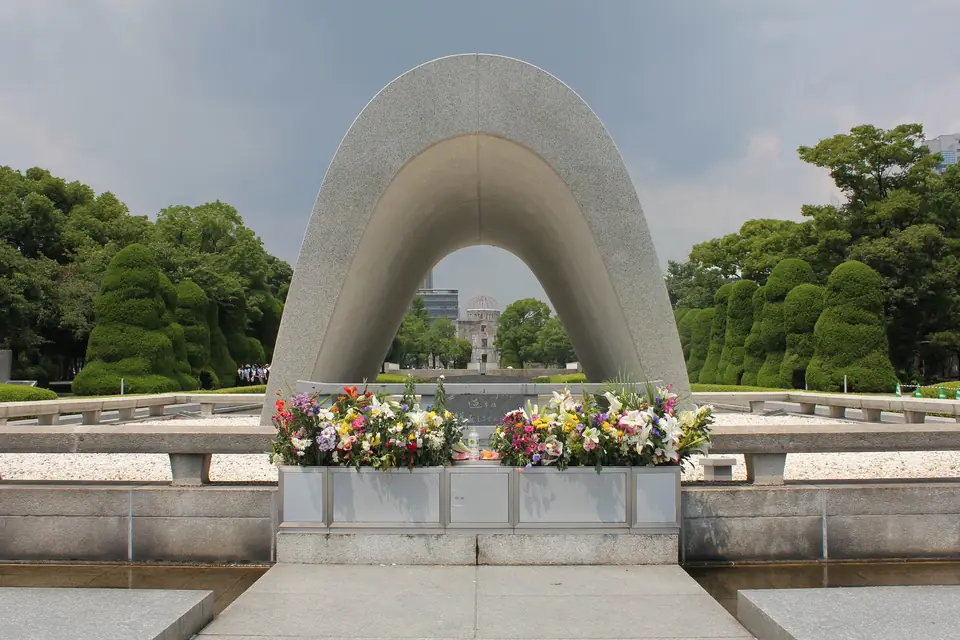
The Cenotaph, officially named the Hiroshima Peace City Memorial, was inaugurated on 6 August 1952. Its arch imitates an ancient haniwa clay house, meant to shelter the souls of the victims from dew and rain. Beneath it, a stone chamber holds the register of victims, open to any nationality: 353,639 names in 132 volumes as of 6 August 2026, one of them dedicated to “many of unknown name”. Every May, from 8:15, the stone lid is removed to clean the chamber and air the books.
The monument was born from a rejected design. The first project chosen was by the sculptor Isamu Noguchi, a great arch with an underground space; Hideto Kishida, Tange’s teacher, and other committee members vetoed it because of his Japanese-American origin, and Tange redesigned it keeping the idea of the arch. The original concrete arch was replaced by a granite one in 1985.
On the front of the sarcophagus is engraved the epitaph “Let all the souls here rest in peace; for we shall not repeat the evil”, written by Professor Tadayoshi Saika, a survivor of the bomb. In Japanese the sentence has no explicit subject, and since 1952 there has been debate about who promises not to repeat the error: some read it as a Japanese self-accusation, others attribute it to the United States, and the official municipal position is that the “we” is all humanity and the evil, war. A plaque in eight languages beside the Pond of Peace explains it. What an Indian judge of the Tokyo Tribunal replied in 1952 on reading it is the episode with which the narration opens that debate.
A flame lit until the last bomb
Flame of Peace
Summary of this stop
Before the Flame of Peace the straight line that Tange drew over the ruins is understood at once: looking north through the arch of the Cenotaph, the Pond of Peace, the Flame and, in the background, the Atomic Bomb Dome line up.
The flame has burned without interruption since 1 August 1964 and is to stay lit until nuclear weapons disappear from the Earth. Its pedestal, also by Tange, represents two hands joined at the wrists with palms to the sky, in memory of the victims who died asking for water. In 1994 it lit the cauldron of the Hiroshima Asian Games, and every year embers are taken from it for antinuclear relays. Who lit it that day in 1964, and with what fires brought from all over Japan, is the episode heard before the pond.
Sadako and the cranes that keep arriving
Children's Peace Monument
Summary of this stop
The Children’s Peace Monument is a three-legged bronze tower nine metres tall, the work of Kazuo Kikuchi, crowned by a girl raising a golden crane. It was born from Sadako Sasaki, exposed to the bomb at the age of two and dead of leukaemia on 25 October 1955: her classmates launched a national collection and, with pupils from more than 3,100 schools in Japan and nine other countries, the monument was inaugurated on 5 May 1958.
Around it, in display cases, hang garlands of paper cranes. About 10 million arrive every year, some 10 tonnes, from Japan and abroad, in memory of those Sadako folded from wrapping paper during her eight months in hospital. All over the world it is repeated that she died after folding only 644 and that her classmates completed the thousand; her family tells it differently. How many she actually folded, and with what paper she made the last ones, is the story the narration corrects beside the display cases.
Seventy thousand ashes under a grass mound
Memorial Mound
Summary of this stop
The tour ends at the Atomic Bomb Memorial Mound, a round grass tumulus 16 metres in diameter and 3.5 high, raised where countless bodies were cremated after the bomb. Since 1955 its crypt has held the ashes of some 70,000 unidentified or unclaimed victims, and in 2007 824 of the 2,432 named urns remained unclaimed. Before it an interfaith service has been held every 6 August since 1946.
A few steps away, on the west side of the park, near the Honkawa River, stands the Monument for the Korean Victims, an obelisk on a tortoise crowned by two dragons. It was erected on 10 April 1970 outside the park, beside the Honkawa Bridge, near where the body of Prince Yi U was found, and only after years of pressure was it moved inside the grounds, in July 1999. That wait of almost three decades is the last thing the narration puts before the visitor.