Shrine over the sea
Itsukushima Shrine Audio Guide (Itsukushima-jinja)
A Shinto shrine raised over the tide because the whole island was a god that could not be trodden. What looks like an intact 12th-century palace is a succession of fires, typhoons, washed-away blood and reconstructions that the sea keeps putting to the test.
- 90 min of audio
- Architecture over the tide
Itsukushima Shrine stands on the island of Miyajima, off the coast of Hiroshima, and according to tradition it was founded in 593 by Saeki no Kuramoto, lord of the island, in an inlet where the tide rises and falls, dedicated to three goddesses protecting navigation. Around 1168 the chief priest Saeki Kagehiro, under the patronage of Taira no Kiyomori, built a shrine on the same scale as the present one, in the shinden-zukuri style of the mansions of the Kyoto nobility. The core of what is seen today is the reconstruction of 1241.
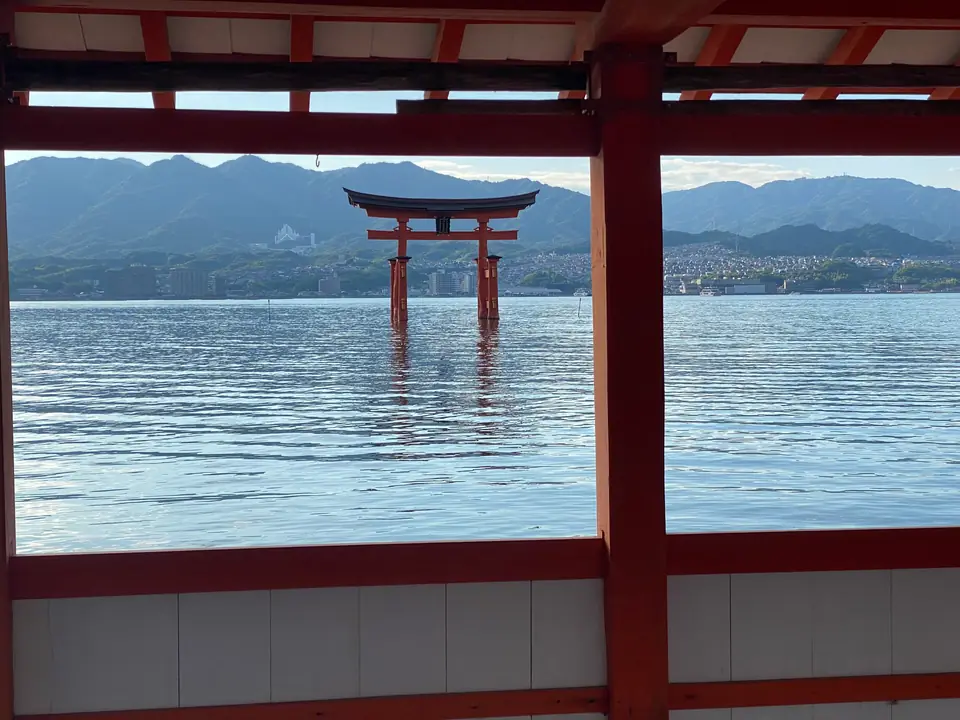
Its great torii of 1875, in the water some 200 metres from the shrine, weighs about 60 tonnes and is not buried in the seabed: it stands by its own weight on a bed of pine piles, with two camphor pillars more than 500 years old and 7 tonnes of stones packed into the lintel. While typhoons batter the later additions, the interior of the honden has not flooded in some 850 years.
Highlights
- Great torii — 60 tonnes in the water, standing only by its own weight
- Corridors over the sea — vermilion galleries with spaced planks to let the tide escape
- Hirabutai — the open platform whose tip points exactly at the torii
- 1680 Noh stage — the only one in Japan over the sea, which sounds different with the tide
- Sori-bashi bridge — the arched bridge of the imperial envoys, with fittings from 1557
The story of Itsukushima Shrine begins with a prohibition. The island of Miyajima, with Mount Misen, 535 metres high, as its sacred summit, was venerated as a whole as a deity and was forbidden ground: until around the Kamakura period the main rites were held at Jigozen, on the opposite coast, and the shrine was raised at the island’s edge, over the shore, so as to pray without touching sacred soil. Even today burials are forbidden, and next to the shrine neither births nor deaths are allowed. Its origin is also the subject of debate: popular memory attributes the great work of 1168 to Taira no Kiyomori, while the documentation names the chief priest Saeki Kagehiro as builder, with Kiyomori as patron.
The architecture of Itsukushima is often presented as a faithful reflection of the Heian era, but its buildings date from 1241, from 1571 and from later periods, and the scale changed with each restoration. Kiyomori’s shrine burned down completely in 1207 and 1223. After the Meiji Restoration, the government judged it Buddhist in style and ordered it burned; an appeal by the chief priest saved it, but all its paint was stripped until it was left in bare wood. On the eastern hill appear the five-storey pagoda of 1407 and the Senjōkaku, the enormous unfinished sutra hall that Toyotomi Hideyoshi ordered built in 1587.
The audio guide covers the shrine in five stops, from the shore facing the torii to the arched bridge at the exit, and works at both high and low tide, with documented narration checked against historical sources.
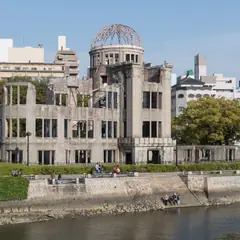
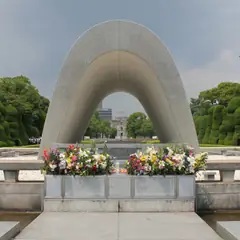
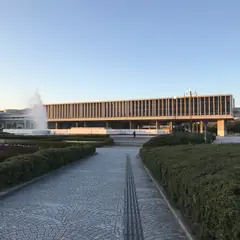
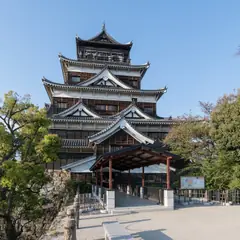
Among its patrons are the Mōri and the Asano, the same lineages that ruled the region from Hiroshima Castle. In the city, some 16 kilometres as the crow flies, the Peace Memorial Museum tells of 6 August 1945, whose best-known ruin, the Dome, joined the World Heritage List the same year as this shrine, 1996.
A torii that stands only by its weight
Itsukushima Great Torii
Summary of this stop
From the shore can be seen the vermilion gate of about 16.6 to 16.8 metres, depending on the source, planted in the water: two camphor pillars with two supporting feet each, six legs in all, a golden sun and moon at the ends of the crossbeam and a plaque with the shrine’s name in two different scripts, one facing the sea and the other facing the shrine. At low tide the coins that tourists push into the cracks can be seen. The present torii, of 1875, stands by its own weight, and the stones that weigh down its lintel, which were believed to be stones with sutras written on them, turned out to be river cobbles without any inscription.
It is the latest in a long chain. A gale brought down the one of 1286 in 1325, the one of 1561 collapsed on its own in 1716, lightning felled the one of 1739 in 1776 and the storm of 7 August 1850 wrecked the one of 1801 and carried its plaque off to Atata island. Even its number is not settled: the restoration begun in 2019 moved it from eighth to ninth. And one day in August, at the hour the tide dictates, the torii becomes the backdrop of a festival on the water that the narration tells from the shore.
The island that could not be trodden
Marōdo Shrine
Summary of this stop
Entry is through the Marōdo shrine, a smaller version of the main shrine with its purification hall open directly to the sea. Beside it, the Mirror Pond, one of the round ponds that served as water reserves against fire when the tide was low. From here the east corridor starts, over the water.
This first group explains why the whole shrine is in the sea: the island was a god, Mount Misen its summit, and the shore the only place to raise a place of worship. The taboo remains in force: pregnant women withdraw to the mainland as childbirth approaches, as do the terminally ill. How precisely this inlet was chosen is a documented legend involving a crow, whose echo lives on in a rite that the narration tells at this point.
The platform that points at the torii
Hirabutai and Hitasaki platform
Summary of this stop
The Hirabutai is a large roofless platform in front of the main shrine, resting on stone pillars donated by Mōri Motonari, with a raised stage for bugaku dances and a spit-like tip, the Hitasaki, that points exactly at the torii. Behind rises the main shrine: a worship hall ten bays wide, an unusual even number for a shrine, with its axis shifted to the right, and the honden with a cypress-bark roof.
Beneath that court-palace elegance there are layers of loss. After the fires of 1207 and 1223 came the reconstruction of 1241. The present honden dates from 1571 and was not rebuilt because of fire: in 1569 the Wachi brothers, lords of Bingo at odds with Mōri Motonari, barricaded themselves in it and were killed inside, and the blood-stained building was rebuilt. It was not the only time blood reached these corridors; the battle of 1555, the only one fought on the sacred island, is the episode the narration tells about the platform.
A Noh stage that sounds with the tide
Noh stage over the sea
Summary of this stop
Surrounded by the west corridor stands the Noh stage, unpainted, with its bridgeway and dressing room. It was paid for in 1680 by Asano Tsunanaga, lord of Hiroshima, and it is the only one in Japan raised over the sea: it does not admit the usual resonating jar under the floor, so its planking works like the skin of a drum and its sound changes with high and low tide.
The sea has brought it down too. The typhoon of 27 September 1991 carried off pieces of the left music hall and, while they were being tied down with ropes, toppled the stage; three of its four pillars were replaced afterwards, and in 2004 another typhoon felled that hall again. The music halls and the small guardian shrines, the most exposed to the surf, have been rebuilt so many times that they keep no old piece. One night a year, by tradition since the 12th century, court music enters by boat through the torii, and the narration tells how.
The bridge of the imperial envoys
Arched Sori-bashi bridge
Summary of this stop
The exit passes beside the Sori-bashi, a steeply curved bridge between the west corridor and land, used by imperial envoys, with metal fittings bearing the date 1557. Nearby, the small Tenjin shrine, of 1556, contrasts with its unlacquered wood against the vermilion of the rest.
The shrine survived politics too. The Buddhism still visible on the hill almost condemned it to the bonfire in Meiji, when its paint was stripped and roof fittings were added that were later removed. And a few steps away the Heike Nōkyō is preserved complete, the 33 scrolls of sutras decorated with gold and silver that the Taira clan offered from 1164, with one scroll copied by each member, a National Treasure along with its copper case. What allowed that case to be shown off during its transfer is the last detail of the tour.