Atomic bomb museum
Hiroshima Peace Memorial Museum Audio Guide
A museum born from the melted roof tiles that a geologist gathered among the ruins two days after the bomb. On Kenzo Tange's pilotis, a staircase, a tricycle and some paper cranes tell 6 August at the scale of a single person.
- 90 min of audio
- Kenzo Tange architecture
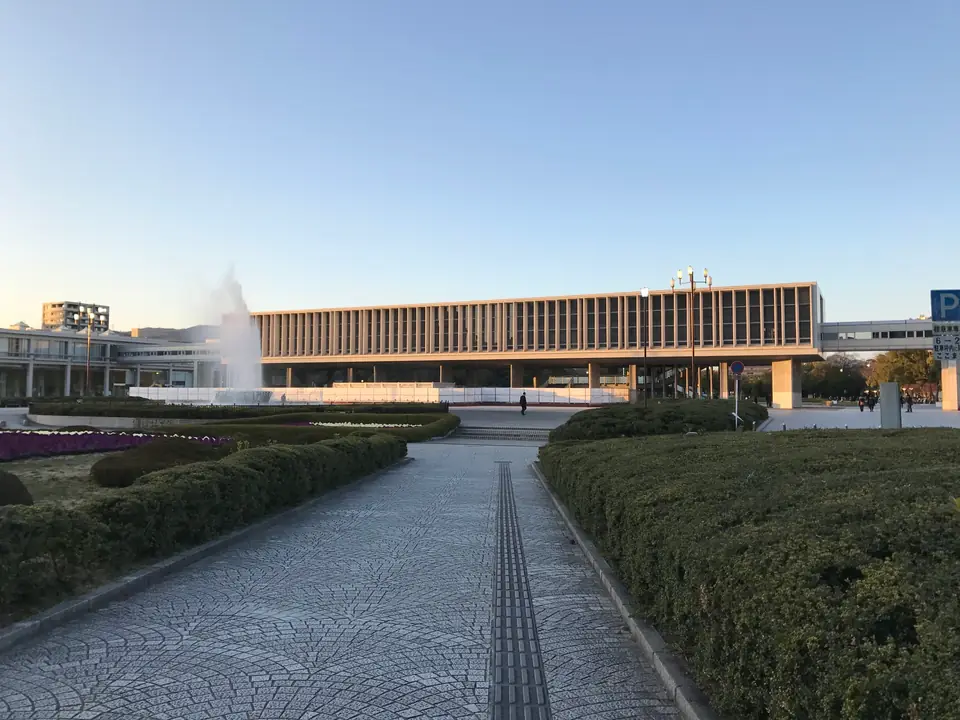
The Hiroshima Peace Memorial Museum opened on 24 August 1955 in the building that Kenzo Tange raised on pilotis, a two-storey reinforced concrete volume with a mezzanine and about 1,615 square metres. Tange placed it on the same straight line as the Cenotaph and the Atomic Bomb Dome, with the idea of a “peace factory”, and on 5 July 2006 it became the first Japanese postwar building designated an Important Cultural Property. Since 1994 it has been joined by the East Building, linked to it by a raised walkway.
The bomb fits in no figure, and the museum knows it: it counts it in objects belonging to specific people. Even the way of showing it has been the city's argument with itself. For decades a scene of burned victim figures greeted visitors; it was removed on 26 April 2017 despite a petition of more than 10,000 signatures, and since the 2019 reopening the visit begins with two photographs taken from the ground, not from the aircraft.
Highlights
- Kenzo Tange's pilotis — the building that frames the Cenotaph and the Dome in a single line
- Peace Watch Tower clock — reset to zero with every nuclear test in the world
- Human Shadow Etched in Stone — the steps of a bank some 260 m from the hypocentre
- Shin'ichi Tetsutani's tricycle — buried in 1945 with its 3-year-old owner
- Sadako Sasaki's cranes — folded from the wrappers of her medicines
The story of the Peace Memorial Museum begins with a geologist and some odds and ends. Nagaoka Shōgo entered Hiroshima on 8 August 1945, two days after the bomb, and gathered from the ruins melted stones, roof tiles, glass bottles, sheet metal and bricks. With them he opened on 25 September 1949 a materials room in one room of the Central Public Hall, and when the museum opened in 1955 he was its first director, until January 1962. Between 1955 and 2005 it was visited by 53 million people, and in fiscal year 2025 it received 2,580,926 visitors, a third consecutive record, of whom 945,618 were foreign.
The way of telling the bomb has changed several times, and not without controversy. From 1955 victims’ clothing was shown on wooden mannequins; in 1973, on the proposal of Mayor Setsuo Yamada, three wax figures of burned victims arrived, replaced in 1991 by plastic figures, and everything was removed in 2017. The 2019 renovation created the first section on foreign victims, with Koreans, American prisoners and students from Southeast Asia, although critics point out that it does not explain why there were Koreans in Hiroshima nor address Japanese responsibility in the war.
The audio guide covers the museum in four stops, from the pilotis of Tange’s building to the room of victims’ belongings, with documented narration checked against historical sources.
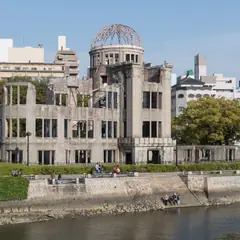
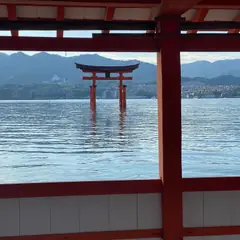
The museum is the southern head of the Peace Memorial Park, and from its pilotis the view runs along Tange’s axis to the Atomic Bomb Dome. Outside the city, some 16 kilometres as the crow flies, the Itsukushima Shrine joined the World Heritage List the same year as the Dome, 1996.
Between the pilotis, in line with the Dome
Main Building pilotis
Summary of this stop
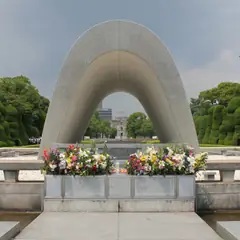
The architecture of the Peace Memorial Museum is understood from below. The concrete columns that lift the Main Building off the ground open a covered passage over the park’s axis, and from there, looking north, the building works like a peephole: the Cenotaph in the foreground and the Atomic Bomb Dome in the background, on the same line. Kenzo Tange placed the three pieces on a straight line perpendicular to Peace Boulevard. The building was completed on 6 August 1955, and when in 2006 it was designated an Important Cultural Property, the old West Building was renamed the Main Building.
What it keeps inside began very humbly, with the materials that a geologist saved from the ruins two days after the bomb and displayed for years in a single room. What was special about those stones and tiles for someone who knew how to read them is what the narration tells under the pilotis.
The clock that never reaches a thousand days
Peace Watch Tower clock
Summary of this stop
Entry is through the East Building, opened in June 1994 on the site of the old 1955 Peace Memorial Hall and designed with a “supporting role” next to Tange’s building: more massive, with stone-clad columns and symmetrical to the International Conference Center about the axis. In the lobby, the Peace Watch Tower clock, a granite tower of about 3 metres inaugurated on 6 August 2001 with 8:15 engraved on its dial, counts the days since the Hiroshima bomb and since the last nuclear test in the world. Each test returns it to zero, and since its installation it has never reached a thousand days.
The museum has not always spoken with the same voice either. In 1956, a year after opening, it was the main venue of the American “Atoms for Peace” exhibition, and its pieces on the bomb were temporarily moved to a nearby civic centre; a section on peaceful uses of nuclear energy stayed inside the museum until May 1967. What the longest interval marked by the counter has been, and what interrupted it, is heard in front of the tower.
A bank staircase with a human shadow
Human Shadow Etched in Stone
Summary of this stop
Since 2019 the visit to the Main Building starts with two photographs that Yoshito Matsushige took around 11:00 on 6 August 1945 beside the Miyuki Bridge, 2.3 kilometres south of the hypocentre, with the wounded at large size. The mushroom cloud photos that follow were taken from the ground, not from the American aircraft. These first rooms also display a stone Buddha head with a burned surface, found in the ruins of the Seigan-ji temple, which occupied the site where the museum itself now stands.
The best-known piece is the Human Shadow Etched in Stone: the entrance staircase of the Sumitomo Bank branch, some 260 metres from the hypocentre (240, according to other sources). The bank protected it with a fence in 1959 and tempered glass in 1967, and when rebuilding the branch in 1971 it cut out the fragment, of about 3.3 square metres of footprint and 2 in height, and donated it to the museum. The dark stain, today barely visible, is not a vaporised body: the ground temperature is estimated at 3,000-4,000 °C, not enough to make bones and tissue disappear, and the silhouette corresponds to the stone that the body shielded from the flash. Its exact mechanism and the identity of the person who was sitting there are still debated, and the narration explains why.
A buried tricycle and cranes of medicine paper
Shin'ichi Tetsutani's tricycle
Summary of this stop
In the room of victims’ belongings, the bomb is reduced to the scale of a child. Shin’ichi Tetsutani, aged 3 years and 11 months, was playing with his tricycle when the bomb went off and died; his father, Nobuo, buried him in the garden beside the tricycle so he could keep playing, and in 1985, when moving the remains to the family cemetery, he dug it up and donated it to the museum. Today it is displayed twisted and rusted, beside a metal helmet and the portrait of Shin’ichi with his sister Michiko. Nearby, a charred lunch box and a wristwatch with its hands stopped at the time of the explosion.
Among the smallest pieces are the cranes that Sadako Sasaki folded from the paper of her medicine wrappers. Exposed to the bomb at the age of 2, she died of leukaemia on 25 October 1955, two months after the museum opened, and her death drove the Children’s Peace Monument. A distinguished visitor stopped before them in a few minutes without cameras, an episode the narration tells beside the display case.
In this same room something is missing that was here for 44 years: the scene of the three burned victim figures. The plastic ones of 1991 were made by Toho Bijutsu and modelled by Kobayashi Tomoki, the sculptor of the monsters of the Godzilla franchise. Their removal in 2017 divided Hiroshima: the City Council justified it by a criterion of displaying only real objects, survivors such as Sunao Tsuboi saw them as “toys” that did not reflect reality, and more than 10,000 signatories asked to keep them. How to show the horror without betraying it is the question that closes the tour.